(888) 737-7690

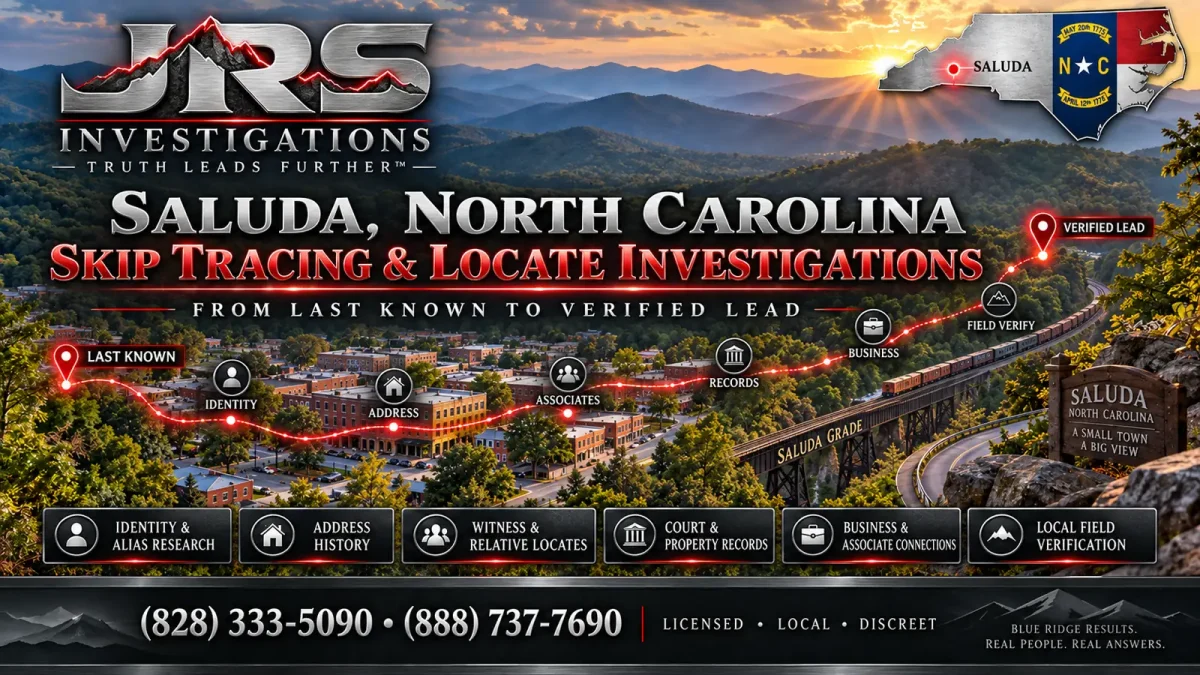
Saluda NC Skip Tracing Investigator | JRS
Finding a person is rarely as simple as entering a name into a public search site. Names repeat, records become outdated, telephone numbers change, and people may use relatives, businesses, post-office boxes, seasonal homes, or addresses in neighboring counties. A Saluda NC skip tracing investigator develops and verifies location leads so a client, attorney, business, or family can make an informed next decision.
JRS Investigations provides lawful skip tracing and locate research in Saluda, Polk County, Henderson County, and throughout Western North Carolina. We do more than return a list of possible addresses. We compare identifiers, build a timeline, test conflicting information, and document which leads are current, historical, or unresolved.
Every assignment requires a legitimate purpose. JRS does not help anyone stalk, threaten, harass, evade a court order, or obtain protected personal information without legal authority. If a person is in immediate danger or has disappeared under suspicious circumstances, contact law enforcement first.
What Skip Tracing Means in a Professional Investigation
Skip tracing is the process of locating a person or developing reliable contact and address information from multiple lawful sources. The word “skip” does not mean the person committed a crime or intentionally disappeared. A witness may have moved, a relative may have changed names, an heir may be unaware of an estate, or a former client may simply have outdated contact information.
A professional locate should connect the correct person to the correct record. A matching name alone is not enough. Age, middle name, prior addresses, relatives, telephone numbers, email addresses, business connections, property records, court records, and other identifiers may be used to distinguish one person from another.
Skip tracing is not the same as an emergency missing-person search
A routine locate investigation focuses on identity and current-location leads. An endangered child, vulnerable adult, possible abduction, or unexplained disappearance requires a different response, often involving immediate law-enforcement coordination and urgent safety decisions. JRS evaluates the situation before defining the assignment so a time-sensitive case is not treated like ordinary records research.
Why Saluda Location Research Requires Local Context
The City of Saluda describes the community as a small Blue Ridge mountain town. Its surrounding area includes steep terrain, rural roads, seasonal residences, older family properties, and connections extending into both Polk and Henderson counties. A person associated with “Saluda” may use a mailing address, physical address, property record, business address, or relative’s residence that falls under a different jurisdiction or database.
Interstate 26, U.S. 176, the historic Saluda Grade, and nearby communities such as Tryon, Columbus, Flat Rock, and Hendersonville can also matter when building a realistic movement or address history. Local context helps investigators avoid treating county lines, mailing designations, and mountain geography as contradictions when they may describe the same person’s life.
Seasonal and family properties can create outdated leads
A mountain home may be used seasonally, owned through a family member or entity, or connected to a mailing address elsewhere. Property ownership does not prove current residence. JRS compares property and address information with other evidence before labeling a location current.
Seven Reasons Clients Request Skip Tracing in Saluda
1. Locating a witness or former employee
Attorneys and businesses may need to locate someone who witnessed an accident, workplace event, transaction, contract, or family matter. The objective is to develop accurate contact information and document the research. Whether and how the person is contacted should be decided within the client’s legal strategy.
2. Finding an heir, beneficiary, or relative
Estate representatives, attorneys, and families sometimes need help identifying or locating relatives whose addresses are unknown. Name changes, blended families, adoption history, and moves across state lines can complicate the search. The investigation may require a family-association timeline rather than one database result.
3. Developing a current address for lawful service
A lawyer or process server may have an outdated address for a defendant or other case participant. JRS can research possible current locations and indicators of occupancy. We do not serve legal papers unless separately authorized and qualified to do so, and we do not represent a probable address as confirmed without supporting evidence.
4. Reconnecting with a family member
Adults may seek a biological relative, former guardian, military friend, or family member with whom contact was lost. Privacy and consent remain important. In some cases, an intermediary-contact approach is safer than disclosing a private address directly to the client.
5. Locating a subject connected to civil litigation
A party to a civil matter may move, use multiple business addresses, or maintain connections in several states. JRS can develop lawful identity and address leads for attorney review. We do not threaten the subject, misrepresent legal authority, or guarantee that a person will cooperate.
6. Verifying a debtor or judgment subject
Creditors and counsel may need to confirm that the person named in a judgment or obligation is correctly identified and located. This work must stay within applicable consumer, debt-collection, privacy, and permissible-purpose rules. Skip tracing does not authorize access to bank accounts, credit reports, tax returns, or other protected records.
7. Supporting a broader missing-person investigation
Address, associate, business, court, and social-media research may support a non-emergency missing-person case. When the facts suggest danger, exploitation, self-harm, abduction, or a medical crisis, law enforcement should be involved. For related services, see JRS’s Western North Carolina missing-person investigation guide.
How JRS Builds and Verifies a Locate
Step 1: Define the person and the lawful purpose
The investigation begins with the subject’s full name, known aliases, approximate age or date of birth, prior addresses, telephone numbers, email addresses, relatives, employers, businesses, vehicles, photographs, and the reason for the search. Better starting identifiers reduce false matches and unnecessary contact with unrelated people.
Step 2: Build an identity and address timeline
JRS organizes historical and current data chronologically. A timeline can reveal when an address became outdated, whether two records refer to the same person, and which relatives or businesses consistently appear. Information from professional databases is treated as a lead until corroborated.
Step 3: Cross-check public and professional sources
Depending on the purpose and available identifiers, research may include public records, property connections, business registrations, civil and criminal court indexes, social-media information, professional sources, and other lawful records. The North Carolina Judicial Branch provides official court-record and court-date services, but a name found in a court index must still be matched to the correct individual.
Step 4: Evaluate relatives, associates, and business connections
Relatives and associates may help confirm that the correct person has been identified, but they should not be contacted automatically. JRS considers the case objective, privacy, safety, and the risk of alerting the subject before conducting third-party inquiries.
Step 5: Conduct local verification when appropriate
When records produce a credible Saluda-area location, discreet fieldwork may help determine whether the address is active. Investigators may document lawful observations from public areas or conduct carefully planned inquiries. JRS does not trespass, enter a residence, open private mail, place illegal tracking devices, or create a confrontation.
Step 6: Report confidence and limitations
The final result should distinguish a confirmed location, a strongly supported lead, an historical address, and an unresolved possibility. JRS explains the sources reviewed, relevant connections, conflicts, and limitations so the client understands what the evidence does—and does not—establish.
What a Responsible Skip Tracer Will Not Do
Access to information is controlled by law, source terms, and the purpose of the request. JRS will not obtain records through hacking, bribery, account takeover, illegal pretexting, or false legal authority. We do not pull a consumer credit report without a legally recognized permissible purpose, and we do not promise access to live GPS data, bank balances, tax returns, medical records, private telephone contents, or sealed government information.
We also screen the client’s purpose. A locate request may be declined when the facts suggest stalking, domestic violence, harassment, retaliation, or an attempt to bypass a protective order. A professional investigator protects the subject’s safety as well as the client’s objective.
Information That Helps Start a Saluda Locate
The client does not need every detail, but accurate starting information can save time and reduce false positives. Useful material may include:
- Full legal name, aliases, former surnames, and nicknames
- Approximate age or date of birth
- Last known physical and mailing addresses
- Previous telephone numbers and email addresses
- Known relatives, associates, employers, and businesses
- Photographs and public social-media profiles
- Vehicles or property associated with the person
- Court case number, attorney information, or estate documentation
- The legitimate purpose for locating the person
- Any known safety concerns or protective orders
Do not obtain new information through unauthorized access or impersonation. Provide material already lawfully available to you and let JRS determine which additional research is appropriate.
Frequently Asked Questions About Skip Tracing
Can JRS guarantee that a person will be found?
No. The quality of available identifiers, record coverage, privacy choices, international movement, common names, and the person’s circumstances all affect the result. JRS provides a documented investigative process and honest confidence assessment, not a guaranteed outcome.
Will the subject know that JRS is looking for them?
Many assignments begin with discreet records research. Contact or field inquiries may create a risk of notification, so those steps are discussed with the client before they occur. In some family-reconnection matters, an intermediary approach may be the most respectful option.
How long does skip tracing take?
A well-identified subject with a recent address may be resolved quickly. A common name, limited identifiers, multiple states, family name changes, old records, or required fieldwork can extend the assignment. JRS defines the initial scope before work begins and reports when new information changes the plan.
Is an address from a database considered confirmed?
No. Database records can lag behind moves, repeat old information, or combine two people. Confirmation usually requires consistency across independent sources and, when justified, local verification. This is one reason professional analysis matters more than a long list of unranked addresses.
Hire a Licensed Saluda Private Investigator
JRS Investigations combines Western North Carolina knowledge with structured records research and lawful field investigation. Learn more about our Saluda private investigator services, review the Saluda investigator hiring guide, or explore ten investigation services available in Saluda.
For a confidential case review, call our Western North Carolina number at (828) 333-5090 or toll-free at (888) 737-7690. Provide the known identifiers, the reason for the locate, and any safety concerns so JRS can recommend an appropriate scope.