(888) 737-7690

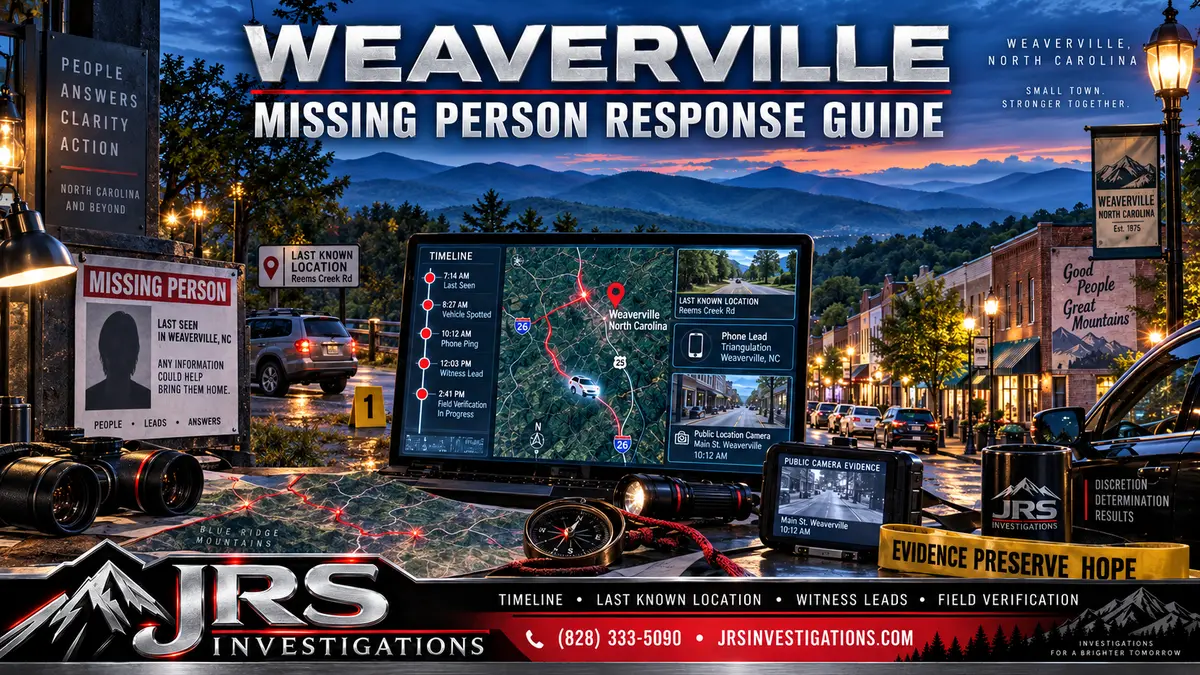
Weaverville Missing Person Response Guide | JRS
When a person cannot be located in or around Weaverville, the first hours should be organized around safety, accurate reporting, and preservation of information. This Weaverville missing person response guide explains what families, attorneys, employers, and authorized representatives can do immediately—before memories fade, video is overwritten, or digital clues become harder to reconstruct.
If a child, vulnerable adult, injured person, or anyone believed to be in immediate danger is missing, call 911 now. North Carolina does not require a waiting period before a missing-person report is made. The first official report should go to the law-enforcement agency with jurisdiction over the place where the person was last seen. For Weaverville, review the Town of Weaverville Police Department contact information; outside town limits, the appropriate Buncombe County or other local agency may have jurisdiction.
1. Report the disappearance without waiting
Do not delay because you have heard a 24- or 48-hour rule. The North Carolina Department of Public Safety advises that there is no waiting period to report a missing person. Give dispatch or the responding officer the person’s full name, recent photograph, physical description, clothing, vehicle information, medical or behavioral concerns, and the most reliable last-known time and location.
Tell law enforcement immediately about any indication of abduction, self-harm, violence, coercion, exploitation, cognitive impairment, medication dependency, or exposure to severe weather. A private investigator complements an official investigation; a private investigator does not replace emergency services, direct police activity, enter restricted scenes, or interfere with evidence.
2. Build one verified timeline
Create a working chronology that separates confirmed events from assumptions. Start with the last independently verified contact and move forward in exact time order. For each entry, record the date, time, location, source, and who verified it. Useful source material may include lawful access to text messages, call logs, receipts, calendars, rideshare information, social posts, photographs, access-control records, and statements from people who had recent contact.
- Confirmed: supported by a direct witness, time-stamped record, video, receipt, or other reliable source.
- Reported: supplied by another person but not yet independently verified.
- Possible: a lead that should be checked without being treated as fact.
Keep the original files unchanged. Work from copies, note where each item came from, and avoid editing screenshots or forwarding compressed versions when an original can be preserved. A clean source trail helps law enforcement, counsel, and an investigator evaluate the same facts without confusion.
3. Define the last known location precisely
“Last seen in Weaverville” may be too broad to guide useful fieldwork. Identify the precise address, business, trail access, roadway, parking area, residence, or intersection; the direction of travel; the transportation method; and the source of the observation. In the mountain environment around Weaverville, Reems Creek and nearby Buncombe County corridors can quickly connect a person to Asheville, Madison County, rural roads, or outdoor terrain. Weather, darkness, elevation, and inconsistent cellular coverage can also affect timing and search assumptions.
If an unoccupied vehicle is found, do not search, move, or disturb it unless emergency safety requires action. Photograph only from a lawful position, note the location and time, and notify law enforcement. The same caution applies to personal property, a residence, a phone, or any potential scene.
4. Preserve video and witness leads quickly
Doorbell cameras, business surveillance, parking-lot systems, traffic-facing cameras, and access logs are often overwritten on short retention cycles. Make a list of cameras near the last-known location and likely travel route. Provide that list to law enforcement. An authorized investigator may also ask an owner to preserve relevant footage or identify the correct records custodian, but cannot compel release without consent or lawful process.
For witnesses, record the person’s name, reliable contact information, when the conversation occurred, and their exact words as closely as possible. Avoid group interviews, leading questions, public accusations, or circulating unverified theories. Independent accounts are more useful than a story that has been repeated and unintentionally changed.
5. Protect digital evidence and the missing person’s privacy
Do not guess passwords, impersonate the missing person, install tracking software, or enter private accounts without lawful authority. Preserve devices in their current condition, document who handled them, and consult law enforcement or counsel before accessing content. If you are an authorized account holder, save available records and original exports without altering them.
Public posts can produce leads, but they can also spread incorrect details, alert a dangerous person, attract scams, and overwhelm the family. Coordinate public notices with law enforcement when practical. Use a current photograph, a verified description, the official agency contact, and only facts approved for release. Never publish private medical, financial, or location data merely to create attention.
6. How a private investigator can support the case
After the official report is underway, JRS Investigations can help organize and pursue lawful investigative tasks that fit the case. Depending on authorization, jurisdiction, and facts, work may include timeline reconstruction, witness development, address and identity research, open-source research, lawful database research, field verification, vehicle or location checks from lawful public positions, and coordination with counsel or local professionals.
The objective is not to create a competing investigation. It is to document viable leads, resolve contradictions, preserve time-sensitive information, and deliver organized findings to the client and, when appropriate, law enforcement. Read the companion article on hiring a Weaverville missing-person investigator, learn about missing-person and skip-tracing services, or review the broader Weaverville private investigator service page.
Information to have ready for an investigator
- Law-enforcement agency, report number, and assigned contact if available
- A recent unfiltered photograph and identifying description
- Verified last contact, last-known location, and transportation details
- Known medical, safety, custody, domestic-violence, or exploitation concerns
- Names and contact details for recent witnesses and associates
- Original copies of relevant messages, photographs, documents, and lawful account records
- Locations of cameras or records that may have short retention periods
- A list of facts that are confirmed, disputed, or still unknown
Start with an organized, confidential case review
For an urgent danger, call 911. For a non-emergency official report or update, contact the law-enforcement agency handling the case. Once those steps are in motion, JRS Investigations can evaluate whether lawful private investigative support may add value.
Call (828) 333-5090 or toll-free (888) 737-7690, or contact JRS Investigations for a confidential consultation. Results depend on the facts, available records, cooperation, and applicable law; no investigator can guarantee that a missing person will be located.