(888) 737-7690

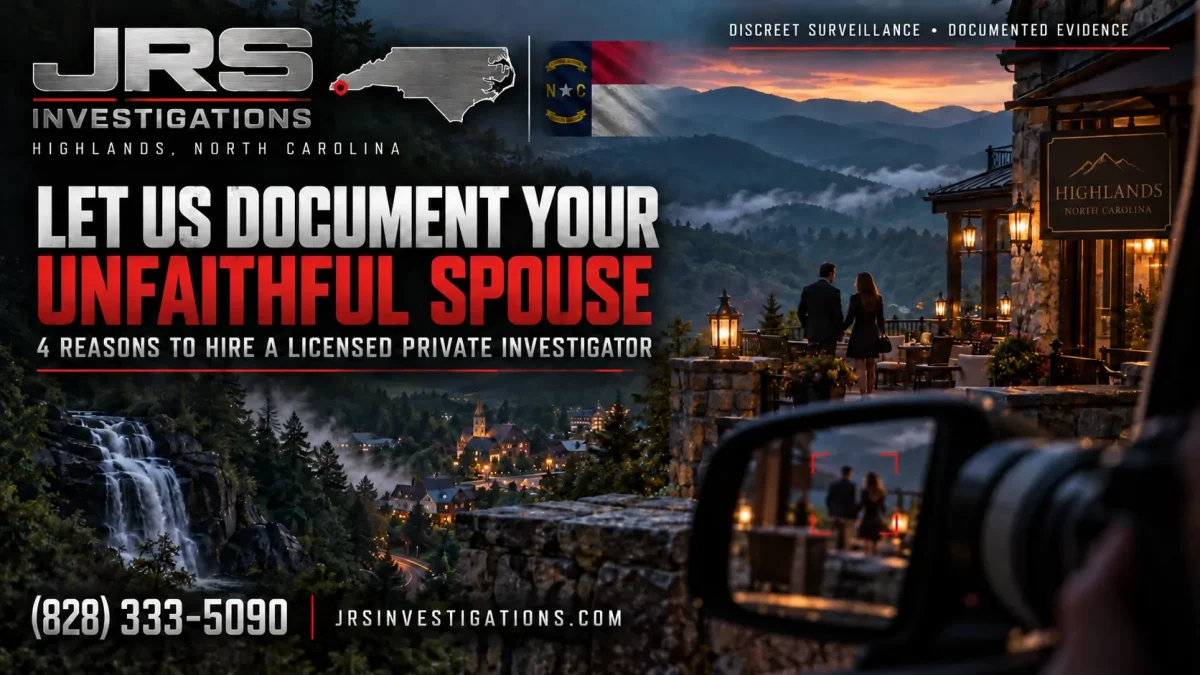
Highlands NC Infidelity Investigator: 4 Reasons to Hire One
Suspecting that a spouse may be unfaithful creates a strong urge to look for answers immediately. You may feel tempted to follow a vehicle, wait outside a restaurant, check unfamiliar addresses, or confront the people involved. In Highlands, North Carolina, those choices can quickly create safety, legal, and investigative problems.
A licensed private investigator provides a more controlled way to document activity without placing the client in the middle of the surveillance. The goal is not to assume infidelity or manufacture a particular result. The goal is to gather accurate observations, preserve context, and help the client make decisions based on documented facts.
Here are four important reasons to let a professional handle a suspected-infidelity investigation in Highlands, NC.
For another Western North Carolina perspective, see our overview of infidelity investigation services in Flat Rock.
1. Following a spouse yourself can become dangerous
Highlands and the surrounding Blue Ridge Mountains include winding roads, elevation changes, limited passing areas, changing weather, and stretches where drivers have few safe places to turn or stop. Trying to keep another vehicle in sight can lead to speeding, distraction, unsafe lane changes, abrupt stops, or parking in an exposed location.
The emotional pressure makes the situation harder. A client who believes a spouse is meeting someone may focus more on the suspected activity than on traffic, surroundings, or personal safety. If the spouse recognizes the client’s vehicle, the encounter may also turn into a roadside argument or confrontation.
Do not risk an accident or volatile encounter for a photograph. If there is an immediate threat of violence, call 911. If the concern is documentation, discuss the circumstances privately with a licensed investigator and let the assignment be planned before anyone begins surveillance.
2. Personal surveillance can cross legal or property boundaries
Being married to someone does not grant permission to enter every property they visit, access every account they use, or place a tracking device on property without considering ownership and applicable law. A person acting emotionally may follow a spouse onto private property, remain after being asked to leave, enter a restricted area, impersonate someone, or attempt to access protected communications.
North Carolina regulates private investigators through the Private Protective Services Act. The statute defines private-investigator work to include contractual inquiries into a person’s conduct, activity, movement, whereabouts, associations, and acts. It also requires a license before someone provides those services professionally. You can review North Carolina General Statutes Chapter 74C and information from the North Carolina Private Protective Services Board.
A license does not give an investigator permission to trespass, hack accounts, violate privacy laws, or ignore other restrictions. It does provide a regulated professional framework and an investigator who should understand the limits of the assignment. JRS Investigations performs surveillance only from lawful locations and within the agreed scope.
3. If your spouse spots you, the opportunity may be lost
Clients know their spouses, but spouses also know their clients. They recognize each other’s vehicles, driving habits, clothing, routines, relatives, and friends. In a small mountain community, an unfamiliar parked vehicle may stand out, but the client’s own vehicle may be recognized immediately.
Once a person believes they are being followed, behavior often changes. Meetings may be cancelled, routes altered, communications moved to different devices, or future activity hidden more carefully. That can end the opportunity to document ordinary patterns and may increase conflict at home.
Professional surveillance is planned around discretion, legal access, the local environment, and the client’s objectives. It may involve more than one investigator when the assignment and budget justify it. No professional can promise that surveillance will never be detected, but preparation and experience reduce avoidable mistakes.
4. You need objective documentation, not an emotional confrontation
A client following a spouse is emotionally involved and may interpret an ambiguous event as proof. A vehicle at an address, a conversation in public, or a meal with another person does not automatically establish infidelity. Context matters.
A private investigator records what was observed rather than deciding what the client should believe. Depending on the lawful assignment, documentation may include dates, times, locations, movements, public interactions, photographs, video, and a written chronology. The report should distinguish direct observations from information supplied by the client.
Documentation is not guaranteed to prove an affair, determine the outcome of a family-law matter, or be admitted by a court. An attorney decides how information may relate to a client’s legal strategy, and a court decides what evidence is admissible. The investigator’s responsibility is to gather and report facts accurately within the authorized scope.
What a Highlands infidelity investigation can document
Every case is different. Before surveillance begins, the investigator should ask what prompted the concern, what schedule information is reliable, which vehicles are involved, whether there are safety issues, and what result the client actually needs. A well-defined objective prevents wasted time and keeps the investigation focused.
Depending on the circumstances, a lawful investigation may document:
- Departure and arrival times at relevant public locations
- Travel patterns and stops observed during the assignment
- Public meetings and interactions
- Vehicles associated with observed activity
- Photographs or video obtained from lawful vantage points
- A factual chronology of the investigator’s observations
The investigator cannot guarantee what will happen during a scheduled period. Surveillance captures activity that occurs while the assignment is active and observable. Honest case planning includes that limitation.
Why Highlands requires careful planning
Highlands has a distinctive surveillance environment. Downtown activity, resort and restaurant traffic, mountain roads, wooded properties, gated or private areas, and routes toward Cashiers, Franklin, and the Georgia border can affect visibility and access. Some locations offer safe public observation points. Others do not.
A professional should evaluate the starting location, likely travel routes, available lawful vantage points, daylight, weather, traffic, and the possibility that the subject may enter private property. If surveillance cannot continue lawfully or safely, the investigator should disengage rather than force the observation.
Learn more about local services on the Highlands NC private investigator page or read our guide to hiring a private investigator in Highlands. JRS also serves assignments across the Blue Ridge Mountains of North Carolina.
What to provide during a confidential consultation
Accurate information helps the investigator estimate the appropriate schedule and resources. Be prepared to provide:
- The reason for concern and the dates of any significant incidents
- A current photograph and physical description of the subject
- Vehicle descriptions and license-plate information
- Work schedules, travel plans, appointments, or recurring activities you know lawfully
- Likely locations and relevant public destinations
- Any known safety concerns, protective orders, or history of confrontation
- Your primary question and how you expect to use the information
Do not obtain this information by breaking into an account, installing spyware, impersonating another person, or taking an action that may be unlawful. Tell the investigator what you already know and how you learned it. That allows the case to be evaluated responsibly.
What not to do while surveillance is underway
- Do not follow the subject or appear at the surveillance location.
- Do not repeatedly call or text to test where the subject is.
- Do not confront the subject based on an incomplete update.
- Do not post suspicions, photographs, or case details on social media.
- Do not tell friends who may contact the subject or interfere with the assignment.
Interference can expose the surveillance, create safety problems, and remove the opportunity to document events in context. Agree on a communication plan before the assignment begins.
Frequently asked questions
Can an investigator guarantee proof of infidelity?
No. A professional can document observable activity during the authorized surveillance period. The outcome depends on what occurs, where it occurs, lawful access, visibility, and other conditions.
How many surveillance hours will I need?
The answer depends on the subject’s schedule, the reliability of the starting information, travel patterns, the objective, and the location. A consultation helps identify the periods most likely to answer the client’s question without promising a specific result.
Will I receive photographs and a report?
The deliverables should be defined before the assignment. They may include a written chronology and available photographs or video obtained lawfully. Ask what is included in the proposed package.
Should I confront my spouse before hiring an investigator?
That is a personal decision, but confrontation can change behavior and make later documentation more difficult. If there is any risk of violence, prioritize safety and contact law enforcement or an appropriate support resource.
Let JRS Investigations document the facts
You do not need to follow a suspected unfaithful spouse through Highlands or put yourself in a dangerous confrontation. JRS Investigations can discuss a lawful, discreet surveillance plan designed around your specific concern and the local mountain environment.
Call (828) 333-5090 or contact JRS Investigations for a confidential consultation.
This article provides general information, not legal advice. Surveillance methods, access, documentation, and possible use of information depend on the facts, applicable law, and the authorized scope of the investigation.