(888) 737-7690

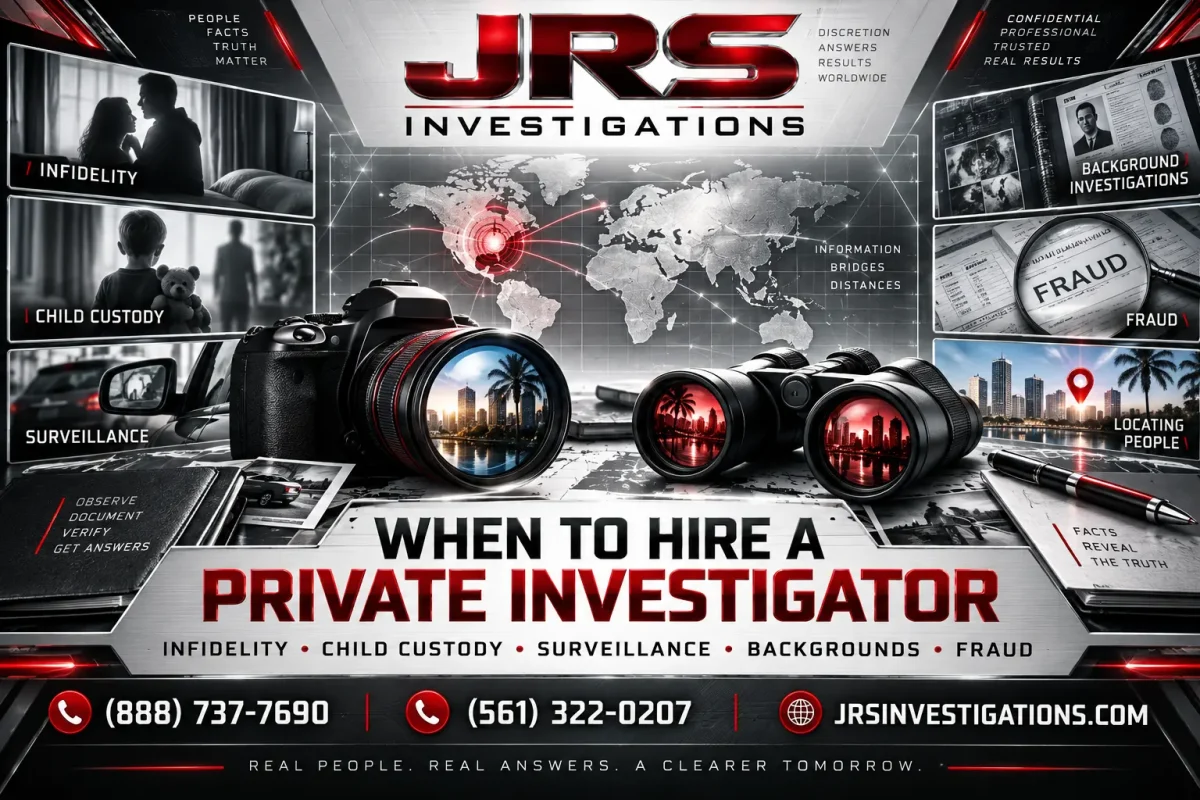
When Should You Hire a Private Investigator? 7 Clear Signs
There are times when uncertainty is merely uncomfortable—and times when unanswered questions can affect your family, finances, safety, or legal position. If you are wondering when to hire a private investigator, the deciding factor is usually whether you need reliable facts that you cannot safely, lawfully, or objectively obtain on your own.
JRS Investigations provides discreet, licensed investigative services for individuals, families, attorneys, and businesses. Every matter begins with a confidential conversation about your concerns, the information already available, and the lawful objectives of the investigation. No ethical investigator can promise a particular outcome, but a well-planned investigation can replace assumptions with documented facts.
When Should You Hire a Private Investigator?
You should consider hiring a private investigator when the information you need is important, time-sensitive, difficult to verify, or likely to require professional observation, research, interviews, or documentation. The following seven situations are among the most common reasons clients contact JRS Investigations.
1. You Suspect Infidelity but Need Facts, Not Assumptions
Changes in routine, unexplained absences, guarded phone use, inconsistent explanations, or unusual spending may create concern, but none of these signs proves infidelity by itself. Confronting a spouse without reliable information can increase conflict and may make future fact-finding more difficult.
A professional infidelity investigation can be designed to document observable conduct from lawful public vantage points. The goal is not harassment or intrusion. It is objective documentation that helps a client make an informed personal or legal decision.
2. A Child-Custody or Domestic Matter Requires Documentation
Family disputes can become emotionally charged, especially when a child’s welfare is involved. A parent may need neutral documentation concerning supervision, living conditions, compliance with a parenting plan, substance-related concerns, unsafe associates, or conduct occurring during visitation.
JRS provides child-custody and domestic investigation services that focus on observable facts and legally obtained information. Investigators do not decide custody and should never interfere with parenting time. They document relevant activity so the client and legal counsel can determine the appropriate next step.
3. You Need Surveillance Conducted Discreetly and Lawfully
Surveillance may be appropriate when a person’s public activities, travel patterns, contacts, or compliance with an agreement are directly relevant to a legitimate matter. Professional investigators understand how to plan an assignment, maintain detailed activity notes, preserve photographs or video, and avoid actions that could compromise the case.
JRS’s surveillance investigators use lawful public vantage points and adapt operational decisions to traffic, safety, access, and changing conditions. Surveillance cannot guarantee that a particular activity will occur, but professional planning improves the quality and reliability of the documentation obtained.
4. A Background Decision Carries Real Risk
Basic online searches can miss aliases, address history, business affiliations, civil records, or inconsistencies between what a person says and what public records show. A deeper investigation may be useful before entering a significant personal relationship, hiring for a sensitive position, forming a business partnership, making a major investment, or responding to suspected fraud.
A professional background investigation should be tailored to a lawful purpose. The scope may include identity verification, address history, civil and criminal-record research where legally available, business connections, professional licensing, and other relevant public-record findings. Employment, housing, credit, and consumer-reporting matters may be governed by additional laws, so the intended use must be discussed before research begins.
5. You Suspect Fraud, Hidden Assets, or Material Misrepresentation
Unexplained financial activity, concealed business interests, inconsistent ownership claims, suspicious transactions, or false statements can justify a more structured inquiry. Online databases alone rarely tell the complete story. Records must be connected, verified, and interpreted in context.
JRS provides fraud investigation services and investigative research for appropriate personal, corporate, and legal matters. Depending on the objective and jurisdiction, the work may involve public-record research, business and property connections, litigation history, interviews, or coordination with legal counsel. Investigators cannot access private bank accounts or protected records without lawful authority.
6. You Need Help Locating a Person or Verifying an Address
A current address may be needed for a family matter, estate issue, witness interview, civil case, debt-related matter, or another legitimate purpose. People often leave behind conflicting addresses, outdated phone numbers, alternate names, or fragmented public records.
Professional locate work combines lawful databases, public records, address history, digital research, and field verification when appropriate. JRS also handles certain missing-person and locate investigations. The reason for the search is reviewed first; JRS will not assist with stalking, harassment, evading court orders, or locating someone for an improper purpose.
7. Trying to Investigate the Matter Yourself Could Create Risk
Following someone, entering private property, impersonating another person, accessing accounts without permission, placing a tracking device, recording private communications, or using information obtained through deception may be unlawful or may damage a legal case. Even actions that appear simple can create safety, privacy, or evidentiary problems.
A licensed investigator should understand the limits of the assignment and explain what can—and cannot—be done. The Florida Department of Agriculture and Consumer Services regulates the private investigative and security industries under Chapter 493, Florida Statutes. In North Carolina, private investigators are regulated through the Private Protective Services Board. Licensing requirements vary by jurisdiction, so clients should confirm that an investigator is properly authorized for the location and service involved.
What a Professional Private Investigator Can Provide
- A confidential review of your objectives and available information
- A lawful investigative plan tailored to the facts and jurisdiction
- Public-record and database research from appropriate sources
- Discreet surveillance and contemporaneous activity notes
- Photographic or video documentation when lawfully obtainable
- Clear communication about findings, limitations, and next steps
- A written report suitable for review by the client or legal counsel
Investigators are fact finders. They do not make arrests, guarantee evidence, provide legal advice, or use unlawful methods. If a matter involves litigation, a court order, domestic violence, or an immediate safety concern, the investigator may recommend coordinating with an attorney or law enforcement.
How to Choose the Right Private Investigator
Before retaining an investigator, ask direct questions about licensing, relevant experience, communication, billing, reporting, and the proposed scope. A professional should be willing to explain the objective, expected limitations, hourly or flat-fee structure, and what information is needed to begin.
- Confirm licensing: Verify the agency and investigator where the work will occur.
- Look for relevant experience: Domestic surveillance, background research, fraud, and locate cases require different skills.
- Request a written agreement: The scope, fees, limitations, and client responsibilities should be clear.
- Avoid guarantees: No legitimate investigator can guarantee what another person will do or what an investigation will uncover.
- Protect confidentiality: Discuss how case information, reports, photographs, and communications will be handled.
What Information Should You Provide?
A concise timeline is often more helpful than a large collection of unsorted screenshots. Prepare the subject’s correct name, recent photograph, known addresses, vehicle information, important dates, relevant court orders, and the specific questions you need answered. Tell the investigator about safety concerns, prior confrontations, weapons, protective orders, or anything else that could affect planning.
Do not obtain information unlawfully or access accounts that do not belong to you. Provide materials you already possess legally, and let the investigator determine what additional information can be collected.
Frequently Asked Questions
How much does a private investigator cost?
Cost depends on the service, location, number of investigators, travel, research, surveillance hours, and reporting requirements. JRS explains the proposed scope and fee structure before work begins. Some matters use an hourly retainer, while defined research projects may use a flat fee.
Can a private investigator guarantee results?
No. An investigator can guarantee professional effort, lawful methods, and accurate reporting, but cannot guarantee that a subject will appear, that misconduct will occur, or that a particular fact will be discovered.
Is hiring a private investigator confidential?
Initial consultations and case information are handled discreetly. However, reports or investigators may become relevant in litigation, and legal disclosure requirements can vary. If the matter is connected to a lawsuit, discuss strategy with your attorney.
Can an investigator track a phone or access private accounts?
Not without lawful authorization. JRS does not hack accounts, intercept private communications, trespass, or install tracking devices unlawfully. Legitimate investigations rely on authorized research, public records, interviews, and lawful fieldwork.
When should I contact an investigator?
Contact an investigator before confronting the subject, changing established routines, or taking steps that might alert someone. Early planning can protect safety, preserve options, and prevent avoidable mistakes.
Get Clear Answers From JRS Investigations
If the unanswered question matters to your family, finances, business, or legal position, a confidential consultation can help determine whether an investigation is appropriate. JRS Investigations serves clients in Florida, North Carolina, and select Caribbean locations, subject to licensing, jurisdiction, and case requirements.
Call (888) 737-7690 or (561) 322-0207, or contact JRS Investigations online.
#PrivateInvestigator #JRSInvestigations #InfidelityInvestigation #ChildCustodyInvestigation #Surveillance #BackgroundInvestigation #FraudInvestigation #FloridaPrivateInvestigator