(888) 737-7690

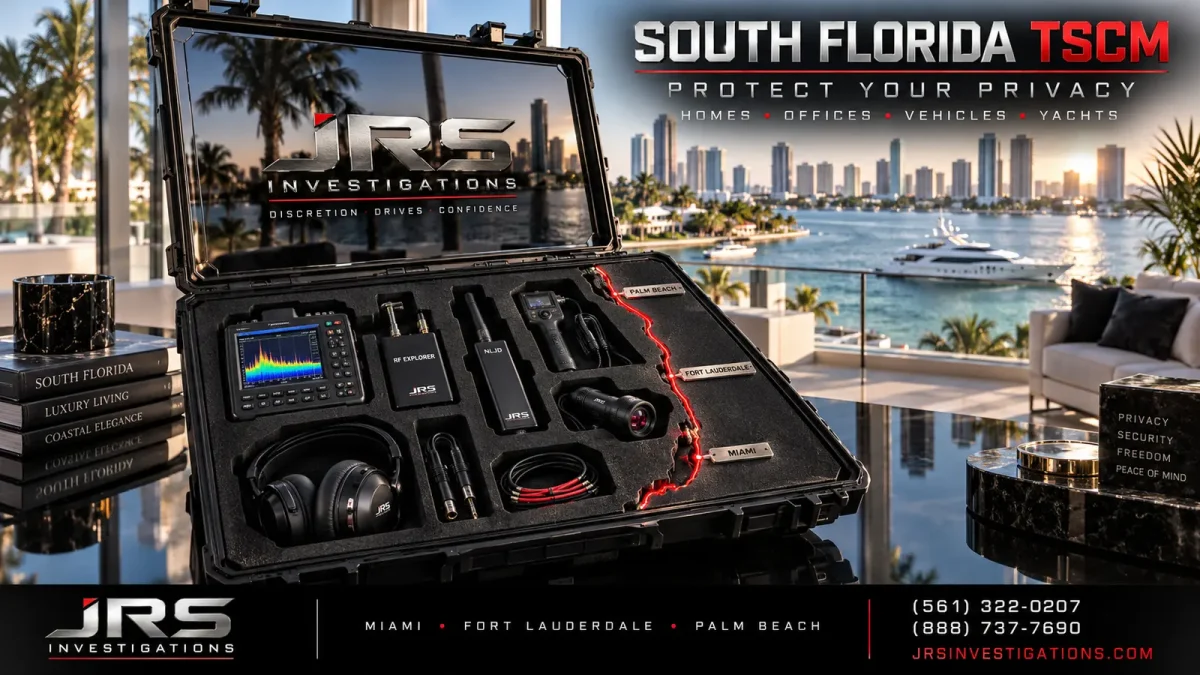
South Florida TSCM Bug Sweeps: Homes, Offices, Vehicles and Vessels
South Florida TSCM bug sweeps help property owners, executives, businesses and authorized vehicle owners evaluate concerns involving hidden cameras, listening devices, covert transmitters and GPS trackers. JRS Investigations provides confidential Technical Surveillance Countermeasures support throughout Miami-Dade, Broward and Palm Beach counties.
A professional inspection is more than a quick pass with a handheld detector. South Florida homes, offices, hotels and vehicles contain dense Wi-Fi, Bluetooth, cellular and smart-device activity. A credible TSCM process combines technical testing, physical inspection, threat assessment and clear reporting to distinguish ordinary electronics from conditions that require further investigation.
Protect your privacy. Call JRS Investigations at (561) 322-0207 or (888) 737-7690 for a confidential consultation.
What a South Florida TSCM bug sweep evaluates
Technical Surveillance Countermeasures is a structured examination of a defined property, vehicle or work area for signs of unauthorized surveillance. The inspection scope depends on the client’s lawful authority, the suspected threat, the location, access conditions and the technology already operating in the environment.
Depending on the assignment, the work may evaluate:
- unauthorized audio transmitters and recorders;
- concealed or disguised video cameras;
- unfamiliar GPS trackers or vehicle-surveillance equipment;
- electronic components hidden in fixtures, furniture or ordinary-looking objects;
- unexplained wiring, power sources or network connections;
- radio-frequency activity that warrants identification; and
- physical vulnerabilities that could permit later device placement.
No single instrument can detect every device. JRS uses complementary methods and explains the limitations of the authorized inspection. Learn more about our counter-surveillance and bug-detection services and the dedicated South Florida TSCM service page.
South Florida locations and environments
South Florida presents a wide range of inspection conditions, from high-rise condominiums and waterfront residences to corporate offices, medical practices, law firms, hospitality properties and vehicles. Dense development can produce significant radio-frequency activity from neighboring properties, public networks and nearby traffic. That background makes proper signal identification especially important.
Homes and condominiums
A residential sweep may cover bedrooms, living spaces, home offices, entry areas, network equipment, accessible fixtures and other areas identified during the intake. Condominium inspections require careful interpretation because legitimate wireless signals can originate from units above, below or beside the client’s property.
Corporate offices and meeting rooms
Businesses may request an inspection before sensitive negotiations, after an access-control problem, during a personnel transition or when confidential information appears to have been disclosed. The scope can include executive offices, conference rooms, communications equipment, reception areas and accessible wiring.
Hotels, temporary offices and travel environments
Executives, attorneys and other clients may have privacy concerns while traveling or using temporary meeting space. The client must have permission to authorize the inspection. The limited access available in a hotel or shared property may affect what can be examined and how conclusions are reported.
Vehicles
With the owner’s authorization, JRS can inspect accessible interior and exterior areas of a vehicle for unfamiliar trackers, cameras, recorders or associated wiring. Factory components and aftermarket electronics can resemble suspicious devices, so an item should be identified and documented before removal.
Vessels and waterfront properties
South Florida vessels and waterfront properties may combine marine electronics, navigation equipment, communications systems and shore-based networks. The authorized scope, safety requirements and equipment layout should be discussed before the inspection begins.
The professional TSCM process
Confidential intake and threat assessment
The process starts with the client’s specific concern: what information may have been exposed, who had access, which locations are involved and what changed before the concern arose. The investigator confirms ownership or control of the property and identifies any rooms, vehicles or devices that are outside the authorized scope.
Environmental baseline
The client identifies known Wi-Fi networks, Bluetooth devices, security systems, smart electronics, recent repairs and authorized communications equipment. Preserving normal conditions can help establish what belongs in the environment before controlled testing or shutdown procedures begin.
Radio-frequency analysis
RF analysis evaluates relevant frequency activity and helps locate signals that require identification. A detected signal is not automatically evidence of spying. Nearby wireless systems, consumer electronics and legitimate equipment must be considered.
Non-linear junction detection
A non-linear junction detector may help locate semiconductor components, including some electronics that are not actively transmitting. The results must be interpreted in context because many ordinary devices contain similar components.
Optical and physical inspection
Optical methods can assist with hidden-camera concerns. A physical examination checks accessible concealment areas, fixtures, furniture, power sources, network equipment and wiring. Technical instruments support this work, but they do not replace careful visual inspection and professional judgment.
Documentation and next steps
Material findings should be photographed and described with their location and significance. When an unfamiliar device is located, the client may need advice from an attorney or law enforcement before it is removed, powered down or examined further. JRS distinguishes verified facts from unresolved anomalies and explains any inaccessible areas or conditions that limited the inspection.
When a TSCM consultation may be appropriate
Ordinary electronic interference, battery drain or unusual sounds are not reliable proof of surveillance. A consultation may be reasonable when those concerns accompany credible access or information-security issues, such as:
- confidential discussions becoming known outside the intended group;
- unauthorized access to a home, office, meeting room or vehicle;
- an unfamiliar adapter, charger, cable, fixture or electronic device appearing in a private area;
- unexplained vehicle equipment or altered wiring;
- a recent employee, contractor, domestic or business dispute involving access;
- a hidden-camera concern in a residence, rental or private workspace; or
- a security event before a sensitive meeting, transaction or legal matter.
If there is an immediate stalking, domestic-violence or personal-safety concern, contact law enforcement and prioritize safety. Do not confront a suspected person based only on an unexplained signal or device.
What clients should expect before the sweep
- A clearly defined list of rooms, vehicles and equipment included in the scope.
- Confirmation that the client has authority to request the inspection.
- Instructions about access, occupants and known electronics.
- A discussion of timing, travel, building rules and parking requirements.
- An explanation of the methods appropriate for the assignment.
- Realistic limitations rather than a guaranteed result.
- A plan for documenting and escalating significant findings.
Clients should avoid resetting equipment, removing suspicious items or announcing the planned sweep to unnecessary people. Preserve relevant photographs, access records, messages and incident dates, but do not obtain passwords or private account information without authorization.
Florida law and responsible TSCM work
Florida restricts the interception and disclosure of certain communications. The official text of Florida Statutes section 934.03 provides the governing statutory language. An attorney should address questions involving consent, employment, domestic litigation, evidence admissibility or possible criminal conduct.
Signal jammers are not a lawful counter-surveillance method. The Federal Communications Commission’s jammer-enforcement guidance explains that operating, marketing or selling devices designed to block authorized radio communications is prohibited.
How to select a South Florida TSCM provider
Ask how the provider will define the scope, distinguish legitimate electronics from potential threats, document findings and protect confidential information. The provider should discuss authorization, site preparation, equipment categories and the limits of the examination.
Warning signs include guaranteed detection, reliance on a single consumer detector, vague reporting, immediate assumptions about who placed a device and recommendations involving unlawful jamming. Review JRS’s questions to ask before hiring an investigator and our recently updated guide to Delray Beach TSCM sweeps.
Frequently asked questions
Can TSCM locate a device that is not transmitting?
Some methods can help locate electronic components that are powered off or not transmitting, but results depend on the device, its concealment, surrounding materials and access. Multiple methods are used because each has limitations.
Can a sweep cover several South Florida locations?
Yes, when the client has lawful authority for each location. Multiple sites should be prioritized according to access, risk, timing and the information being protected.
Should the Wi-Fi network be turned off before the inspection?
Do not change the environment unless instructed. Known wireless activity can help establish a baseline, and the investigator may use controlled shutdown testing during the inspection.
Does a clean sweep guarantee the property is secure?
No. The inspection documents conditions within the agreed scope at that time. It cannot guarantee that a device was never present or will not be introduced later.
How often should an organization schedule a sweep?
There is no universal interval. Timing should reflect the threat assessment, changes in access, sensitive events and the value of the information involved. A credible incident or material security change may justify a new review.
Schedule a confidential South Florida consultation
JRS Investigations can review your concern, lawful authority, property type, vehicle requirements, locations and practical TSCM scope. Call (561) 322-0207 or (888) 737-7690, or use the JRS contact page.
This article provides general information and is not legal advice. Inspection results depend on the authorized scope, environment, accessibility and technology present at the time of the examination.