(888) 737-7690

Hawaiian Islands TSCM Planning: Multi-Island Privacy Guide
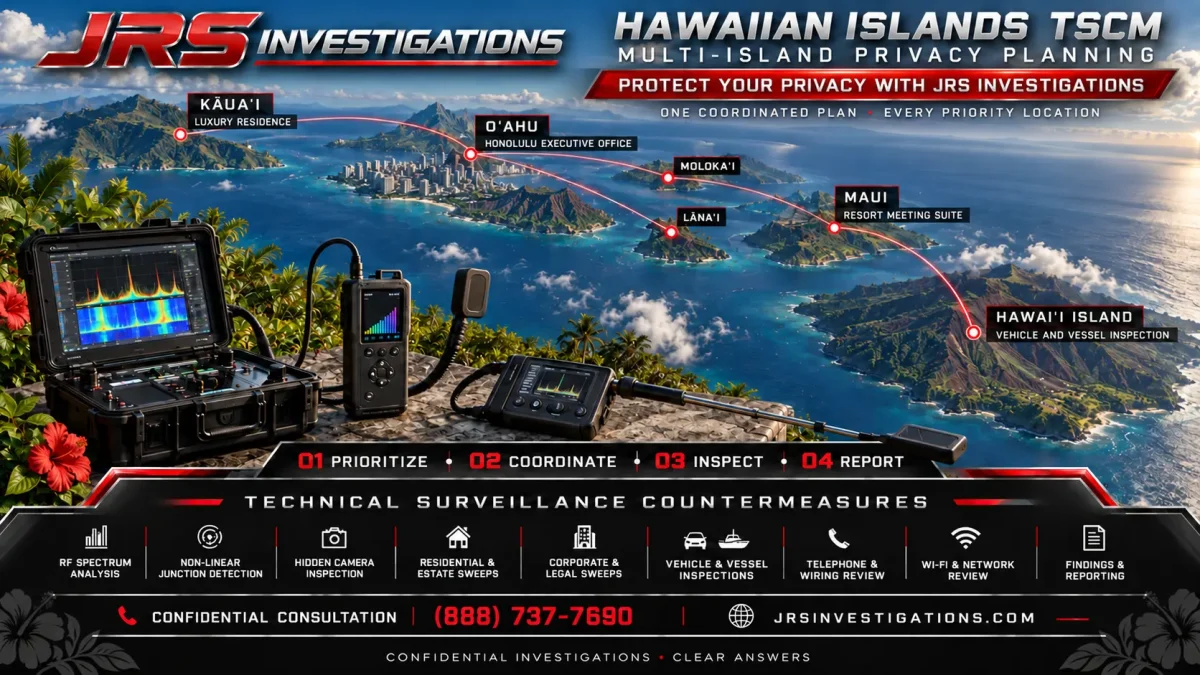
A privacy concern involving more than one Hawaiian island requires more than a standard room-by-room checklist. Travel, property access, equipment transport, occupancy schedules, and the type of location all affect the inspection plan. JRS Investigations approaches Hawaiian Islands TSCM planning as a coordinated technical assignment designed around the client’s highest-risk spaces, lawful access, and need for confidential findings.
This guide explains how a multi-island technical surveillance countermeasures engagement can be organized for residences, offices, hospitality properties, executive travel, vehicles, and vessels. It focuses on planning and prioritization rather than repeating our separate guides for Oahu, Maui, and Kauai.
Why Multi-Island TSCM Planning Is Different
Hawaii’s geography can turn one privacy concern into several distinct inspection environments. A client may have a primary office on Oahu, a residence on Maui, a hospitality property on Kauai, or a vehicle and meeting location on Hawaii Island. Each site can have different building systems, wireless activity, access rules, and operational schedules.
A responsible plan identifies which location has the greatest exposure and which assets need to be inspected first. That prevents unnecessary travel and keeps the scope tied to the client’s actual concern. It also allows equipment, access credentials, site contacts, and documentation requirements to be organized before the inspection team arrives.
Start With a Confidential Threat Assessment
The intake process should establish what prompted the concern without asking the client to diagnose the technology. Useful information can include unexplained disclosure of private conversations, recent personnel or relationship changes, contractor access, security-system work, travel patterns, unusual objects, or unfamiliar electronic activity.
The assessment should also identify the conversations, rooms, vehicles, and devices that matter most. A boardroom used for an upcoming transaction may take priority over general office space. A temporary rental may require inspection before a principal arrives. A vehicle used across several islands may need to be examined before it is shipped or returned.
Prioritizing Oahu, Maui, Kauai, and Hawaii Island
Island-specific planning should be based on the property and risk—not stereotypes about the location. Oahu assignments may involve high-rise residences, executive offices, hotels, government-adjacent facilities, and dense wireless environments. Maui and Kauai can involve resorts, vacation properties, private estates, and meeting spaces with controlled access. Hawaii Island may add longer ground travel between properties, large estates, hospitality locations, and geographically separated assets.
Lanai and Molokai assignments may require additional coordination for transportation, property access, and scheduling. In every case, the client should confirm which areas they own, lease, control, or have authority to authorize for inspection.
Build the Scope Around the Assets
A multi-island engagement can be divided into logical inspection groups:
- Residential spaces: bedrooms, home offices, living areas, security equipment, garages, and agreed exterior-access areas.
- Corporate and legal spaces: boardrooms, executive offices, conference rooms, interview rooms, and private client areas.
- Hospitality and temporary spaces: hotel rooms, villas, rentals, meeting suites, and event preparation areas where lawful access is confirmed.
- Vehicles: passenger compartments, cargo areas, accessible trim, power connections, diagnostic-port vicinity, and likely tracker locations.
- Vessels: cabins, meeting areas, communications equipment, accessible wiring, and spaces identified during intake.
Defining assets this way creates a clear work plan and prevents the assignment from expanding into unrelated areas without authorization.
RF Spectrum Analysis in Island Environments
Radio-frequency spectrum analysis evaluates active wireless signals and their behavior. Hotels, condominiums, offices, and densely occupied properties can contain many legitimate Wi-Fi, Bluetooth, cellular, security, and building-management signals. The investigator must distinguish expected activity from unexplained transmissions and follow significant anomalies to a reasonable source.
A signal peak alone does not prove surveillance. The process may include repeated measurements, controlled changes to known devices, near-field checks, and comparisons between rooms or zones. Intermittent devices may require additional observation because they do not transmit continuously.
Finding Devices That Are Not Transmitting
Some surveillance devices store data locally, remain dormant, use timers, or activate only when triggered. A quiet RF survey therefore cannot be treated as a complete inspection. A non-linear junction detector may help locate semiconductor components even when a device is powered off or not broadcasting.
NLJD responses must be interpreted carefully. Ordinary electronics, metal junctions, and legitimate building components can create responses. The operator compares harmonic behavior, inspects the area, and correlates the result with physical, optical, RF, or wiring observations.
Hidden-Camera, Wiring, and Network Review
Optical tools can help identify concealed camera lenses, while a physical examination addresses fixtures, chargers, smoke detectors, décor, power sources, network connections, and other plausible concealment points. Wired cameras and local-storage devices may produce no useful RF signature, which is why optical and physical inspection remains important.
When included in the agreed scope, accessible telephone equipment, low-voltage wiring, network hardware, and visible connections can also be reviewed for unexplained additions or changes. TSCM is not a substitute for a complete cybersecurity assessment, but it can help identify physical devices, unfamiliar access points, and conditions that require separate network or forensic analysis.
Vehicle and Tracker Inspections
Vehicles may be examined for unauthorized location tracking, audio capture, hidden cameras, or unexplained electronic components. A professional review can combine RF observations with a systematic physical inspection of accessible interior and exterior areas.
Factory electronics, toll devices, fleet-management equipment, insurance monitors, aftermarket alarms, and personal accessories can all create legitimate signals or hardware. The objective is to identify and document what is present, then distinguish expected equipment from unresolved anomalies.
Access and Timing for Hotels, Rentals, and Shared Properties
Temporary and managed properties require careful authorization. A guest may have control of a hotel room or rental during a reservation, but common areas, building systems, adjoining spaces, and staff-only areas may fall outside that authority. Property management or counsel may need to approve additional access.
Timing also matters. The inspection should occur when the space can be controlled and ordinary activity can be understood. Housekeeping, contractors, deliveries, meetings, and occupant movement can affect both access and the wireless environment. A short pre-inspection coordination call can prevent avoidable delays.
Preparing Equipment for Inter-Island Work
Professional TSCM equipment should be matched to the scope before travel. The plan may include RF spectrum analysis, near-field tools, non-linear junction detection, optical inspection, physical-search equipment, documentation tools, and vehicle-access equipment. Battery management, protective transport, calibration checks, and backup components should be addressed before departure.
Clients can help by providing accurate site details, access windows, room lists, parking arrangements, property contacts, and known equipment inventories. This preparation allows the technical team to spend more time inspecting and less time resolving preventable logistics.
What to Do Before the Sweep
- Limit discussion of the planned inspection to authorized people who need to know.
- Do not remove, open, or confront anyone about a suspected device.
- Keep ordinary electronics in their normal locations unless instructed otherwise.
- Create a concise timeline of suspicious events, access, and information disclosures.
- Identify the highest-priority rooms, conversations, vehicles, and travel locations.
- Confirm keys, credentials, management approval, and lawful authority for every area.
- Use a different device or location to make the initial inquiry if the current environment may be compromised.
Documenting and Resolving Anomalies
An instrument alert is the beginning of an evaluation, not the conclusion. The investigator may repeat measurements, compare nearby spaces, isolate known devices, trace wiring, inspect a physical location, or document an item for additional review. Several correlated observations are more meaningful than one detector response.
If a suspicious device is found, preserving its condition and location may be more important than immediate removal. The next step depends on safety, client objectives, legal advice, and whether law enforcement or litigation may become involved. Photographs, notes, signal observations, and a documented handling process can support later decisions.
Reporting Across Multiple Locations
A multi-island engagement benefits from one coordinated findings structure. The report or briefing should identify each inspected location, the agreed scope, methods used, significant observations, identified equipment, unresolved anomalies, access limitations, and recommended next steps.
No professional provider can promise that every possible device will be detected under every condition. Results depend on access, timing, construction, device behavior, environmental activity, and the systems available for inspection. Clear reporting distinguishes what was examined from what remained outside the scope.
Hawaii Privacy Law and Signal Jammers
Hawaii’s interception law is addressed in Hawaii Revised Statutes § 803-42. The law includes fact-specific rules and exceptions involving parties, consent, purpose, court orders, and government activity. Clients should consult qualified counsel when recording, interception, evidence handling, employment, or litigation questions may arise.
JRS Investigations does not use or recommend signal jammers. The Federal Communications Commission warns that jammer use by the public is illegal and can interfere with authorized cellular, GPS, Wi-Fi, and emergency communications. TSCM focuses on lawful detection, analysis, documentation, and protective recommendations.
Related Hawaiian Islands TSCM Guides
For details focused on one destination, review our guides to Oahu TSCM bug sweeps, Maui TSCM bug sweeps, and Kauai TSCM bug sweeps. You can also review our guide to devices a Hawaiian Islands sweep may encounter.
Request a Confidential Consultation
If you need help planning an authorized TSCM inspection for one or more Hawaiian islands, contact JRS Investigations to discuss the locations, assets, timeline, and appropriate scope. Call toll-free at (888) 737-7690 or use the confidential contact options at JRSInvestigations.com.
Confidential Investigations • Clear Answers.