
(888) 737-7690
TSCM Bug Sweeps on Oahu, Hawaii: Professional Guide
Concerns about hidden cameras, listening devices, unauthorized trackers, or unexplained wireless activity deserve a careful and confidential response. Professional Oahu TSCM bug sweeps use multiple technical and physical inspection methods to evaluate an authorized residence, office, rental, hotel room, vehicle, or vessel for signs of covert surveillance.
nn
The purpose of a sweep is not to confirm a suspicion in advance or promise that every possible device will be found. It is to replace guesswork with a defined scope, disciplined testing, documented observations, clear limitations, and practical next steps. On Oahu, the environment can range from dense Waikiki hotels and Honolulu office towers to private homes, gated properties, vehicles, and marina-based vessels. Each setting requires a different inspection plan.
nn
What is a professional TSCM bug sweep?
nn
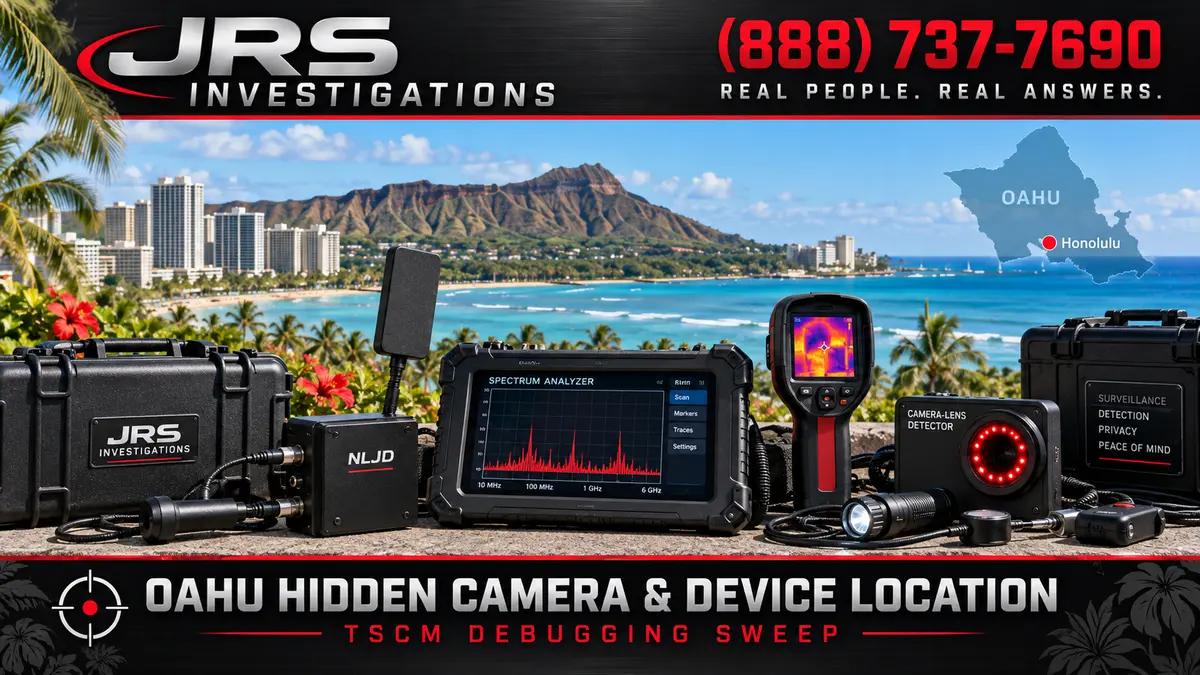
Technical Surveillance Countermeasures, commonly called TSCM or a bug sweep, is a structured examination for unauthorized surveillance technology and related vulnerabilities. A professional inspection may combine radio-frequency spectrum analysis, nonlinear junction detection, optical hidden-camera searches, thermal review, physical inspection, and selected network or equipment checks when those services are included in the written scope.
nn
No single detector is sufficient. Ordinary electronics can create strong radio signals, while a covert device may transmit intermittently, store information locally, use cellular or Wi-Fi connections, or remain inactive during the inspection. Layered methods help the examiner distinguish expected activity from a signal, object, modification, or access point that needs closer review.
nn
JRS Investigations provides an Oahu hidden-camera and device-location service for authorized assignments. The scope should identify every room, building, vehicle, vessel, network component, or personal device that the client expects the team to evaluate.
nn
When clients request an Oahu TSCM inspection
nn
A sweep is most useful when it responds to a concrete event or defined security concern. Common triggers include unauthorized access, confidential information becoming known unexpectedly, suspicious wiring or objects, unexplained changes to electronic equipment, domestic or business disputes, executive travel, renovations, staffing changes, vendor access, and preparation for a sensitive meeting.
nn
Hotels and short-term rentals create a distinct concern because a guest may have limited knowledge of installed electronics and previous access. Professional offices may contain conferencing systems, access controls, cameras, wireless presentation equipment, and managed networks. Private residences can include smart-home devices, alarms, routers, speakers, thermostats, and legitimate security equipment. These ordinary systems must be documented so the examiner can separate them from unexplained activity.
nn
A concern does not prove that surveillance is occurring. Many alerts have routine explanations, including neighboring Wi-Fi networks, Bluetooth devices, cellular equipment, hotel infrastructure, smart televisions, wireless locks, and building security systems. A responsible provider tests the environment instead of treating every signal as evidence.
nn
Why Oahu environments require location-specific planning
nn
Honolulu and Waikiki can have extremely dense radio environments. High-rise buildings may place dozens of access points, phones, cameras, and wireless devices within a small area. Shared walls, adjoining hotel rooms, nearby businesses, and rooftop communications equipment can affect signal strength and direction. RF findings must therefore be correlated with location, timing, frequency, known devices, and physical observations.
nn
Concrete construction, limited access above ceilings, built-in cabinetry, furnished rentals, and compact mechanical spaces can also influence the inspection. Resort properties and event venues may contain extensive audiovisual and building-control systems. A useful plan identifies what may be moved or opened, which areas require property-management approval, and what must remain untouched.
nn
Vehicles and vessels require separate procedures because factory electronics, telematics, aftermarket accessories, power systems, antennas, and hard-to-access compartments differ from a room inspection. Clients should disclose every vehicle, boat, detached structure, outdoor meeting area, or communications system they want included before scheduling.
nn
How layered TSCM detection methods work
nn
Radio-frequency spectrum analysis
nn
RF analysis examines the local radio environment for active transmissions and unusual signal behavior. The examiner compares detected activity with known devices and common services. A signal alone does not establish that a covert device exists. Meaningful evaluation considers frequency, strength, modulation, timing, movement, and whether the signal can be correlated with a physical source.
nn
Nonlinear junction detection
nn
A nonlinear junction detector, or NLJD, can help identify electronic components even when a device is not transmitting. It may be used on accessible furniture, fixtures, walls, containers, and selected objects. Results still require professional interpretation because normal electronics and certain metal junctions can produce responses.
nn
Optical hidden-camera inspection
nn
Optical methods can reveal the reflection from some camera lenses. The examiner also evaluates likely sight lines and accessible objects such as clocks, chargers, smoke detectors, power adapters, decorative items, vents, and modified fixtures. The position and field of view matter as much as the object itself.
nn
Thermal and physical examination
nn
Thermal imaging may identify heat patterns that warrant closer examination, but heat is not proof of surveillance. Physical inspection remains essential. The team may evaluate power sources, wiring, ceiling areas, vents, furnishings, communications equipment, and recently disturbed surfaces within the authorized scope and without unnecessary property damage.
nn
Authorized network and device review
nn
When specifically included, the assignment may cover connected-device lists, authorized access points, selected equipment settings, or basic network observations. A TSCM sweep is not automatically a full cybersecurity audit, penetration test, malware examination, or digital-forensics engagement. Those services require separate authorization, objectives, and technical procedures.
nn
What to do before the team arrives
nn
- n
- Use a safe communication channel. If a phone, computer, email account, or network may be compromised, avoid using it to discuss the inspection.
- Preserve the environment. Do not dismantle suspicious objects, disconnect unfamiliar wiring, or conduct an improvised search before receiving guidance.
- Document the concern. Record dates, access events, unexplained disclosures, equipment changes, and the rooms or vehicles involved.
- Confirm lawful authority. Be prepared to establish ownership, occupancy, management authority, or written permission for each space, vehicle, vessel, account, or device included.
- Inventory known electronics. List routers, cameras, smart-home devices, alarms, conferencing equipment, access points, trackers, and building systems.
- Arrange private access. Provide enough uninterrupted time and minimize unnecessary occupants while the inspection is underway.
n
n
n
n
n
n
nn
The related guide to what to expect during an Oahu TSCM sweep can help clients plan access, timing, and questions before the appointment.
nn
Authorization, privacy, and evidence preservation
nn
TSCM work must remain within the client’s lawful authority. An investigator should not inspect another person’s property, private account, communications, or electronic device without permission or another valid legal basis. Federal interception law, including 18 U.S.C. Section 2511, may apply alongside Hawaii law and other privacy rules. Legal counsel should address questions about consent, access, employment policies, evidence, or reporting obligations.
nn
If a suspicious device is located, do not immediately remove, activate, test, or destroy it. Photograph it in place when that can be done safely, limit access, and obtain direction from the investigator, legal counsel, or law enforcement as appropriate. The correct response depends on safety, legal authority, potential criminal conduct, and the need to preserve evidence.
nn
A professional report should distinguish verified observations from known electronics, benign signals, unresolved anomalies, inaccessible areas, and recommended follow-up. JRS Investigations does not promise that a sweep will detect every device or that a particular finding will automatically be admissible in court.
nn
What a useful TSCM report should explain
nn
At the conclusion, the client should understand which areas and items were inspected, the methods used, the conditions observed, material limitations, and the recommended next steps. Photographs, signal information, or technical notes may be included when appropriate to the assignment and the client’s confidentiality requirements.
nn
The report should explain how known devices and expected signals were correlated. It should identify any condition that requires additional physical access, digital forensics, network-security work, legal advice, or law-enforcement involvement. Dramatic conclusions without supporting observations do not help the client make a responsible decision.
nn
No confirmed covert device means the inspection did not identify one within the tested scope and conditions. It does not establish that surveillance was impossible at an earlier time or in an inaccessible location. Follow-up may be appropriate after a new access event, equipment change, renovation, personnel dispute, or before an especially sensitive meeting.
nn
Questions to ask an Oahu TSCM provider
nn
- n
- Which methods are included beyond basic RF detection?
- How will authorized electronics be separated from unexplained activity?
- Does the scope include physical inspection, NLJD work, hidden-camera checks, vehicles, vessels, networks, or personal devices?
- What authority and access must the client provide?
- How are potential findings validated, documented, and preserved?
- Will inaccessible areas and other limitations appear in the report?
- How is confidential client information protected before, during, and after the assignment?
n
n
n
n
n
n
n
nn
Price and duration depend on the actual scope. Property size, construction, signal density, access conditions, number of rooms, vehicles or vessels, travel, timing, and reporting requirements all affect the work. A responsible estimate should clearly state what is included instead of relying on a universal price promise.
nn
Frequently asked questions
nn
Can a sweep detect a device that is turned off?
nn
Sometimes. Physical inspection and nonlinear junction detection can identify certain electronics that are not transmitting. No method detects every device in every concealment condition, which is why layered methods and clear limitations matter.
nn
Should I use a consumer RF detector first?
nn
Consumer tools often react to ordinary wireless activity and can create false confidence or unnecessary alarm. If the concern is serious, preserve the environment and speak privately with a professional before conducting an improvised search.
nn
Can an inspection include a Waikiki rental and a vehicle?
nn
Yes, if the client has lawful authority for both and includes them in the written scope. Tell the provider in advance so the time, access, equipment, and reporting plan account for each environment.
nn
How often should an organization schedule a sweep?
nn
Frequency should follow the organization’s risk and access history. Event-driven inspections may be appropriate after unauthorized access, renovations, staffing disputes, vendor work, executive travel, equipment changes, or before a sensitive negotiation.
nn
What happens if something suspicious is found?
nn
Do not dismantle or test it. Preserve the location, restrict unnecessary access, and follow guidance from the investigator, legal counsel, or law enforcement. Evidence preservation may be more important than immediate removal.
nn
Schedule a confidential Oahu TSCM consultation
nn
A well-planned inspection replaces speculation with a defined technical process. JRS Investigations can discuss the location, authority, concern, timing, access, and reporting needs for an Oahu residence, office, hotel room, rental, meeting space, vehicle, or vessel. Learn more about the broader JRS Investigations TSCM program.
nn
Call JRS Investigations at (888) 737-7690 or request a confidential consultation. Do not use a device or network you believe may be compromised to discuss sensitive details.
n