
(888) 737-7690

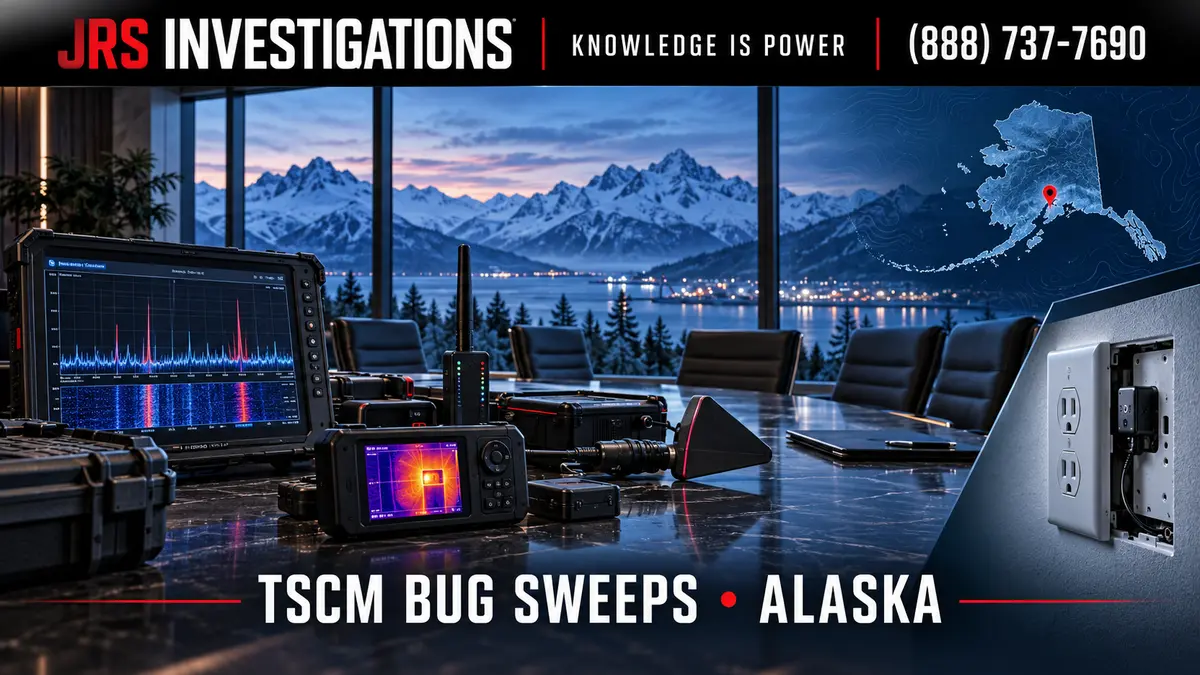
TSCM Bug Sweeps in Alaska: What to Expect
When a confidential conversation, business plan, legal strategy, or personal matter may have been exposed, guessing is rarely useful. Professional TSCM bug sweeps in Alaska are structured technical examinations designed to identify signs of unauthorized audio, video, tracking, or transmitting devices in a defined space.
Alaska adds practical complications that deserve advance planning. A sweep may involve an Anchorage office, a remote lodge, an executive residence, a vehicle, or several locations separated by significant travel time. The right approach begins with a clear risk assessment, lawful access to the property, and a scope tailored to the environment—not a quick pass with a consumer detector.
JRS Investigations provides professional TSCM and bug-detection services in Alaska. Call (888) 737-7690 for a confidential consultation.
What a TSCM Bug Sweep Actually Does
TSCM stands for Technical Surveillance Countermeasures. A professional sweep combines technical testing with a careful physical inspection and an understanding of how a particular room, building, or vehicle is normally used. The objective is to identify anomalies, document findings, and recommend practical steps to reduce exposure.
No single instrument can detect every possible device. Some devices transmit continuously, some transmit only at scheduled times, some store data locally, and others may be built into familiar electronics. That is why a credible examination uses multiple methods and compares the results instead of treating one reading as proof.
Reasons Clients Request TSCM Bug Sweeps in Alaska
A concern does not have to begin with a dramatic discovery. Many clients request a sweep after a change in circumstances or when information appears to be reaching someone who should not have it. Common reasons include:
- confidential business information appearing outside a small decision-making group;
- sensitive negotiations, litigation strategy, or executive discussions requiring greater privacy;
- an unexplained object, wiring change, charger, adapter, smoke detector, or electronic accessory;
- concerns involving a former employee, contractor, partner, tenant, or domestic relationship;
- suspected vehicle tracking or repeated knowledge of private movements;
- a recent office move, renovation, break-in, access-control failure, or period of unsupervised access; or
- a preventive review before a high-value meeting or sensitive project.
These indicators do not prove that surveillance is occurring. They help define the questions a sweep should address and determine which areas deserve priority.
How a Professional Alaska TSCM Sweep Is Planned
1. Confidential intake and threat assessment
The process begins with a private discussion about what changed, who had access, which information may have been exposed, and when the concern began. The technician should understand the layout, normal electronics, communications systems, and any unusual events without alarming employees or other occupants.
For remote Alaska assignments, planning also covers access, travel time, power availability, weather, communications, and the equipment needed on site. A detailed intake helps prevent an incomplete inspection caused by avoidable logistical limits.
2. Scope and lawful authorization
The client should have authority to authorize inspection of the rooms, devices, vehicles, or property included in the assignment. Recording, monitoring, network access, device handling, and evidence preservation may be governed by state and federal law. The Alaska Legislature’s official statutes database is a starting point for statutory research, but clients should obtain legal advice for their specific circumstances.
A TSCM provider should not promise to intercept private communications, enter property without permission, defeat passwords, or use illegal signal jammers. The purpose is defensive: inspect authorized areas, identify suspicious conditions, and document what can be supported.
3. Site control and baseline review
Whenever possible, the area should be kept in its normal operating condition until the team gives instructions. Unplugging devices, moving furniture, confronting a suspected person, or announcing the sweep can alter evidence or cause a device to disappear. The team may first inventory visible electronics, access points, network equipment, fixtures, and other objects that establish the room’s baseline.
Methods Used During a Bug-Detection Sweep
Physical and visual inspection
Physical inspection remains essential. Technicians examine places where a device could be concealed, powered, positioned for audio or video capture, or connected to existing infrastructure. The inspection may include furniture, wall plates, clocks, chargers, conference equipment, telephones, lighting, vents, alarms, cabling, and recently introduced objects.
Radio-frequency spectrum analysis
RF analysis evaluates the local signal environment and helps identify transmissions that warrant investigation. In an office, hotel, residence, or remote facility, normal Wi-Fi, Bluetooth, cellular, satellite, and operational systems can create a busy spectrum. A trained examiner correlates signals with known sources, observes behavior over time, and investigates anomalies rather than labeling every peak a “bug.”
Non-linear junction detection
A non-linear junction detector can help locate electronic components even when a device is not actively transmitting. It is useful for examining selected objects, walls, fixtures, and furnishings, but the results still require interpretation and physical confirmation.
Thermal, optical, and camera inspection
Thermal imaging may reveal unexpected heat associated with powered electronics. Optical inspection can help identify camera lenses or modifications that are difficult to notice with the unaided eye. Neither method is conclusive by itself; each becomes more useful when combined with the physical and RF findings.
Network and communications review
When authorized and appropriate, the scope may include selected network devices, wireless access points, telephones, and conferencing systems. The goal is to identify unfamiliar equipment, configuration concerns, or physical connections that deserve remediation. A TSCM inspection is not a substitute for a full cybersecurity assessment, and the report should distinguish between physical-surveillance findings and broader IT risks.
Vehicle inspection
Vehicle work may require a separate process because trackers and recording devices can be installed inside the cabin, connected to vehicle power, or attached externally. The examiner should consider the vehicle’s construction, normal factory electronics, lawful ownership or authorization, and whether suspicious items should remain untouched for law-enforcement or legal review.
What the Client Should Receive
A professional assignment should end with clear documentation. Depending on the scope and findings, the report may include areas examined, equipment and methods used, relevant observations, photographs, identified devices or anomalies, limitations, and recommended next steps.
If a suspicious item is located, the safest response is not always immediate removal. Documentation, chain of custody, ownership, safety, and potential law-enforcement involvement may affect the next step. The examiner should explain what was observed and coordinate with the client and counsel rather than making unsupported accusations.
Preparing for an Alaska TSCM Appointment
Good preparation improves efficiency and discretion. Before the appointment:
- Identify the rooms, buildings, vehicles, and devices within the authorized scope.
- Prepare a short timeline of incidents, access changes, and information leaks.
- List recent repairs, renovations, deliveries, visitors, contractors, and new electronics.
- Preserve suspicious objects in place unless safety requires immediate action.
- Limit discussion of the sweep to people who genuinely need to know.
- Confirm site access, power, travel logistics, and weather contingencies for remote locations.
- Ask counsel about legal or evidentiary concerns before the inspection begins.
For another overview of the process, read how TSCM bug sweeps work in Alaska.
What a Sweep Can—and Cannot—Establish
A thorough sweep can document the condition of authorized areas at a particular time, identify devices or anomalies that are present and detectable, and recommend ways to reduce future risk. It cannot guarantee that a location will remain free of surveillance after the team leaves. It also cannot prove who installed a device, why it was installed, or how recorded information was used unless independent evidence supports those conclusions.
That distinction matters. A careful report separates confirmed findings from possibilities and avoids sensational claims. When the risk is ongoing, periodic sweeps, tighter access control, equipment inventories, visitor procedures, and information-security practices may be appropriate.
Frequently Asked Questions
How long does a TSCM bug sweep take?
Timing depends on the size and complexity of the property, the number of rooms or vehicles, the electronics present, travel logistics, and the depth of the authorized scope. A meaningful inspection should not be reduced to a universal per-room estimate before the intake is complete.
Should I turn off Wi-Fi or unplug devices before the sweep?
Not unless the TSCM team instructs you to do so. Changing the normal environment can remove useful information. Leave the area as close to normal as practical and ask for specific preparation instructions.
Can a sweep find a device that is turned off?
Some non-transmitting electronics may be identified through physical inspection, non-linear junction detection, or other methods. Results depend on the device, concealment, materials, access, and scope. No instrument detects every device in every condition.
Do you inspect remote Alaska locations?
Remote work can be evaluated during the confidential intake. Access, weather, transportation, power, lodging, communications, and the number of locations affect scheduling and scope.
What should I do if I find a suspicious device?
Avoid handling, dismantling, or confronting anyone unless immediate safety requires action. Photograph the item from a safe distance, restrict access if lawful, and contact qualified counsel, law enforcement, or a TSCM professional for guidance.
Request a Confidential Alaska TSCM Consultation
JRS Investigations can help define the risk, authorized locations, practical logistics, and appropriate technical scope for an Alaska assignment. We focus on discreet examinations, defensible documentation, and recommendations grounded in what the evidence supports.
Knowledge is power. Call (888) 737-7690 or contact JRS Investigations to discuss a TSCM bug sweep in Alaska.