(888) 737-7690
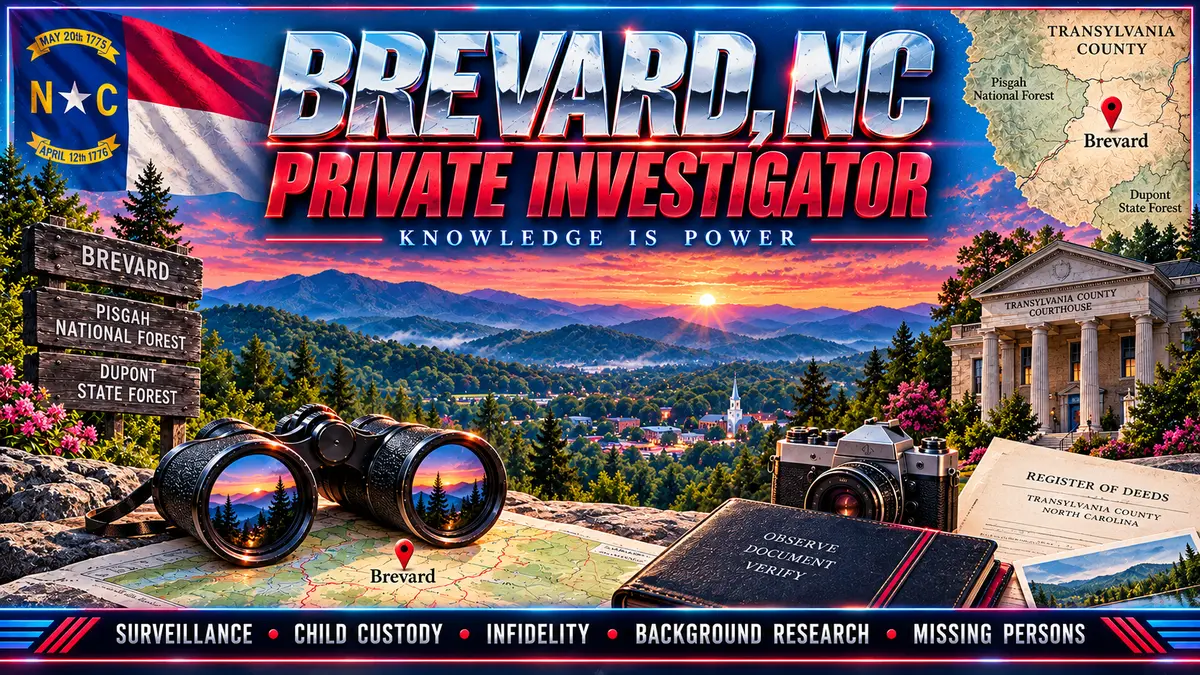
How to Hire a Private Investigator in Brevard, NC
Hiring a private investigator in Brevard, North Carolina, should begin with a clear question—not a promise of a particular result. A well-planned investigation can help a person, family, attorney, or business gather lawful facts, document observations, locate public records, and make better decisions. The right investigator will also explain what cannot legally or reliably be done.
Brevard cases can involve a distinctive mix of small-city neighborhoods, rural roads, mountain properties, seasonal residences, visitor traffic, and matters that extend beyond Transylvania County. That makes planning, lawful access, documentation, and realistic timing especially important. This guide explains how to evaluate a private investigator in Brevard, NC, what services may fit your situation, and what to expect before work begins.
JRS Investigations serves clients who need discreet fact development in Brevard and surrounding western North Carolina communities. Review the dedicated Brevard private investigator service page, explore our broader private investigation services, or call (888) 737-7690 for a confidential consultation.
Why careful selection matters in Brevard
Private investigations often touch sensitive relationships, litigation, employment, property, finances, or personal safety. Poorly defined work can waste money, create unnecessary privacy risks, or produce information that is difficult to use. A professional investigator should connect each proposed step to the client’s lawful objective and explain the limits of available records and fieldwork.
North Carolina regulates private investigative work through the Private Protective Services Board. The state’s Private Protective Services Act establishes licensing requirements and describes regulated activities. The North Carolina Private Protective Services Board provides licensing information and a licensee search. Verification should be an early step, not an afterthought.
How to hire a private investigator in Brevard, NC: 7 steps
1. Define the decision the investigation must support
Start with the decision you need to make. Are you preparing for a custody hearing, evaluating suspected infidelity, trying to locate a person, documenting conduct, checking a business representation, or assisting counsel with a civil matter? A focused objective helps the investigator propose relevant work and avoid collecting material that has no practical value.
Share known names, dates, addresses, vehicles, companies, court files, and prior attempts. Separate confirmed facts from suspicions. If an attorney is involved, ask whether the investigation should be directed through counsel and what evidence format may be most useful.
2. Verify the investigator and company
Ask for the company name, the responsible license holder or qualifying agent, and the type of license under which the work will be performed. Confirm the information through the state board rather than relying only on a website badge or verbal assurance. North Carolina’s licensing page explains that a private protective services firm must employ a license holder designated as its qualifying agent.
Licensing is a baseline. Also evaluate experience, communication, discretion, report quality, and familiarity with the type of matter you are presenting. A capable investigator should be willing to discuss relevant experience without disclosing another client’s confidential information.
3. Match the method to the case
Different objectives require different tools. Surveillance may be useful when lawful observation of conduct in public view is relevant. Public-record and database research may help confirm identities, addresses, businesses, litigation, or property connections. Interviews may clarify timelines or identify additional witnesses. Field verification can test whether an address, vehicle, workplace, or property lead remains current.
A good proposal explains why each method is being considered. It should not simply offer a generic block of hours. For family matters, learn more about child custody and domestic investigations and infidelity investigations.
4. Discuss legal and privacy limits before work starts
Private investigators do not have police powers. They cannot trespass, impersonate law enforcement, hack accounts, obtain protected financial or medical information without lawful authority, or guarantee access to private communications. Recording, tracking, database use, and access to restricted records depend on the facts and applicable law.
Be cautious of anyone who promises a private bank balance, private tax return, phone contents, password, live location, or guaranteed result. A professional investigator will refuse unlawful methods and may recommend that counsel review a proposed step.
5. Build a Brevard-specific operational plan
Fieldwork in and around Brevard may require more preparation than a simple urban assignment. Mountain roads, limited sight lines, weather, seasonal traffic, gated or private property, and travel between communities can affect scheduling and observation opportunities. An investigator should discuss reasonable coverage windows, lawful vantage points, travel assumptions, and what happens when a subject changes locations.
Local records can also shape the plan. The North Carolina Judicial Branch’s Transylvania County page provides court information and services. The Transylvania County Register of Deeds maintains real-estate and other public records. These official sources can help confirm leads, but a record match should be validated before it is treated as proof about a person.
6. Agree on budget, authorization, and communication
Request a written agreement identifying the client, objective, authorized work, rates, retainer, travel, expenses, reporting, and conditions for additional approval. Ask whether the matter will be billed hourly, by a defined phase, or under another structure. No ethical investigator can guarantee how many useful observations a particular surveillance period will produce.
Set communication rules at the outset. Decide who may receive updates, whether sensitive messages should be avoided, how urgent developments will be handled, and when the investigator must stop and seek approval. These details protect privacy and prevent budget surprises.
7. Require clear, supportable reporting
The final product should distinguish observed facts, public-record findings, source information, analysis, and unresolved questions. Surveillance reports should identify dates, times, locations, and the basis for observations. Images or video should be preserved in a usable format. Research findings should include enough source detail to allow review.
Ask how records and media are stored, transmitted, retained, and disposed of. If litigation is possible, tell the investigator early so documentation and evidence handling can be planned with counsel. The goal is not a dramatic story; it is a careful record that helps the client or attorney evaluate the next step.
Investigation services commonly requested in Brevard
Child custody and domestic matters
Custody-related assignments may involve documenting conduct relevant to a child’s welfare, verifying living arrangements, or identifying facts for counsel to assess. The investigator should remain neutral, avoid interfering with parenting time, and report what was actually observed. Emergency safety concerns should be directed to law enforcement or the appropriate protective agency rather than treated as a routine private assignment.
Infidelity and relationship concerns
Discreet surveillance and factual documentation may help a client replace uncertainty with evidence. Before beginning, define the question, useful time periods, known patterns, and budget. Avoid accessing a partner’s private accounts, installing unauthorized tracking software, or entering property without permission.
Background and due-diligence research
Background work can help verify identity details, litigation history, business affiliations, credentials, addresses, or other lawful public-record leads. The scope must fit the purpose. Employment, housing, credit, and similar decisions can trigger specialized consumer-reporting requirements, so clients should disclose the intended use before research begins.
Missing-person and locate investigations
A locate assignment may combine identifiers, address history, public records, interviews, and field verification. Each result should be corroborated because names, relatives, and old addresses can produce false matches. Review JRS missing-person and skip-tracing services. If a person is missing under dangerous or suspicious circumstances, contact law enforcement promptly.
Civil litigation, witness, and property support
Attorneys and parties may need help identifying witnesses, confirming locations, documenting conditions, organizing public records, or developing leads. Transylvania County court resources and recorded-property records may provide starting points. North Carolina business records can also help identify registered entities and filings, but ownership and control should not be inferred from a single record without further verification.
Questions to ask during the consultation
- Who will supervise and perform the work, and how can I verify the applicable license?
- What specific objective do you recommend, and which methods support it?
- What legal, practical, or privacy limits apply?
- What retainer, hourly rate, travel, and other expenses should I expect?
- When will I receive updates, and what requires additional authorization?
- What will the final report contain?
- How will photographs, video, notes, and personal information be protected?
- What facts would cause you to stop, change direction, or refer the matter to counsel or law enforcement?
Warning signs when choosing an investigator
Do not hire based solely on the lowest price or the boldest promise. Warning signs include guaranteed results, vague licensing answers, requests for cash without documentation, plans involving trespass or account access, refusal to provide a written scope, exaggerated claims of special government access, or pressure to begin before the objective is defined.
Another concern is a report that mixes facts with assumptions. Reliable investigative work acknowledges uncertainty and negative results. It also avoids overstating what a database, social profile, property record, or brief observation proves.
What to prepare before contacting JRS
Gather a concise timeline, the subject’s correct identifiers, known addresses and vehicles, relevant photographs, court information, company names, and copies of documents you are authorized to share. Note the source of each item. Explain deadlines, safety concerns, pending hearings, prior investigative work, and any protective or no-contact orders.
Do not conduct risky surveillance yourself or obtain information through passwords, deception, trespass, or unauthorized tracking. Preserving lawful source information from the beginning makes the consultation more efficient and reduces the risk of contaminating useful evidence.
Frequently asked questions
How much does a private investigator in Brevard cost?
Cost depends on the objective, required hours, travel, urgency, records, reporting, and whether the matter changes during the assignment. A written agreement should explain the retainer, rates, expenses, and approval process before work begins.
Can an investigator guarantee proof?
No. An investigator can plan and perform lawful work, but cannot guarantee what a person will do, what a record will contain, or whether a particular fact exists. The value lies in disciplined methods and accurate reporting, including when a lead cannot be confirmed.
Can a private investigator access private accounts or phone data?
Not without lawful authority. Passwords, private messages, protected financial data, medical information, and device contents are not automatically available to a private investigator. Be wary of anyone promising secret or unrestricted access.
Will the investigator testify in court?
Potential testimony should be discussed before the assignment. Availability, qualifications, notes, evidence handling, report preparation, and fees may all matter. Your attorney should determine how investigative findings fit the legal strategy.
How quickly can work begin?
Timing depends on licensing review, conflicts, the written agreement, retainer, available personnel, weather, travel, and the facts of the case. Urgent matters should be identified during intake, but immediate danger belongs with 911 or law enforcement.
Speak with JRS Investigations
The best investigation begins with a lawful, specific objective and realistic expectations. JRS Investigations can review the known facts, explain possible methods and limits, and propose a scope for Brevard or a related western North Carolina matter.
Knowledge Is Power. Get the facts you need. Contact JRS Investigations or call (888) 737-7690 for a confidential consultation. You can also learn more about JRS Investigations.