(888) 737-7690
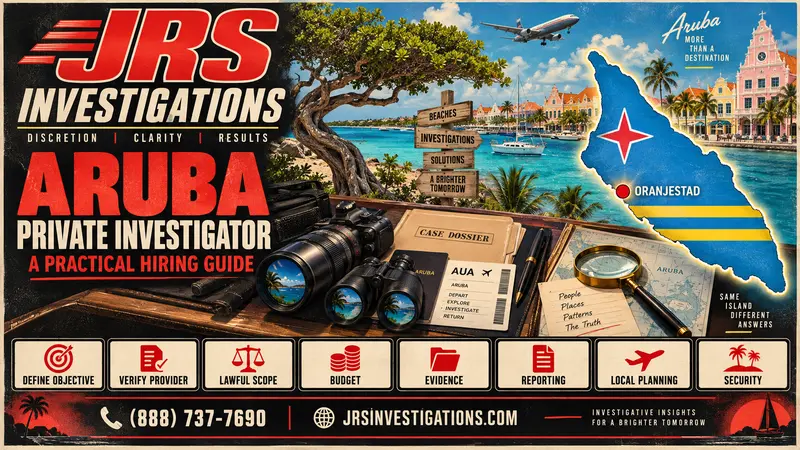
How to Hire a Private Investigator in Aruba: A Practical Guide
Hiring a private investigator in another country requires more than finding someone who promises quick answers. The right approach begins with a clear question, a lawful plan and realistic expectations about what can be documented. An experienced Aruba private investigator should help define the assignment, identify the information that matters and explain which investigative steps are appropriate before work begins.
JRS Investigations assists individuals, attorneys and businesses with carefully planned assignments in Aruba and throughout the Caribbean. This guide explains how to prepare, what to ask and how to evaluate an investigative proposal without relying on exaggerated claims or intrusive methods. For location-specific information, review the Aruba private investigator service page or the broader Caribbean investigations service area.
Start with the decision the investigation must support
A productive investigation starts with a specific decision, not a broad request to “find everything.” A spouse may need to know whether a documented travel pattern supports a family-law consultation. An employer may need to verify a candidate’s stated history. An attorney may need help locating a person or confirming facts connected to a civil matter. A business may need to understand a suspected internal loss or verify a potential partner.
Write the central question in one sentence. Then list the facts already known, the facts that remain uncertain and the date by which the information is needed. This prevents the assignment from expanding without purpose and allows the investigator to recommend a focused schedule and budget.
Contact public authorities first when safety or crime is involved
A private investigator does not replace law enforcement, emergency responders or legal counsel. If someone is in immediate danger, a crime is in progress or a vulnerable person may be at risk, contact the appropriate local authorities before arranging private investigative work. The Government of Aruba provides information about the Aruba Police Force. Its explanation of the Public Prosecutor’s Office also describes how police investigations, witness information and formal reports fit into criminal proceedings.
After urgent reporting is complete, an investigator may be able to preserve a timeline, identify witnesses, document publicly observable activity or gather information for an attorney. The scope should never interfere with a police investigation or place a client, subject or investigator at unnecessary risk.
Match the investigator to the type of case
Different assignments require different experience, planning and tools. Ask how the investigator would approach your particular objective rather than accepting a generic list of services. Common requests in Aruba may include:
- Infidelity and relationship matters: targeted observation of lawful public activity, travel schedules and relevant meetings. Learn more about infidelity investigation services.
- Background and due diligence: identity, employment, business and record verification using sources that may lawfully be accessed. See JRS background-check services.
- Missing persons and difficult-to-locate subjects: organized lead development, database research where permitted, interviews and local inquiries. Review missing-person and skip-tracing services.
- Business and asset questions: company relationships, public filings, property leads and other documented indicators. A related Aruba example is the JRS guide to hidden-asset investigative support.
- TSCM and privacy concerns: professional inspection of rooms, offices, vehicles or meeting spaces for unauthorized surveillance devices. Read the Caribbean TSCM bug-sweep guide.
- Executive protection and security planning: risk-based advance work, secure transportation coordination and protective coverage. See private security and executive-protection services.
Confirm jurisdiction, authority and local coordination
Rules governing investigative activity, privacy, records, surveillance and business operations are jurisdiction-specific. Do not assume that a method permitted in one U.S. state is permitted in Aruba. A responsible proposal should identify where the work will occur, which party will perform it and whether local coordination, authorization or legal guidance is required.
For business verification, the Aruba Chamber of Commerce and Industry provides access to its trade registry and official company products. Registry information can help confirm a legal or trade name, but it does not by itself prove that a provider is qualified for every investigative assignment. Ask for the firm’s full legal identity, written contact details and an explanation of who will be responsible for the work.
Evaluate the plan, not a list of gadgets
Technology can support an investigation, but equipment does not replace judgment. Be cautious when a provider leads with promises about trackers, covert recording, drones, account access or “guaranteed” evidence. These methods may be restricted, unsafe, irrelevant or unlawful depending on the facts and location. A professional should explain the objective of each proposed step, the legal basis for using it and the limits of the result.
For surveillance, the plan should address dates, likely locations, transportation, lawful observation points and the conditions that would cause the investigator to pause or change coverage. For research, it should identify the records or source categories to be checked and distinguish verified facts from leads requiring additional confirmation.
Require a written scope, budget and communication plan
Before authorizing work, request a written agreement that states the client, objective, geographic scope, anticipated schedule, rates, retainer, expenses and reporting method. Ask how travel time, vehicles, local support, lodging and schedule changes are billed. Cross-border assignments can change quickly, especially when a subject changes a flight, hotel, rental vehicle or meeting location.
The agreement should also explain when the investigator will provide updates and who may authorize additional time. A defined stop point protects the budget and gives both parties a chance to review what has been learned before expanding the assignment.
Protect evidence without invading private accounts
Preserve information that you already possess lawfully: original messages sent to you, photographs, travel confirmations, invoices, shared-account statements, vehicle details and a dated timeline of events. Keep original files when possible and avoid repeatedly editing, forwarding or screenshotting material in ways that remove useful context.
Do not guess passwords, access private email or cloud accounts, install monitoring software, impersonate another person, place a tracking device or enter private property without legal authority. Tell the investigator how each item was obtained. If litigation is expected, ask your attorney how information should be preserved and whether special evidence-handling requirements apply.
Understand what the final report will contain
Ask for a sample description of the deliverable before work begins. Depending on the assignment, a professional report may include a chronology, locations, observations, source notes, photographs or video captured where permitted, and a clear distinction between confirmed facts and unresolved leads. It should not convert assumptions into conclusions or claim certainty that the evidence does not support.
Discuss how files will be transferred, who may receive them and how long records will be retained. Sensitive family, legal and corporate matters should be shared only with authorized recipients. If a report may be used by counsel, provide the attorney’s contact information early so the assignment can be structured around the actual legal question.
Plan around Aruba’s geography and travel patterns
Aruba assignments often involve airports, resorts, beaches, restaurants, marinas, residential areas and business districts across Oranjestad, Noord, Palm Beach, Eagle Beach and San Nicolas. A useful intake identifies confirmed arrival and departure times, hotel or property information, expected vehicles, reservation details and known events. Advance notice improves scheduling and reduces time lost to incomplete travel information.
Clients should also prepare for ordinary complications: flight changes, rental-car substitutions, resort access rules, crowded public areas and last-minute itinerary changes. An ethical investigator will not promise continuous coverage or a predetermined result. The goal is accurate documentation within the agreed time, place and lawful scope.
Questions to ask before hiring an Aruba private investigator
- Who will conduct the work in Aruba, and what authorization or local coordination applies?
- What specific question will the proposed investigation attempt to answer?
- Which methods are planned, and how will privacy and property boundaries be respected?
- What is included in the retainer, hourly rate and expense estimate?
- When will updates be provided, and who can approve additional work?
- What written report, photographs or other documentation should the client expect?
- How will sensitive records be delivered and protected?
- What circumstances would cause the investigator to stop, change or decline the assignment?
Prepare for a confidential consultation with JRS Investigations
For an efficient consultation, provide a short factual summary, the objective, relevant dates, known Aruba locations, travel information, recent lawful photographs and the deadline. Separate direct observations from assumptions and identify any police report, court matter or attorney involvement. JRS will review the available information, explain practical options and define the next step without promising a particular outcome.
To discuss an Aruba assignment, call JRS Investigations at (888) 737-7690 or use the confidential contact page. Early planning is especially important for travel-related surveillance, coordinated Caribbean investigations and time-sensitive legal matters.