(888) 737-7690

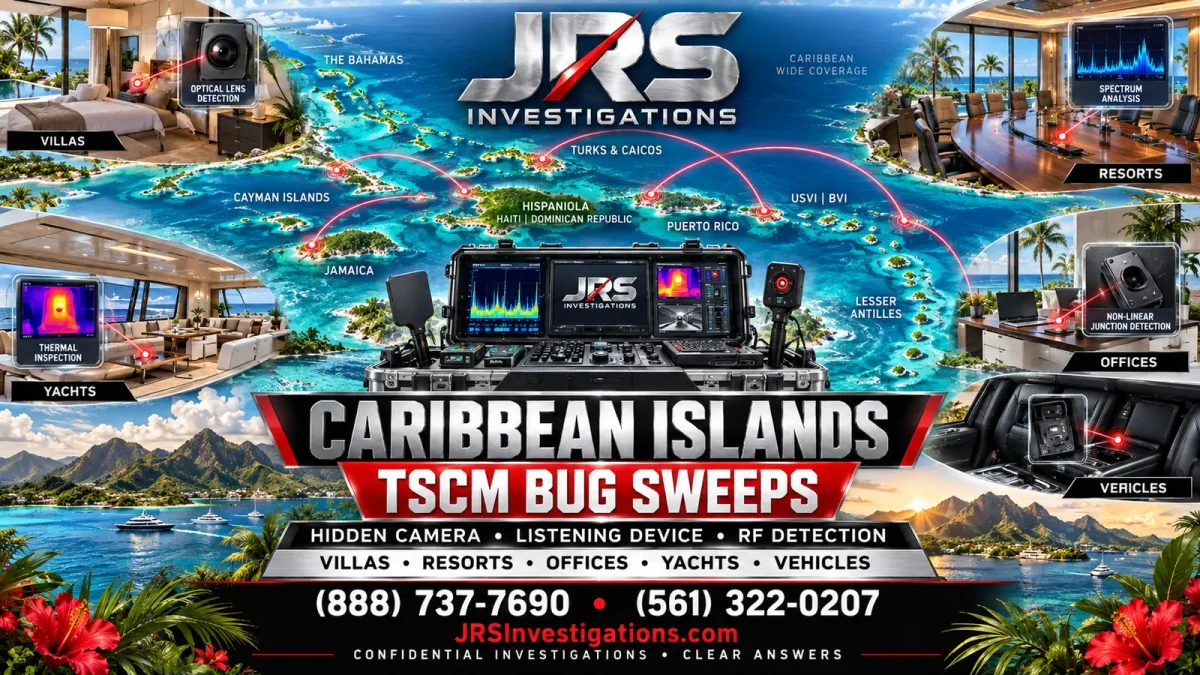
Caribbean TSCM Bug Sweep Planning Guide: What to Expect
A Caribbean TSCM bug sweep is not a quick pass with a handheld detector. Resorts, private villas, offices, yachts, vehicles, conference spaces, and temporary executive accommodations each present different access, radio-frequency, electrical, and privacy conditions. A professional Technical Surveillance Countermeasures assignment begins with threat-based planning and combines electronic analysis with a methodical physical inspection.
JRS Investigations coordinates TSCM and hidden-camera detection services across the Caribbean for individuals, companies, legal teams, executives, property owners, and security professionals. The objective is to identify and evaluate potential technical surveillance risks, document anomalies, and help the client improve the security of sensitive spaces. No legitimate provider can promise that every device will be found or that a sweep will prove a particular person planted one.
For a confidential consultation, call (888) 737-7690 or (561) 322-0207. If you believe a room or device may be compromised, do not discuss the planned inspection inside that space.
What Is a TSCM Bug Sweep?
Technical Surveillance Countermeasures, commonly called TSCM, is a structured process used to assess an environment for covert audio, video, location, and data-collection threats. The term “bug sweep” is useful shorthand, but professional work is broader than searching for one type of transmitter.
A properly scoped inspection may evaluate radio-frequency activity, visible and concealed electronics, optical threats, wiring, power sources, furnishings, network-connected equipment, and physical access points. The specific methods depend on the client’s concern, the property, authorized access, available time, and local law.
This guide focuses on how Caribbean assignments are planned and executed. For JRS Investigations’ primary regional service page, visit Caribbean Islands TSCM bug sweeps.
Why Caribbean TSCM Assignments Require Special Planning
Inter-Island Travel and Equipment Logistics
The Caribbean is a region, not a single jurisdiction. Flights, ferries, customs procedures, equipment transportation, local access, and island-specific regulations affect scheduling. A site on a major island may be reached differently from a remote villa, marina, private cay, or vessel. The provider should confirm the destination, property type, access window, and equipment plan before quoting deployment.
Resort, Villa, and Marina Access
Hotels and gated developments may require guest authorization, management coordination, identification, parking access, or a limited service window. Yacht inspections add vessel layout, shore power, communications equipment, crew access, and marina security. The client must have the authority to authorize the inspection; a TSCM team cannot simply enter or search property controlled by another party.
Dense and Changing Radio Environments
Resorts, business districts, marinas, and condominium towers can contain many legitimate wireless devices. Nearby Wi-Fi networks, cellular systems, Bluetooth products, radios, access-control equipment, smart televisions, and marine electronics can create a busy spectrum. The task is not merely to detect a signal—it is to analyze whether activity is expected, unexplained, intermittent, or associated with a physical source.
Salt, Humidity, Power, and Construction
Tropical humidity, salt exposure, power variations, reinforced concrete, stone, dense furnishings, and renovations may influence readings and physical inspection. These conditions do not automatically indicate a threat. They are part of the baseline an examiner must understand when evaluating anomalies.
When Should a Caribbean Property Be Swept?
Before a Sensitive Meeting or Transaction
Board meetings, negotiations, investor discussions, legal strategy sessions, mergers, acquisitions, and confidential hospitality events may justify a preventive inspection. Scheduling before the room is occupied provides time to evaluate anomalies without interrupting the event.
After Unauthorized Access or Staff Changes
A lost key, unexplained maintenance visit, access-control failure, contractor activity, employee departure, property turnover, or open-house period can change the risk profile. The concern should be documented factually rather than treated as proof that a device is present.
When Information Appears to Be Leaking
Repeated knowledge of private discussions, unexplained competitive intelligence, or confidential details appearing outside a small group may justify a broader security review. A technical sweep is one part of that response. Access permissions, document handling, account security, staff practices, and ordinary human disclosure may be equally important.
Before an Executive or Family Occupies a Temporary Space
High-profile travelers, legal teams, family offices, and corporate groups may request a sweep of a villa, suite, meeting room, vehicle, or yacht before use. Advance coordination is critical because the inspection must occur after the space is secured but before sensitive activity begins.
When a Hidden Camera Is Suspected
Unusual objects, altered fixtures, unexplained holes, unknown electronics, unexpected network devices, or an intrusion may justify professional review. Avoid dismantling or destroying a suspicious item. Photograph it from a safe position, restrict access when appropriate, and obtain legal or law-enforcement guidance if the circumstances may involve a crime.
How JRS Plans a Caribbean TSCM Sweep
1. Confidential Threat Assessment
The initial intake identifies who authorized the inspection, the reason for concern, the information at risk, the people with access, relevant dates, property type, and any suspicious events. JRS distinguishes confirmed facts from assumptions and avoids discussing the operation through channels or rooms the client believes may be compromised.
2. Written Scope and Site Inventory
The scope should list the authorized rooms, structures, vehicles, vessels, and equipment to be assessed. Floor plans, photographs, device lists, network information, access procedures, and renovation history can improve preparation. Areas not included in the agreement should not be implied to have been cleared.
3. Pre-Sweep Communication Protocol
Clients may be instructed to limit discussion of the sweep, preserve normal conditions, avoid powering off unknown devices, and select a secure communication method. Sudden changes can remove evidence, alter the radio environment, or alert a person who has access to the property.
4. On-Site Technical and Physical Inspection
A professional examiner layers complementary methods rather than relying on one detector. Work may include spectrum analysis, radio-frequency evaluation, non-linear junction detection, thermal review, optical-lens detection, authorized network review, examination of wiring and power, and a detailed physical inspection. The chosen tools and sequence depend on the site and threat model.
5. Anomaly Resolution
Electronic activity must be correlated with legitimate sources whenever possible. A Wi-Fi access point, smart appliance, television, alarm component, marine system, or building control may explain an initial anomaly. Conversely, an unfamiliar device should not be declared malicious until it has been identified, documented, and evaluated in context.
6. Reporting and Security Recommendations
The client should receive a clear account of the areas inspected, methods used, observations, unresolved limitations, identified devices or anomalies, and recommended next steps. Reporting should not overstate what the sweep can prove. A clean inspection means no confirmed threat was identified within the tested scope and conditions—not that future compromise is impossible.
What Equipment May Be Used During a TSCM Inspection?
Radio-Frequency Spectrum Analysis
Spectrum-analysis equipment helps examine radio activity across relevant frequency ranges. The examiner looks for signals, patterns, timing, modulation, strength, and location clues. Because modern properties contain many legitimate transmitters, interpretation matters more than a dramatic screen display.
Non-Linear Junction Detection
A non-linear junction detector can help locate semiconductor components, including electronics that may not be actively transmitting. It does not automatically identify a listening device; legitimate electronics can also respond. Physical inspection and contextual analysis are required.
Optical and Thermal Tools
Optical techniques may assist with locating exposed camera lenses, while thermal equipment may help identify unusual heat patterns or powered devices. Reflections and heat have many innocent sources, so findings must be investigated rather than assumed to be surveillance equipment.
Physical Inspection and Documentation
Careful visual and physical examination remains essential. Fixtures, furniture, smoke detectors, clocks, power adapters, televisions, telephones, access points, AV systems, wiring, and recent modifications may require review. Photographs and notes help preserve the condition and location of relevant findings.
No single consumer “bug detector” can reliably clear every room of every threat. A professional process uses multiple methods because devices may transmit continuously, intermittently, through a network, or not at all.
Preparing for a Caribbean Bug Sweep
- Confirm that you control the property or have written authority for the inspection.
- Provide the exact island, address, property type, room count, square footage, vehicles, and vessels in scope.
- Share floor plans, recent photographs, access restrictions, and known electronics when available.
- Describe suspicious events with dates and facts; do not move or dismantle questionable items unless safety requires it.
- Choose a secure point of contact who can authorize decisions during the sweep.
- Arrange access when the site can remain controlled and free from unnecessary traffic.
- Do not announce the inspection to everyone with access to the property.
- Ask counsel or authorities how potential evidence should be handled when litigation or a crime may be involved.
JRS also provides dedicated regional information for Puerto Rico TSCM bug sweeps and Saint Martin and Sint Maarten TSCM services.
Legal, Privacy, and Evidence Boundaries
Caribbean jurisdictions have different privacy, telecommunications, evidence, search, and recording laws. A sweep must be authorized by a person with lawful control of the property and performed within the rules that apply to the location. JRS does not represent that one country’s law applies throughout the region.
Signal jamming is not a routine TSCM solution. It may interfere with emergency, cellular, aviation, maritime, or other authorized communications and can be unlawful. For example, the U.S. Federal Communications Commission maintains a jammer-enforcement program applicable in the United States and its territories. Local legal guidance is necessary elsewhere.
If a suspected device is identified, the next step depends on ownership, safety, local law, and the client’s objective. Removing, powering down, transmitting through, or destroying it may compromise evidence or alert another person. Documentation and coordinated decision-making are often more important than immediate removal.
Frequently Asked Questions
Does a bug sweep guarantee that a room is secure?
No. A sweep assesses the authorized space under the conditions present at that time. Professional reporting should explain the tested scope, findings, and limitations. Security also depends on access control, device management, staff practices, and what happens after the inspection.
Can JRS sweep a hotel room or rented villa?
Only with appropriate authority and within property rules and local law. A guest’s rights may differ from an owner’s rights, and management coordination may be required. The exact situation must be evaluated before scheduling.
Can a sweep include vehicles or yachts?
It can when the client has authority and the vehicle or vessel is included in the written scope. Marine electronics, communications equipment, compartments, access history, shore power, and operational systems can make a yacht inspection different from a room inspection.
Should suspected devices be unplugged before the team arrives?
Generally, do not alter the environment without receiving case-specific guidance. A device that is moved, reset, powered down, or discarded may become harder to identify or document.
How often should a Caribbean property be swept?
There is no universal schedule. Risk may change after high-level meetings, renovations, contractor access, staff turnover, property rental, an intrusion, or unexplained information leakage. A repeat-inspection plan should be based on threat, exposure, and how the space is used.
Schedule a Caribbean TSCM Consultation
A well-planned Caribbean TSCM bug sweep protects more than a room. It helps a client understand the site, identify technical and physical vulnerabilities, document anomalies, and build better procedures for future privacy.
Call JRS Investigations at (888) 737-7690 or (561) 322-0207 to discuss the island, property type, concern, timing, and authorized scope. You can also review Caribbean private investigation services and the complete JRS services overview.