(888) 737-7690
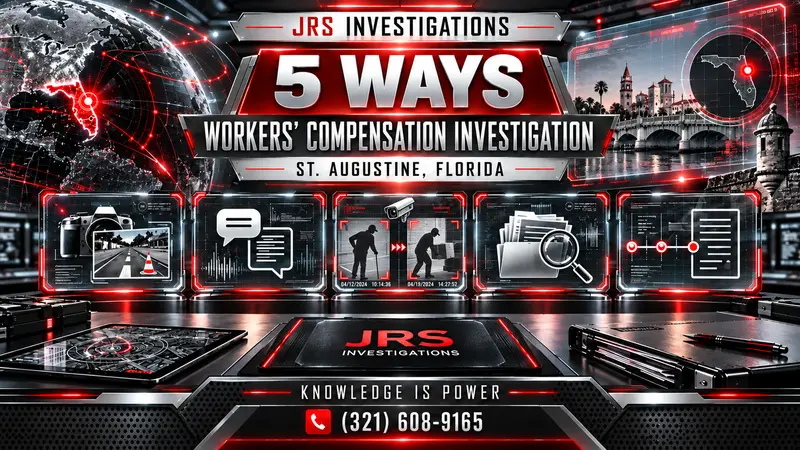
5 Ways a St. Augustine Workers’ Compensation Investigation Can Help
A St. Augustine workers’ compensation investigation can help attorneys, insurers, employers, self-insured organizations and other authorized parties replace assumptions with documented facts. The goal is not to label an injured worker dishonest or to decide whether a claim is compensable. It is to gather relevant information lawfully, preserve it clearly and give the professionals handling the matter a stronger factual record.
Florida’s workers’ compensation system covers injured workers, employers, carriers and health-care providers. Chapter 440 states that cases should be decided on their merits and that disputed facts should not be interpreted broadly in favor of either the employee or the employer. That makes disciplined, neutral fact-finding especially important. For official guidance, consult the Florida Division of Workers’ Compensation and the current Florida Statutes, Chapter 440.
JRS Investigations approaches these assignments with a defined scope, lawful methods and careful reporting. Here are five ways an investigation may assist a St. Augustine workers’ compensation matter.
1. Document the reported incident and surrounding conditions
Early scene work can preserve details that may change quickly. Depending on the assignment and lawful access, an investigator may photograph or video the location, note lighting and weather conditions, identify camera positions, document equipment or walking surfaces, and create basic measurements or diagrams. The investigator may also help identify time-sensitive sources such as surveillance footage, access logs, dispatch records or incident reports before they are overwritten or lost.
This work does not determine medical causation or legal responsibility. It creates a contemporaneous record that counsel, adjusters, safety professionals and qualified experts can evaluate. When a site cannot be accessed, public vantage points and properly authorized records may still help establish context without trespassing or interfering with the workplace.
2. Locate and interview relevant witnesses
Supervisors, coworkers, customers, vendors, first responders and nearby residents may each hold a different piece of the timeline. A professional investigator can identify potential witnesses, conduct neutral interviews and separate direct observations from rumor or secondhand information.
A useful witness interview should clarify what the person personally saw or heard, when it occurred, where they were positioned and whether anything could have affected their ability to observe. When appropriate and permitted, the investigator may obtain a written or recorded statement with the witness’s knowledge and consent. The resulting report should distinguish facts, estimates and opinions rather than blending them together.
3. Conduct lawful surveillance of observable activity
Surveillance may be appropriate when a client has a legitimate, authorized need to compare publicly observable activity with specific representations in a claim. The assignment should be based on clear objectives and conducted from lawful public locations or other places where the investigator has permission to be.
A single photograph or brief activity rarely tells the whole story. Good surveillance reporting records dates, times, locations, continuity, environmental conditions and meaningful gaps. It documents what was actually observed without diagnosing an injury, claiming that pain is absent or stretching an ordinary movement into a conclusion it cannot support. Productive and unproductive periods should both be reported honestly.
JRS Investigations does not trespass, harass a subject, unlawfully track a person or intrude into places where there is a reasonable expectation of privacy. Learn more about the firm’s broader investigative services and local support from a St. Augustine private investigator.
4. Verify records and preserve relevant online information
Public records, authorized business records and lawfully accessible online material can help verify identities, employment or business relationships, addresses, ownership interests and dates. Public social-media content may also be preserved when it is relevant to the authorized scope of the case. An investigator should record the source, date and context instead of relying on an isolated screenshot with no supporting information.
Access limits matter. Investigators should not use fake accounts, stolen credentials or deceptive contact to enter private profiles. Medical records, protected employment records and other confidential material require proper authorization or formal legal process. A private investigator does not independently interpret medical findings or decide whether a condition was caused by work; those questions belong to qualified medical and legal professionals.
5. Build a clear chronology and investigation report
Facts become more useful when they are organized. A final report may combine incident documentation, witness information, surveillance logs, public-record findings and preserved exhibits into a chronological account. Clear source notes and file-handling practices help counsel or a claims professional evaluate the material and determine what additional work, if any, is justified.
An investigator can preserve and explain how information was obtained, but cannot guarantee that any item will be admitted into evidence or produce a particular claim outcome. Admissibility, compensability, fraud and legal strategy are decisions for the appropriate court, agency, attorney or claims professional.
When an investigation may be useful
An investigation may be considered when accounts conflict, a scene is changing, witnesses are becoming difficult to locate, relevant video may soon be erased, the timeline is unclear or counsel needs independent documentation. It can also confirm facts that support the injured worker’s account. Neutral findings are valuable whether they support, contradict or simply clarify an allegation.
Information to gather before calling
- The claim or case number and the name of the authorized contact.
- The reported incident date, time and precise location.
- A concise list of disputed facts or questions to be answered.
- Known witness names, employers, addresses and contact information.
- Relevant deadlines, hearing dates and record-retention concerns.
- Any lawful access permissions or restrictions that affect the assignment.
- Existing photographs, reports or video that can prevent duplicated work.
Starting with a narrow scope protects the budget and helps keep the investigation relevant. The scope can be expanded if verified findings identify a legitimate need for additional work.
Local knowledge for St. Augustine and Northeast Florida
St. Augustine assignments can involve the historic district, beach communities, residential areas, construction sites, hospitality properties and busy travel corridors across St. Johns County. Local planning helps account for parking restrictions, pedestrian traffic, seasonal congestion, special events and the practical limits of lawful observation.
For related examples of workers’ compensation investigation planning, see JRS Investigations’ guides for Daytona Beach and Cocoa Beach. Organizations with a separate concern about unauthorized cameras or listening devices can also review the St. Augustine TSCM bug-sweep guide.
Discuss a St. Augustine workers’ compensation investigation
Every assignment begins with the client’s authority, objectives, deadlines and budget. JRS Investigations can help define a focused plan, explain realistic limits and document the work performed. No result or legal outcome can be guaranteed.
Call (321) 608-9165 or contact JRS Investigations to discuss a confidential case assessment.
This article provides general information and is not legal advice. Consult a qualified Florida attorney or workers’ compensation professional about a specific claim.