
(888) 737-7690

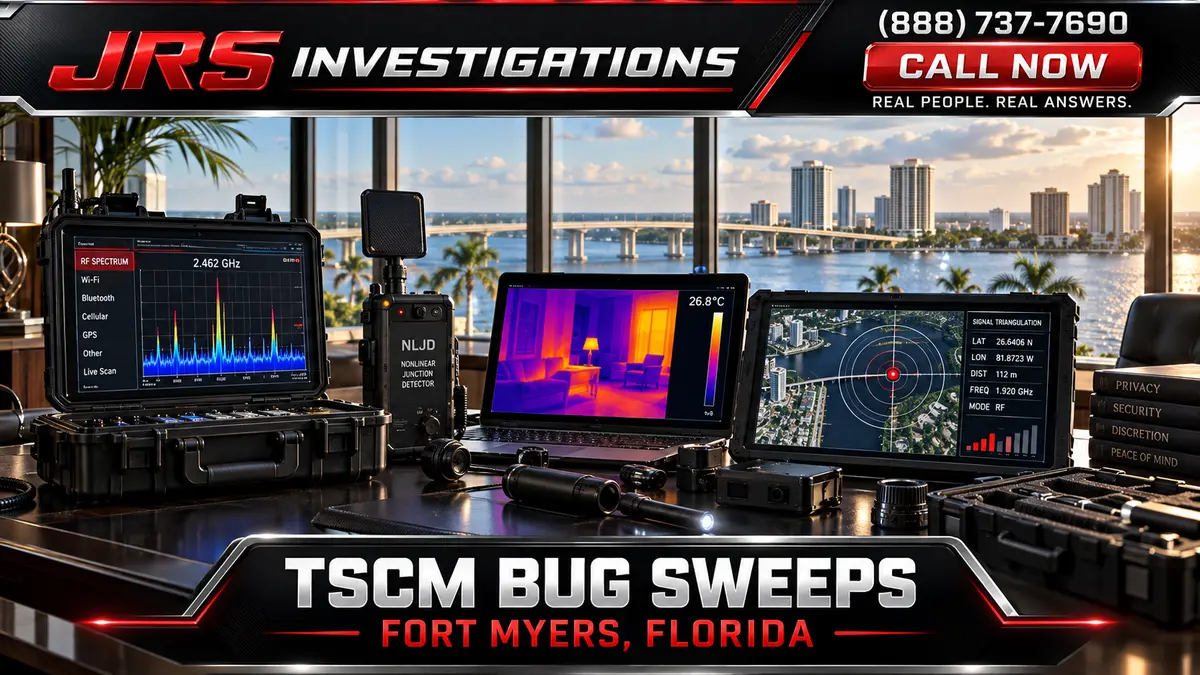
TSCM Bug Sweeps in Fort Myers, Florida: A Practical Guide
Privacy concerns involving hidden microphones, covert cameras, wireless transmitters, or unauthorized tracking require more than a quick scan with a consumer detector. Professional TSCM bug sweeps in Fort Myers, Florida combine technical analysis, physical inspection, threat assessment, and careful documentation to evaluate whether a home, office, vehicle, meeting space, or temporary accommodation shows signs of electronic surveillance.
JRS Investigations approaches Technical Surveillance Countermeasures as a defined investigative process. The goal is to understand the client’s concern, examine the authorized environment with complementary methods, identify anomalies that deserve attention, and explain the findings without exaggerated promises. This guide describes when a sweep may be appropriate and what Fort Myers clients should expect.
TSCM Risks in Fort Myers Environments
Fort Myers and the surrounding Southwest Florida area include waterfront residences, condominiums, professional practices, executive offices, hospitality properties, construction activity, seasonal occupancy, and frequent vendor access. Each environment creates different technical conditions. A condominium can contain dense Wi-Fi, Bluetooth, cellular, and building-system signals from nearby units. An office may have conferencing equipment, access controls, structured cabling, and authorized network devices. A rental property or hotel suite may contain fixtures the occupant did not select or install.
These conditions do not prove that surveillance exists. They make context and source identification essential. A detector that produces an alert cannot, by itself, determine whether the source is a legitimate router, a neighboring device, an ordinary power supply, or unauthorized equipment. A professional sweep compares observations across several methods before drawing conclusions.
Reasons to Request a Fort Myers TSCM Sweep
A technical sweep may be appropriate when there is a specific incident, a meaningful change in access, or a planned conversation that requires additional privacy. Clients commonly seek an assessment when:
- Confidential business, legal, financial, medical, or personal information appears to be reaching an unauthorized person.
- A former partner, employee, contractor, tenant, caregiver, or service provider recently had unsupervised access.
- An unfamiliar charger, cable, adapter, network component, camera-like opening, or altered fixture appears in the space.
- A residence, boardroom, executive office, vehicle, or temporary accommodation must be assessed before sensitive activity.
- There has been a renovation, repair, equipment installation, staff change, or unusual access event.
- A client needs a preventive review as part of an executive-security or information-protection plan.
Isolated symptoms are not proof. Static, battery drain, unexplained noises, or a device behaving differently can have ordinary causes. Our related guide to warning signs that may justify a Fort Myers TSCM sweep explains how access history and multiple indicators can help determine whether a professional assessment is warranted.
How a Professional TSCM Inspection Works
The inspection plan should match the property, suspected threat, electronic environment, and client’s lawful authority. Although every assignment differs, a professional process generally includes the following stages.
Confidential Intake and Threat Assessment
The investigator first asks what prompted the concern, which information may have been exposed, who had access, and which rooms, devices, or vehicles are most important. Dates, renovations, visitors, property-management access, and changes in electronic equipment can help establish priorities. A clear threat assessment prevents the sweep from becoming an unfocused search.
Authorization and Inspection Boundaries
The person requesting the work must have appropriate authority over the areas and equipment included in the scope. Condominiums, leased offices, hotels, shared workplaces, common areas, employer-owned systems, and jointly controlled vehicles can create additional restrictions. The scope should be resolved before anything is opened, disconnected, moved, or accessed.
Systematic Physical Examination
Physical inspection remains central because some devices record locally, transmit only at intervals, or remain inactive until triggered. The examiner looks for altered fixtures, unexplained openings, unusual power sources, displaced objects, suspicious wiring, and components that do not match the room’s normal use. Attention is directed by the threat assessment rather than by assumptions about where a device “should” be hidden.
RF Spectrum Analysis
Radio-frequency analysis evaluates the surrounding signal environment. In Fort Myers condominiums, offices, and hospitality properties, legitimate transmissions may come from neighboring networks, cellular devices, smart-home systems, Bluetooth accessories, security equipment, and building operations. The examiner works to characterize signals, identify probable sources, and isolate activity that does not correspond to known equipment.
Nonlinear Junction Detection and Additional Methods
A nonlinear junction detector may help locate semiconductor components even when a device is powered down or not transmitting. Depending on the assignment, the process may also include thermal analysis, optical inspection for concealed camera lenses, examination of accessible cabling, and review of authorized wireless or network devices. Each method addresses a different limitation, which is why relying on one instrument can miss important context.
Findings, Documentation, and Next Steps
The client should receive a clear explanation of the areas inspected, methods used, observations, limitations, and recommendations. If an unfamiliar or suspicious item is located, immediate removal may not be the best first step. Photography, access control, evidence preservation, and coordination with legal counsel or law enforcement may be important, depending on the circumstances.
Properties and Assets Commonly Examined
Residences and Condominiums
Residential work can include home offices, bedrooms, living areas, security systems, chargers, appliances, and objects introduced by visitors or service providers. Neighboring signals in a multi-unit building can complicate RF findings, so the investigator must combine signal analysis with physical inspection and source confirmation.
Businesses and Professional Offices
Commercial sweeps may address executive offices, conference rooms, reception areas, communications closets, and spaces used for legal strategy, healthcare, finance, personnel matters, or negotiations. Scheduling and confidentiality matter because changes in normal operations can alter the electronic environment or alert someone who should not know about the inspection.
Temporary Accommodations
Hotels and short-term rentals include unfamiliar fixtures and equipment, but the guest’s authority is limited. Accessible objects and the immediate environment may be assessed without damaging property or entering restricted building systems. The permitted scope should be discussed before the appointment.
Vehicles and Tracking Concerns
Vehicle inspections may address suspected trackers, recorders, or unauthorized electronics. Ownership, lawful control, factory telematics, aftermarket accessories, and prior repair work all affect the process. Read our overview of tracking and surveillance devices encountered in Fort Myers investigations for additional context.
Preparing for a Sweep
- Limit knowledge of the appointment to people who need to know.
- Leave the environment in its usual condition unless the investigator instructs otherwise.
- Do not discard, dismantle, or repeatedly handle a suspicious item.
- Prepare a timeline of visitors, vendors, repairs, renovations, deliveries, or equipment changes.
- Identify priority rooms, conversations, dates, information, and suspected access points.
- Have authorized device lists, network names, floor plans, vehicle information, and keys available when practical.
Avoid repeated scans with phone apps or inexpensive detectors before the appointment. Those tools can misidentify normal electronics and create confusion without establishing the source of an alert. If something appears concerning, preserve the setting and discuss it privately with the investigator.
Florida Law and the Limits of a Defensive Sweep
TSCM is a defensive inspection. It does not authorize entry into another person’s property, access to private accounts, interception of communications, or examination of equipment outside the client’s lawful control. Florida addresses interception and disclosure of wire, oral, and electronic communications in Florida Statutes section 934.03. Clients involved in litigation or a disputed-access situation should seek advice from a qualified Florida attorney.
A responsible provider will also explain that no sweep can guarantee permanent or absolute certainty. A device may be intermittent, remotely controlled, removed before the inspection, concealed beyond the authorized area, or located where construction prevents access. Honest reporting identifies the scope and limitations and recommends follow-up steps when the risk remains active.
Selecting a Fort Myers TSCM Provider
Ask prospective providers how they assess the threat, which complementary methods they use, how they distinguish authorized electronics from anomalies, and what documentation they provide. Discuss confidentiality, legal authority, evidence handling, and limitations before the inspection. Be cautious of anyone who promises a guaranteed result based on one detector or a fixed checklist.
JRS Investigations provides Fort Myers TSCM bug-detection services and publishes a broader Florida TSCM bug-sweep guide. Our work emphasizes a documented scope, layered examination, discretion, and clear communication.
Frequently Asked Questions
How long does a Fort Myers TSCM sweep take?
Time depends on square footage, the number of rooms or vehicles, electronic complexity, access, and the level of concern. The intake process allows the investigator to estimate an appropriate scope before scheduling.
Can inactive or powered-off devices be detected?
Some non-transmitting electronics may be located through physical inspection or methods such as nonlinear junction detection. Results depend on concealment, materials, access, and the inspection scope.
Should electronics and Wi-Fi be turned off?
Leave the property in its normal state unless directed otherwise. Known devices can be documented and selectively controlled during the inspection to help identify legitimate signals.
Can a condominium or rental be swept?
Areas and objects under the client’s lawful control may be examined. Common building systems, neighboring units, and fixtures owned by another party may limit access or require additional authorization.
What should happen if a suspicious item is found?
The response should reflect safety, evidence, and legal objectives. Documenting and preserving the item may be more useful than immediate removal. Counsel or law enforcement can be consulted when appropriate.
When should a business repeat a sweep?
Frequency should be based on risk. Relevant triggers include sensitive meetings, unusual access, executive travel, staff or vendor changes, renovations, and continuing indications that protected information is being exposed.
Request a Confidential Fort Myers Consultation
If you have a credible privacy concern in Fort Myers, begin with a confidential discussion of the property, access history, and objectives. Contact JRS Investigations or call (888) 737-7690 to discuss an appropriate TSCM inspection.