(888) 737-7690

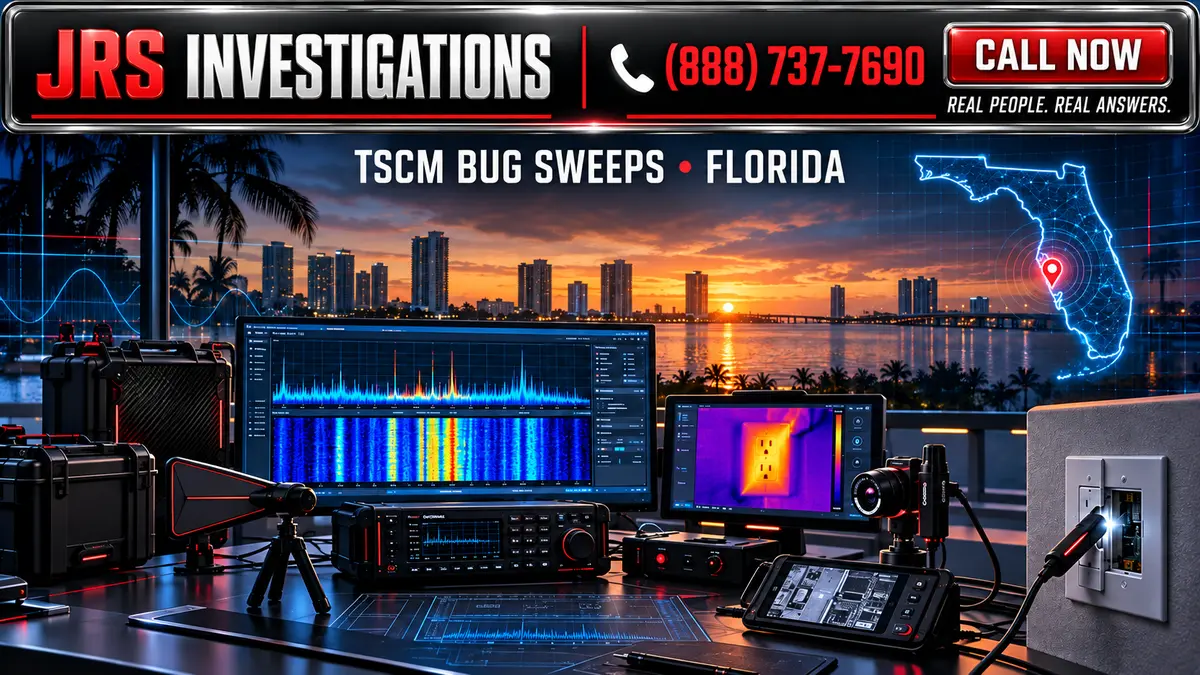
TSCM Bug Sweeps in Florida: A Practical Guide
Privacy concerns can begin with a leaked conversation, an unfamiliar device, unexplained knowledge of private travel, or a change in who has access to an office or home. Professional TSCM bug sweeps in Florida use a structured combination of technical testing and physical inspection to examine authorized locations for signs of covert audio, video, tracking, or transmitting devices.
A credible sweep is not a quick scan with a consumer detector. Florida homes, offices, vehicles, boats, hotels, and conference spaces contain dense mixtures of Wi-Fi, Bluetooth, cellular, security, entertainment, and smart-building signals. Those normal systems must be separated from anomalies through methodical examination and informed interpretation.
JRS Investigations provides professional TSCM bug-detection services throughout Florida. Call (888) 737-7690 for a confidential consultation.
What TSCM Means
TSCM stands for Technical Surveillance Countermeasures. The work is defensive: define the potential exposure, inspect a lawful and clearly identified scope, evaluate technical and physical evidence, document findings, and recommend practical ways to reduce risk.
No single instrument can locate every possible surveillance device. Some devices transmit continuously, while others send short bursts, activate only when they detect sound or movement, use cellular or Wi-Fi networks, or store information locally. A professional examination therefore uses several complementary methods instead of treating one signal or one tool as conclusive.
When a Florida Bug Sweep May Be Appropriate
Many clients call after circumstances change rather than after a device is discovered. Reasons to consider a professional review may include:
- confidential information reaching someone outside the authorized group;
- sensitive business, legal, financial, or personal discussions requiring additional privacy;
- an unfamiliar charger, adapter, smoke detector, wall plate, clock, camera, or electronic accessory;
- a former employee, contractor, tenant, partner, or household member retaining access;
- concerns about unwanted vehicle tracking or unexplained knowledge of private movements;
- a break-in, renovation, office move, access-control failure, or period of unsupervised access;
- preparation for a confidential meeting, transaction, deposition, or strategy session; or
- a preventive privacy review for an executive office, residence, conference room, or vehicle.
These circumstances are not proof of surveillance. They help identify the locations, time periods, people with access, and types of information that should guide the examination.
Florida Environments That May Require Different Planning
Offices and conference rooms
Corporate spaces often contain audiovisual systems, smart displays, wireless presentation tools, desk phones, access-control hardware, and network equipment. A sweep may prioritize executive offices, boardrooms, legal departments, meeting areas, and objects that were recently installed or serviced.
Residences and home offices
Homes can contain smart speakers, cameras, alarms, chargers, toys, appliances, and connected devices that produce normal signals. The examiner must distinguish ordinary household technology from items that are unexplained, modified, improperly positioned, or inconsistent with the client’s inventory.
Vehicles and boats
Cars, trucks, fleet vehicles, recreational vehicles, and boats may require a separate inspection plan. Factory electronics, telematics, navigation, security systems, and aftermarket accessories can complicate the signal environment. Lawful ownership or authorization must be established before inspection.
Hotels, rentals, and temporary meeting spaces
Temporary locations create additional limits because the client may not control the property or have authority to open fixtures or inspect infrastructure. The scope should be discussed in advance, and property management or legal counsel may need to be involved. A provider should explain what can be examined without damaging property or exceeding the client’s authority.
How a Professional TSCM Sweep Is Conducted
1. Confidential intake and risk assessment
The first step is a focused conversation about what happened, what information may have been exposed, who had access, and when the concern began. The technician may ask about recent visitors, repairs, renovations, new electronics, unusual objects, vehicle access, and changes in business or personal relationships.
This intake helps prioritize the search and determine whether the work should include rooms, vehicles, communications equipment, or multiple locations. It also supports a more accurate schedule and prevents a rushed or incomplete scope.
2. Authorization and legal boundaries
The client must have authority to authorize examination of the property, rooms, devices, or vehicles included in the assignment. Florida law addresses interception of communications, stored communications, and tracking devices in Chapter 934 of the Florida Statutes. The law is fact-specific, and the official statute is not a substitute for advice from qualified Florida counsel.
A defensive TSCM provider should not promise unauthorized access to accounts, interception of private communications, password bypasses, trespass, or illegal signal jamming. The purpose is to inspect authorized areas and report what the evidence supports.
3. Baseline and physical inspection
Before interpreting signals, the examiner should understand the normal environment. Visible electronics, access points, conference equipment, chargers, fixtures, wiring, alarms, and recently added objects may be inventoried. The physical inspection looks for alterations, unexpected components, unusual placement, hidden power sources, and suitable positions for audio or video capture.
4. Radio-frequency analysis
RF spectrum analysis evaluates signals in and around the authorized area. Florida’s urban and coastal environments can contain numerous legitimate transmissions. The examiner correlates signals with known devices, observes how they behave, and investigates anomalies. A signal peak by itself does not prove that a listening device is present.
5. Non-linear junction detection
A non-linear junction detector can help identify electronic components even when a device is not actively transmitting. It can be useful when examining selected fixtures, furnishings, containers, and structural areas. The response still requires trained interpretation and, when appropriate, careful physical confirmation.
6. Thermal and optical examination
Thermal imaging may reveal unexpected heat produced by powered electronics. Optical inspection may help identify a concealed lens or an alteration that is difficult to see under normal lighting. These methods support the broader examination; neither should be presented as a universal standalone solution.
7. Network and communications review
When authorized and included in the scope, selected wireless access points, telephones, conferencing systems, and connected devices may be reviewed for unfamiliar hardware or configuration concerns. TSCM and cybersecurity overlap in places, but they are not identical. A clear report should distinguish physical-surveillance findings from network-security issues that require an IT or cybersecurity specialist.
What Happens If a Suspicious Device Is Found?
Immediate removal is not always the best first step. The item’s location, ownership, safety, evidentiary value, and potential law-enforcement involvement may affect how it should be handled. A professional should document the item and its surroundings, explain the available options, and coordinate with the client and counsel.
A proper report may include photographs, the location and condition of the item, relevant signal observations, areas examined, equipment used, limitations, and recommended next actions. The report should separate confirmed findings from assumptions and should not identify a responsible person without supporting evidence.
How to Prepare for a Florida TSCM Appointment
Preparation protects discretion and makes the inspection more efficient:
- Identify each room, vehicle, boat, device, or building within the authorized scope.
- Create a short timeline of information leaks, access changes, and suspicious events.
- List new electronics, repairs, deliveries, renovations, contractors, and visitors.
- Leave the environment as close to normal as practical unless the examiner advises otherwise.
- Do not confront a suspected person or announce the sweep.
- Preserve suspicious objects in place unless there is an immediate safety concern.
- Arrange lawful access, keys, parking, building permissions, and sufficient uninterrupted time.
- Discuss legal and evidence-handling questions with counsel before the inspection.
Clients interested in camera-specific risks can also read about hidden cameras identified during a Delray Beach TSCM sweep.
What a Bug Sweep Can and Cannot Prove
A professional sweep can document the condition of authorized areas at a particular time, identify devices or anomalies that are present and detectable, and recommend ways to reduce future exposure. It cannot guarantee that surveillance will never occur after the inspection. It also cannot establish who placed a device, why it was installed, or how collected information was used without independent evidence.
For ongoing risk, the response may include periodic sweeps, tighter access control, visitor procedures, equipment inventories, secure meeting practices, and cybersecurity review. The best schedule depends on the client’s threat profile rather than a generic timetable.
Frequently Asked Questions
How long does a Florida TSCM sweep take?
Timing depends on the size and complexity of the property, number of rooms or vehicles, normal electronics, access, and requested documentation. The scope should be assessed before promising a duration.
Should I unplug devices before the technician arrives?
Usually not. Changing the normal environment may remove useful information. Leave equipment in its typical condition and follow the examiner’s preparation instructions.
Can a sweep locate a device that is turned off?
Some dormant or non-transmitting electronics may be found through physical inspection, non-linear junction detection, or other methods. Results depend on the device, concealment, materials, access, and scope. No tool detects every device in every condition.
Can a consumer RF detector replace a professional sweep?
A consumer detector may react to many ordinary signals and may miss devices that are dormant, hardwired, shielded, or storing data locally. Professional work combines instruments, physical inspection, baseline analysis, and documentation.
Do you inspect vehicles?
Vehicle inspections can be discussed during the confidential intake. The client must establish lawful ownership or authority, and the scope should account for factory electronics, aftermarket systems, interior access, and exterior inspection.
Request a Confidential Florida TSCM Consultation
JRS Investigations can help define the potential exposure, authorized areas, appropriate technical methods, and practical scheduling for a Florida assignment. We focus on discreet examinations, clear documentation, and recommendations grounded in the available evidence.
Knowledge is power. Call (888) 737-7690 or contact JRS Investigations to discuss a professional TSCM bug sweep in Florida.