(888) 737-7690

Fort Myers Tracking & Surveillance Risks: 7 Types
If you believe a tracker, hidden camera, listening device, or stalkerware may be connected to abuse or an immediate threat, put personal safety first. Use a device the suspected person cannot access, contact law enforcement when appropriate, and consider speaking with a domestic-violence advocate before removing or disabling anything. Sudden changes can alert the person responsible and may affect evidence.
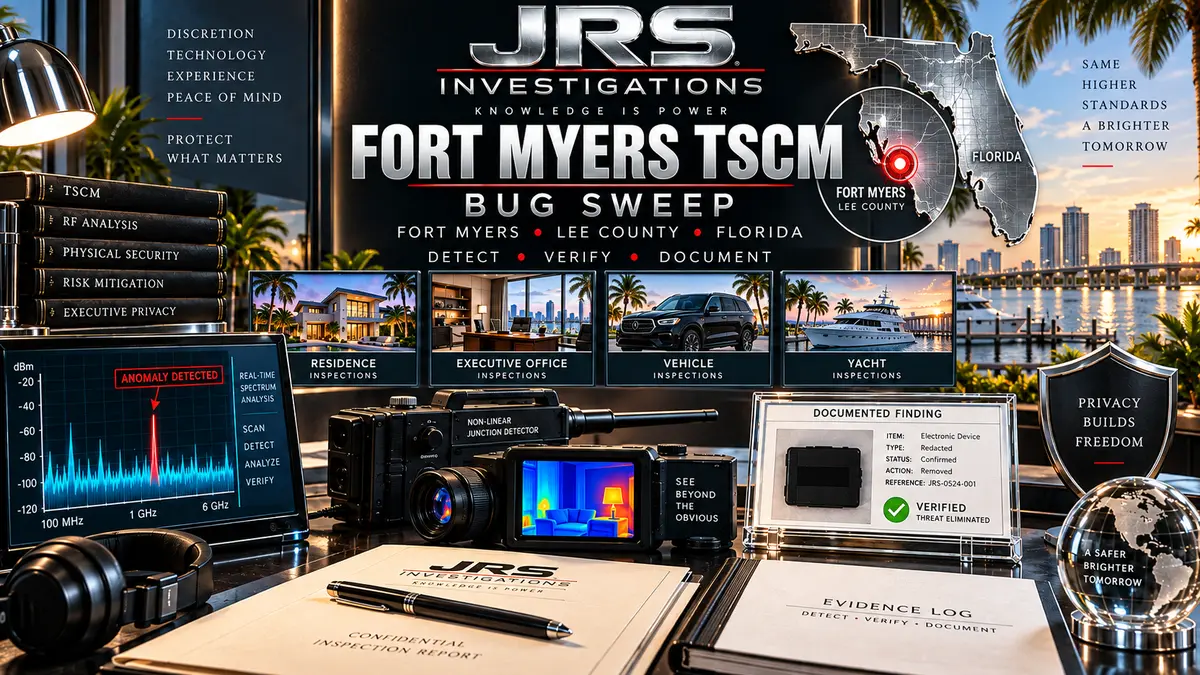
A Fort Myers TSCM bug sweep is a structured technical-surveillance countermeasures inspection of a defined property, room, vehicle, vessel, or working environment. The goal is to identify and document signs of unauthorized tracking, audio capture, video recording, or related technical compromise using lawful, proportionate methods. It is not a promise that every concern will produce a device, and it is not permission to enter property, access accounts, or intercept communications.
Seven surveillance-risk categories relevant in Fort Myers
1. Location-tracking devices and applications
Location exposure may involve a physical tracker, a manufacturer-installed vehicle service, a shared mobile account, an app with location permission, or a family-location service that was never properly revoked. A visual or electronic indication is only the beginning; ownership, consent, account access, and the surrounding facts determine whether the activity is authorized.
Florida Statutes section 934.425 generally prohibits knowingly placing or using a tracking device or tracking application to determine another person’s location or movement without consent, subject to listed exceptions. The statute also addresses revocation of consent and specific circumstances involving vehicles, businesses, caregivers, court orders, and parents. An attorney should interpret how the current law applies to a particular dispute.
2. Unauthorized audio capture
An audio concern might involve a transmitting device, a self-contained recorder, a compromised conference system, or an ordinary smart device with an account or configuration problem. Professional inspection must distinguish an actual surveillance threat from legitimate wireless equipment, electrical noise, nearby transmitters, and consumer electronics.
Florida’s interception law is detailed and fact-specific. Section 934.03 prohibits specified interception, use, and disclosure of wire, oral, or electronic communications except where the statute provides otherwise. JRS does not advise clients to record, intercept, monitor, or disclose communications unlawfully.
3. Hidden or misused video systems
A camera may be purpose-built, part of a legitimate security system, or embedded in a connected device. The legal and practical analysis depends on placement, control, notice, consent, access, and the reasonable expectation of privacy in the location. The presence of a lens-like opening alone does not prove that recording occurred.
Florida’s digital-voyeurism statute addresses specified viewing, recording, broadcasting, and related conduct involving a reasonable expectation of privacy. Potential evidence should be handled carefully and referred to counsel or law enforcement when the facts suggest criminal conduct.
4. Phone stalkerware and account-based monitoring
Not every tracking concern is caused by hardware. Account sharing, cloud synchronization, device-management profiles, forwarding rules, reused passwords, recovery-email access, and stalkerware can expose location or communications. A physical TSCM inspection and a digital-security assessment are related but different scopes; neither should be represented as a substitute for the other.
The Federal Trade Commission’s stalkerware safety guidance explains that secretly installed software may reveal location, messages, browsing, photographs, or microphone activity. It also warns that searching for help or removing software can alert an abusive person. Preserve safety and evidence before resetting a device.
5. Networked, smart-home, and internet-connected devices
Homes, offices, vacation properties, boats, and rental units increasingly use cameras, speakers, access controls, thermostats, hubs, and wireless networks. A legitimate device with an old administrator account or weak access control can create a privacy problem without any hidden transmitter. The engagement should establish who owns the system, who is authorized to administer it, and whether the client has lawful authority to inspect it.
A TSCM sweep may identify indicators that justify a separate network or digital-forensics review. JRS does not hack accounts, defeat passwords, or access provider records without lawful authority.
6. Vehicle and vessel concerns
Fort Myers and the surrounding Lee County area include extensive vehicle travel, marinas, waterfront property, and seasonal occupancy. A concern involving a car, truck, recreational vehicle, or vessel may cross physical, account-based, and manufacturer-connected systems. The owner or other authorized person should establish lawful control of the vehicle or vessel before an inspection begins.
Safe handling matters. Do not crawl under a vehicle in traffic, dismantle safety systems, disconnect unknown wiring, or discard a suspected device. If an object appears hazardous, connected to a criminal threat, or important to an active case, stop and contact law enforcement.
7. Nontechnical explanations and false positives
A professional sweep must also test the possibility that there is no surveillance device. Radio-frequency activity may come from authorized Wi-Fi, Bluetooth, cellular, broadcast, alarm, medical, or building systems. A changed screw, unfamiliar cable, battery drain, or dropped call is not proof by itself.
The value of a disciplined inspection is its ability to document what was examined, distinguish expected signals from anomalies, identify limitations, and recommend a proportionate next step. It should reduce speculation rather than intensify it.
How a professional TSCM inspection works
1. Confidential intake and authority check
JRS begins by defining the client, location, ownership or occupancy rights, people with authorized access, urgency, known incidents, and the specific decisions the client needs to make. A sweep should never be used to facilitate stalking, retaliation, unauthorized entry, or monitoring of another person.
2. Threat and environment assessment
A residence, executive office, meeting room, vehicle, vessel, and short-term rental have different normal equipment and access patterns. The assessment considers who had access, when the concern began, what information appears compromised, what systems are legitimately installed, and whether law enforcement or counsel is already involved.
3. Baseline documentation
Before technical examination, the investigator documents the authorized inspection area, known equipment, observed condition, client-reported indicators, and scope exclusions. This creates a reference for findings and helps prevent ordinary devices from being mischaracterized.
4. Layered technical and physical examination
A professional engagement uses more than a consumer phone app or a single detector. The methods are selected for the environment and may include physical inspection, radio-frequency analysis, examination for nontransmitting electronics, and review of authorized systems. JRS does not publish a universal tool list or step-by-step search pattern because every environment differs and misuse could help someone evade detection.
5. Anomaly validation
An unusual signal or object must be checked before it is labeled a threat. Validation may involve comparing the observation with known equipment, repeating measurements, documenting location and condition, and determining whether the item has a legitimate purpose. Some questions require a specialist in digital forensics, network security, automotive systems, or law.
6. Evidence-conscious response
If a suspected device is found, the safest next step depends on danger, ownership, legal strategy, and law-enforcement involvement. Photographing and documenting the item may be more appropriate than immediate removal. JRS does not promise forensic attribution from the device alone and does not confront a suspected installer.
7. Findings report and remediation priorities
The client receives a clear account of the scope, methods at an appropriate level, observations, confirmed findings, limitations, and recommended priorities. Recommendations may include securing accounts, changing authorized access, repairing a legitimate system, consulting counsel, obtaining digital-forensics support, contacting law enforcement, or scheduling a follow-up inspection after a move, dispute, or sensitive meeting.
Fort Myers settings that may justify a sweep
- Residences and condominiums: privacy concerns after a separation, change in household access, contractor visit, or discovery of unfamiliar equipment.
- Executive offices and meeting rooms: confidential negotiations, trade information, personnel matters, litigation strategy, or unexplained disclosure of private discussions.
- Vehicles and vessels: credible location-tracking concerns involving an owner-authorized car, fleet vehicle, recreational vehicle, yacht, or workboat.
- Vacation and seasonal properties: changes in occupants, vendors, property-management access, or connected-device administration.
- Hotels and temporary venues: sensitive meetings held in spaces the client does not control continuously.
- Professional and healthcare environments: privacy concerns that require coordination with internal security, counsel, compliance personnel, or law enforcement.
For related local support, review the Fort Myers private investigator page and JRS’s broader TSCM bug-detection sweep service. The separate Fort Myers TSCM practical guide explains when a full professional inspection may be appropriate.
What to do before the inspection
- Do not announce the planned sweep to people who do not need to know.
- Write down specific incidents, dates, places, and the information believed to be compromised.
- Preserve suspicious messages, photographs, account alerts, and original files.
- Identify legitimate Wi-Fi, security, audiovisual, access-control, and smart-device systems.
- Gather proof that the client owns, leases, manages, or otherwise has authority over the inspection area.
- Avoid factory resets, device destruction, broad rewiring, or disposal of a suspected item before receiving safety and evidence guidance.
- Use a separate trusted device to seek help if stalkerware or domestic abuse is possible.
What a sweep can and cannot establish
A well-scoped inspection can document the environment at a particular time, identify certain devices or anomalies, verify legitimate equipment, and create a defensible record of observations. It cannot prove that no device ever existed, identify every past interception, compel records from a provider, search property outside the authorized scope, or guarantee who installed an item.
Likewise, an investigator cannot make legal conclusions reserved for counsel or exercise law-enforcement powers. Florida private-investigation activity is regulated under Chapter 493. Clients should confirm licensing, scope, confidentiality, deliverables, and fees before work begins.
Frequently asked questions
Can a phone app perform the same work as a TSCM sweep?
No single app can reliably evaluate every physical, radio-frequency, network, vehicle, and account-based concern. Apps may produce false positives and can miss nontransmitting devices. A professional inspection uses a defined scope and multiple forms of verification.
Should I remove a suspected tracker or camera?
Not automatically. Consider immediate safety, evidence preservation, property ownership, and whether law enforcement or an attorney is involved. Do not handle anything that appears hazardous, and do not dismantle systems you are not authorized to inspect.
Does a detected radio signal prove someone is spying?
No. Homes, offices, vehicles, marinas, and nearby properties contain many lawful transmitters. The signal must be identified and evaluated in context before it can support a conclusion.
Can JRS inspect my spouse’s home, phone, or vehicle?
Only when the client has lawful authority for the specific property or device and the work is legal. Marriage, suspicion, or a financial interest does not create unlimited consent. JRS will not trespass, hack, impersonate, or install surveillance for an unlawful purpose.
How often should a business schedule a sweep?
There is no universal calendar. Risk-based timing may follow an access change, executive dispute, major transaction, litigation event, unexplained disclosure, office move, or high-sensitivity meeting. The intake determines whether a sweep, security review, or another service is appropriate.
Request a confidential Fort Myers consultation
JRS Investigations can evaluate a lawful residential, commercial, vehicle, or vessel concern and define the appropriate technical and investigative scope. Explore all investigation services, learn about related background research and surveillance services, or contact JRS Investigations. Call 1-888-737-7690.