(888) 737-7690
Daytona Beach Workers’ Compensation Investigator: 7 Uses
A workers’ compensation investigation should answer defined factual questions. It should not begin with an assumption that an injured worker, employer, provider or witness is dishonest. In Daytona Beach and throughout Volusia County, a licensed private investigator may assist an insurer, self-insured employer, claims professional, defense counsel or claimant’s counsel by documenting scenes, locating witnesses, researching lawful records and recording observable activity within a written scope.
The investigator does not decide medical restrictions, compensability, benefit entitlement or fraud. Those decisions belong to authorized claims professionals, medical providers, counsel, judges and public agencies. JRS Investigations focuses on objective documentation that can be evaluated alongside the rest of the claim file.
Clients can review JRS private investigation services and our Daytona Beach private investigator page before requesting a case review.
When a workers’ compensation investigation may be appropriate
An investigation may be useful when a material fact cannot be resolved from the existing record. Examples include a disputed accident location, missing or reluctant witnesses, unclear site conditions, inconsistent dates, a question about outside employment, a need to identify available public video, or a request for limited public-place surveillance authorized by the client and counsel.
A broad request to “prove fraud” is not a sound scope. A better assignment identifies the question, the relevant period, available records, lawful methods, budget and reporting standard. That approach protects all parties from overreach and helps the investigator gather information that is actually useful.
7 ways a Daytona Beach workers’ compensation investigator can help
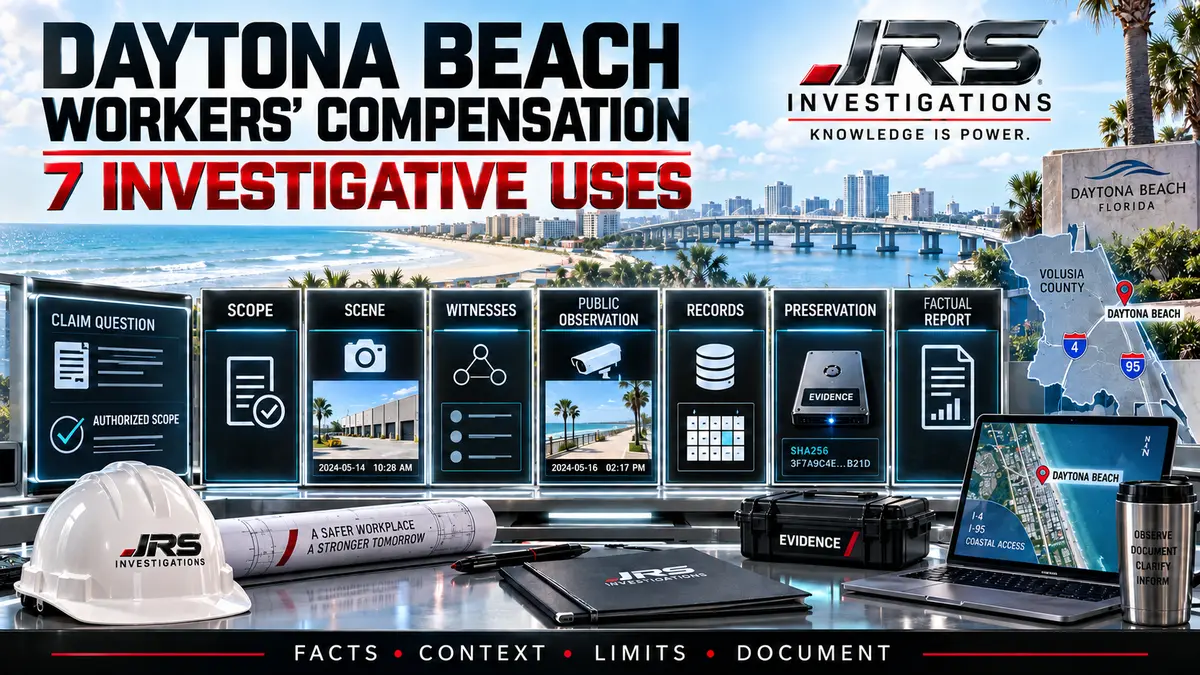
1. Define the assignment and preserve neutrality
The intake should identify who is retaining the investigator, the client’s authority, the claim question and the intended use of the work. The investigator should know the reported incident date, work location, job duties, alleged mechanism of injury, relevant restrictions and important deadlines without treating allegations as established facts.
A staged plan may begin with records and witness development before any surveillance. Scope changes should require client approval. The report should use neutral language and identify both corroborating and conflicting information.
2. Document the worksite or incident location
Site documentation can preserve conditions that may change. Depending on access and authority, an investigator may photograph public or authorized areas, map sight lines, note lighting and weather, identify entrances, measure relevant distances and document equipment or signage. The goal is to record the scene, not reconstruct technical causation beyond the investigator’s qualifications.
Daytona Beach assignments may involve hotels, restaurants, construction sites, retail locations, warehouses, health-care settings, event venues, beachside properties or roadways connected to Interstate 4 and Interstate 95. Tourism, event schedules, temporary staffing, weather and frequent property turnover can affect access and witness availability.
3. Locate and interview relevant witnesses
Early witness work can preserve memories and identify additional records. Interviews should focus on firsthand observations: what the witness saw, heard or did; where the witness was positioned; when the event occurred; and whether photographs, messages, schedules or reports exist.
An investigator should not pressure a witness, misstate authority or discourage legal representation. Family members, neighbors and unrelated personal contacts should not be approached simply because they know the claimant. Outreach must have a legitimate connection to the defined question and comply with instructions from counsel.
4. Conduct proportionate public-place surveillance
Surveillance may document observable conduct during a limited period when the client has a lawful purpose. It should be targeted to the assignment, performed from lawful vantage points and reported without exaggeration. A short video clip does not establish a medical conclusion or prove that someone can perform an activity repeatedly, safely or without later symptoms.
Investigators should avoid trespass, protected private areas, harassment and intrusive recording. Florida’s digital-voyeurism statute illustrates why location, privacy expectations and method matter. Counsel should address any case-specific legal question.
5. Research employment, businesses and public records
Lawful research may help test a specific claim about employment, business ownership, professional licensing, property, litigation or a relevant prior incident. The search must use sufficient identifiers and should disclose uncertainty. A name match alone is not proof that a record belongs to the subject.
A prior claim, lawsuit, criminal matter or business connection is not automatically material to a current workers’ compensation case. The investigator should explain why a record is relevant and avoid compiling personal information that does not serve the authorized objective. JRS provides separately scoped background-check services when a permissible purpose and appropriate identifiers exist.
6. Identify and preserve available records
Potential records may include incident reports, work schedules, training logs, access records, delivery records, public posts, job advertisements, business filings, photographs and available third-party video. Some records are routinely overwritten, so timely preservation requests through counsel or the authorized party may matter.
Investigators do not bypass account settings or enter private social-media accounts under false pretenses. Public content must still be captured with the source, date, URL and surrounding context. A single post can be ambiguous and should not be treated as a medical assessment.
7. Deliver a factual report and evidence log
The report should state the assignment, dates, locations, methods, observations, sources, media references and limitations. It should distinguish direct observation from information supplied by others. Photographs and video should be preserved in their original form with a clear record of handling.
A professional report can assist claim evaluation or counsel, but no investigator can guarantee admissibility, a fraud finding, benefit denial or a litigation result. The decision-maker must assess the investigation together with medical, employment, policy and legal evidence.
A practical investigation workflow
- Confirm authority. Identify the retaining party, counsel, claim number and permitted purpose.
- Frame the question. State the fact to be tested and the relevant time period.
- Review source material. Examine only the records necessary to understand the assignment.
- Select proportionate methods. Choose scene work, witness development, records research or limited surveillance based on the question.
- Preserve original material. Record dates, sources, file names and transfer history.
- Corroborate. Compare observations with independent records and identify uncertainty.
- Report neutrally. Present facts, context, limitations and follow-up options without deciding the claim.
Daytona Beach and Volusia County planning factors
Local planning affects efficiency. Beachside and mainland routes can change with bridge traffic, special events, weather and construction. Large events may alter parking, access, crowd density and travel time. Hotels, condominiums, gated communities, medical facilities and employer worksites may have their own access rules. An investigator should not enter controlled property without authorization.
Assignments extending to DeLand, Ormond Beach, Port Orange, New Smyrna Beach or other Volusia County locations should account for realistic travel windows and whether a witness or record is tied to the correct jurisdiction. JRS coverage is summarized on our areas served page.
Florida workers’ compensation and licensing context
Florida’s workers’ compensation system is governed primarily by Chapter 440. Section 440.105 addresses prohibited conduct involving false, fraudulent or misleading statements connected to benefits and payments. The statute applies to conduct by multiple participants in the system; an investigator should not assume wrongdoing by one side.
The Florida Division of Workers’ Compensation provides resources for injured workers, employers, carriers and providers. Suspected criminal violations may be reported to the state’s Bureau of Workers’ Compensation Fraud. A private investigator gathers information for an authorized client; the investigator does not replace the Division or a law-enforcement agency.
Private-investigation work is regulated under Florida Chapter 493. Clients can verify licensing through the Florida Department of Agriculture and Consumer Services portal. This page provides general information, not legal advice.
Work for different parties in a claim
Insurers, self-insured employers and defense counsel may request scene documentation, witness development, public-record research or limited surveillance to clarify a specific inconsistency. The assignment should not direct the investigator to manufacture contradiction or ignore corroborating facts.
Claimants and claimant’s counsel may use investigators to locate witnesses, document the scene, identify available video, preserve records or test an employer’s factual account. The same standards of authority, neutrality and evidence handling apply.
Employers should coordinate through the appropriate claims or legal channel. Independent activity outside the claim process can create duplication, privacy problems or inconsistent instructions.
Information to provide at intake
- claim number, represented parties and counsel contacts;
- reported incident date, location and job duties;
- the exact factual question to be addressed;
- relevant deadlines and approved geographic area;
- known witnesses and prior contact attempts;
- available incident reports, photographs, schedules and video;
- authorized budget, reporting cadence and approval contact; and
- instructions for urgent safety, legal or evidentiary issues.
Questions to ask the investigator
- Who will manage and perform the assignment?
- What Florida licenses apply?
- How will the scope and exclusions be documented?
- What methods are proportionate to the question?
- How will you avoid trespass, harassment and private-area recording?
- How will you preserve original media and source information?
- How will observations be separated from inference?
- What is included in the fee, and who approves additional work?
- What limitations will appear in the report?
For broader hiring guidance, review 17 questions to ask a private investigator. JRS also maintains a related guide to workers’ compensation investigations in St. Augustine.
Frequently asked questions
Does activity on video prove workers’ compensation fraud?
No. Video documents observable activity during a limited time. Medical significance, work capacity, credibility and fraud require evaluation by the appropriate professionals and decision-makers.
Can an investigator enter private property?
Not without lawful authority. Surveillance and scene work should use lawful access and vantage points and respect areas where privacy is expected.
Can private social-media content be accessed?
An investigator should not hack accounts, use stolen credentials or create deceptive access. Public content may be documented when relevant, with context and source information.
Will the investigator testify?
An investigator may be asked to authenticate work or describe observations, subject to qualifications, procedure and counsel’s direction. Testimony and expert status should never be promised automatically.
Can JRS decide whether a claim is legitimate?
No. JRS can investigate defined facts and report findings. The authorized claims and legal decision-makers evaluate the claim.
Request a Daytona Beach case review
To discuss a lawful, proportionate assignment, contact JRS Investigations with the claim question, relevant dates, locations, available records and reporting deadline. JRS will help define a first phase without presuming fraud or a particular outcome.