(888) 737-7690

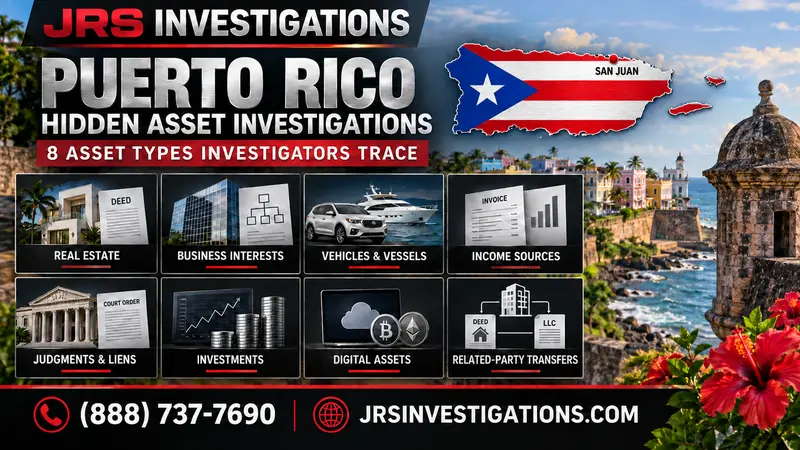
8 Types of Hidden Assets Investigators Search for in Puerto Rico
Assets are rarely “hidden” in only one place. A person or company may hold value through real estate, business interests, vehicles, legal claims, related entities or transfers that are not obvious from a basic name search. A professional Puerto Rico hidden asset investigation organizes lawful records and ownership connections to identify leads that can be verified and used responsibly.
JRS Investigations assists attorneys, judgment creditors, businesses, families and individuals with asset-related research in Puerto Rico and across the Caribbean. Every case begins with a legitimate purpose, a defined scope and an understanding of what information is public, what requires consent and what can be obtained only through counsel or formal legal process.
Important limitation: Private investigators do not have unrestricted access to private bank balances, account transactions, consumer credit reports, tax returns or brokerage statements. Those records generally require the subject’s authorization, a court order, a subpoena or another lawful basis. JRS does not use pretexting, hacking or unauthorized account access.
8 types of hidden assets investigators may search for in Puerto Rico
1. Real estate and land interests
Real property can represent a substantial portion of a person’s or company’s value. An investigation may look for homes, rental properties, vacant land, commercial buildings, development interests and parcels connected through a business entity or close associate. Ownership records, tax information, recorded liens and transaction history can help establish how a property is held and when it changed hands.
The Puerto Rico Digital Cadastre, maintained through the Centro de Recaudación de Ingresos Municipales, provides parcel and mapping information that can assist with property research. A cadastral result is a lead, not a complete title opinion. Formal ownership, encumbrance and priority questions should be confirmed through the appropriate registry, certified records and legal counsel.
2. Corporations, LLCs and other business interests
Value may be held through a corporation, limited liability company, partnership or other legal entity. Business records can reveal entity names, registration numbers, status, resident agents, officers, addresses and links to additional entities. Investigators compare those details with known addresses, transactions, court filings and other records to determine whether a business connection deserves closer review.
The Puerto Rico Department of State Corporations Registry maintains the public registry of legal entities organized in Puerto Rico or authorized to do business there. Registry documents can help verify an entity’s existence and public filing history, but they do not automatically reveal every beneficial owner, asset or private agreement.
JRS provides broader hidden asset investigation services when ownership structures extend beyond one person or one jurisdiction.
3. Vehicles, boats and aircraft interests
Cars, commercial vehicles, recreational vehicles, boats and aircraft may have significant value or may point to additional addresses, businesses and financing relationships. The availability of registration, title, lien and ownership information depends on the asset type, jurisdiction and requester’s legal authority.
An investigator may begin with observations, public filings, litigation exhibits, insurance-related records supplied by the client or other lawful sources. A vehicle seen at a property is not necessarily owned by the subject, so important findings should be corroborated before they are reported as assets.
4. Income sources and business receivables
Employment, professional work, rental income, contract payments and business receivables can be relevant in support, judgment and fraud matters. Public business records, professional licenses, court filings, property ownership, advertising, contracts provided by the client and documented commercial activity may indicate possible income sources.
These indicators are not a substitute for payroll records, tax returns or bank statements. When exact income, balances or payment flows are required, an attorney may need to use subpoenas, discovery or court-authorized financial examination. JRS can help organize the known entities, addresses and leads so legal requests are more focused.
5. Judgments, liens and legal claims
A party may hold value through a judgment, settlement right, secured claim, lawsuit, bankruptcy distribution or other legal interest. Conversely, liens and judgments against an asset may substantially reduce its available equity. Court-record research helps place both sides of that equation in context.
PACER’s District of Puerto Rico court page provides access information for federal court records, while bankruptcy matters are handled through the federal bankruptcy court. Local and Commonwealth records may require separate searches. A case filing alone does not establish that a claim has value or that money was collected; the docket, disposition and current status must be reviewed.
For enforceable judgments, our judgment recovery investigations page explains related research and recovery support.
6. Securities, investment and ownership interests
Shares in public or private companies, investment partnerships, profit-sharing rights and membership interests can carry value even when they are not listed in the subject’s personal name. Public company disclosures, business filings, litigation, financing documents and records supplied through discovery may identify a potential interest.
Private brokerage holdings and account balances are protected information. Investigators can document public connections and inconsistencies, but they cannot lawfully pull a person’s investment statement without authorization or valid legal process. A qualified financial professional may also be needed to value a verified interest.
7. Intellectual property and digital business assets
Trademarks, copyrights, domain names, online businesses, subscription revenue, licensing rights and monetized digital accounts may have economic value. An investigation can examine public registrations, business websites, marketplace activity, advertising, terms of service and documented payment relationships provided by the client.
Ownership of a website or social account should not be assumed from public appearance alone. Domains may use privacy services, companies may manage accounts for clients and digital platforms may restrict disclosure. JRS documents the evidence supporting each connection and identifies what would require platform cooperation or legal process.
8. Transfers to relatives, associates or related entities
Assets may be transferred, retitled or placed in an entity associated with a relative, business partner or nominee. Timing can be significant, particularly when a transfer occurs near a lawsuit, divorce, support dispute, debt collection effort or anticipated judgment. Investigators may compare deeds, entity filings, addresses, signatures, sale information and relationships to identify patterns for counsel to evaluate.
A relationship or shared address is not proof of concealment or fraud. The investigation should report objective connections and transaction history without labeling a transfer improper unless the evidence and applicable law support that conclusion.
Common reasons for a Puerto Rico asset investigation
Asset research may assist with several legitimate matters:
- Divorce, alimony or child-support proceedings handled through counsel
- Judgment enforcement and post-judgment discovery
- Business fraud, embezzlement or partnership disputes
- Estate, probate and disputes involving heirs
- Pre-litigation evaluation and settlement planning
- Corporate due diligence before a transaction or investment
- Locating property connected to a debtor or responsible entity
The objective should be clear before the search begins. A pre-litigation collectability review is different from court-authorized discovery, and an estate matter requires different documentation than a business due-diligence assignment.
How investigators develop and verify asset leads
A productive investigation usually connects several sources rather than relying on one database. Work may include:
- Confirming names, aliases, dates and address history
- Reviewing real-property, tax and recorded-document leads
- Searching corporations, LLCs and associated business addresses
- Examining civil, federal and bankruptcy court records
- Checking public professional licenses and commercial activity
- Comparing ownership changes with the timeline of the dispute
- Documenting the source, date and limitation of each finding
JRS may coordinate with the client’s attorney, forensic accountant or other qualified professional when the case requires subpoenas, valuation, tracing of produced financial records or courtroom presentation. Our international asset investigations page covers matters that extend beyond Puerto Rico.
What an asset investigation cannot guarantee
No ethical investigator can guarantee that every asset will be identified or recovered. Public records may be delayed, names may be inconsistent, private holdings may require discovery and an identified asset may be exempt, encumbered or outside the court’s jurisdiction. Locating a possible asset is also different from proving ownership, establishing value and enforcing a claim against it.
JRS will not obtain private bank records through deception, access accounts without authorization, misrepresent legal authority, trespass or claim that a public-record lead is conclusive when it is not. The final report distinguishes confirmed information from investigative leads and explains material limitations.
Information to prepare before the search
Clients can help focus the work by providing:
- The subject’s full legal name, aliases and known entity names
- Known addresses, telephone numbers and email domains
- The reason for the investigation and the intended lawful use
- Relevant court case numbers, judgments, contracts or settlement documents
- Known relatives, partners, companies and business associates
- Previous property, vehicle or financial information already obtained lawfully
- The geographic scope and deadline
- Contact information for counsel when litigation or discovery is involved
Do not send Social Security numbers, account credentials or sensitive financial documents by ordinary email before discussing a secure delivery method.
Puerto Rico and Caribbean investigative coverage
Puerto Rico matters may involve San Juan, Bayamón, Carolina, Ponce, Mayagüez, Arecibo and municipalities throughout the island. Ownership connections can also extend to the mainland United States or other Caribbean jurisdictions. Visit our Puerto Rico private investigator page for local services and our guide to hiring a private investigator in Puerto Rico for additional planning information.
You can also review JRS investigation services to see how asset research may connect with fraud, litigation support, background work or judgment recovery.
Request a confidential asset-search consultation
For a lawful Puerto Rico hidden asset investigation, call JRS Investigations toll-free at (888) 737-7690. You may also use our contact page to request a confidential consultation.
Explain the legal objective, the parties involved and the information already available. JRS will outline a practical scope, identify the records that may be searched and explain which information would require attorney-directed legal process.