(888) 737-7690

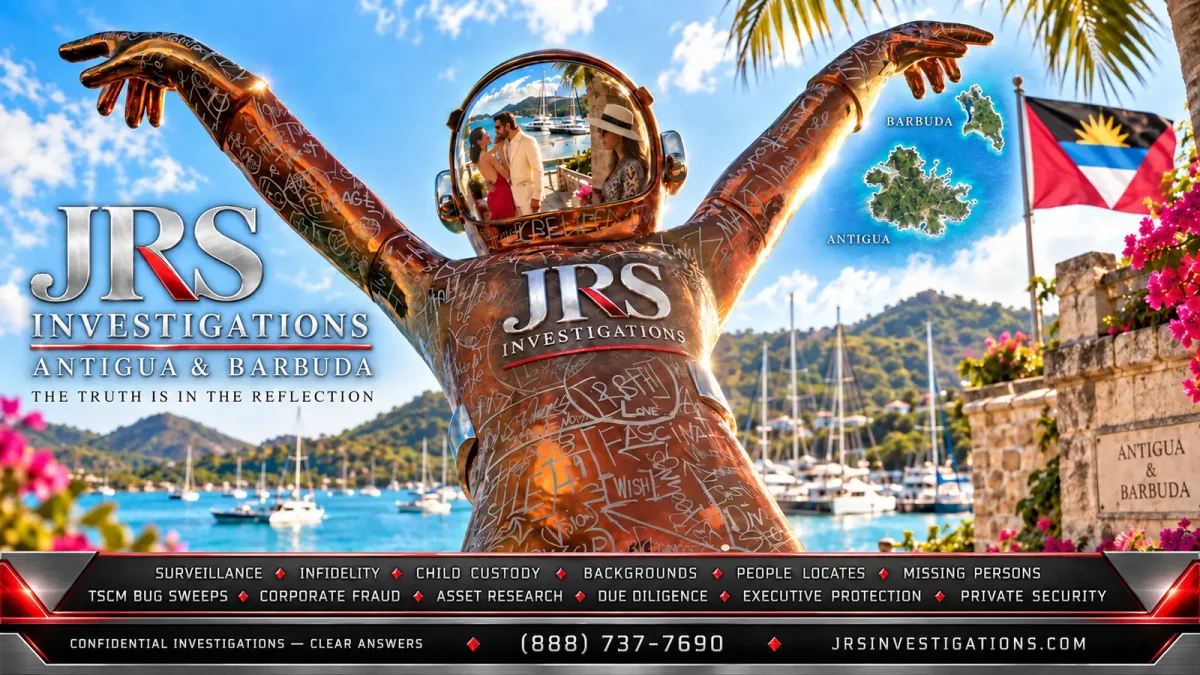
Why Choose JRS Investigations in Antigua and Barbuda? 4 Reasons
Choosing a private investigator in Antigua and Barbuda should begin with a clear objective, a lawful plan, and realistic expectations. An investigation may involve surveillance, a person locate, background research, due diligence, child-welfare documentation, corporate fact-finding, Technical Surveillance Countermeasures, or protective-support planning. The correct method depends on the question you need answered and how the findings will be used.
JRS Investigations manages discreet assignments for individuals, attorneys, businesses, insurers, and other authorized clients. Our approach is built around careful intake, defined priorities, documented work, and professional reporting. Clients can review our broader Antigua and Barbuda private investigator services before arranging a confidential consultation.
Four reasons clients choose JRS Investigations
1. Every investigation starts with a case-specific plan
No two assignments have the same people, locations, risks, deadlines, or evidence needs. A surveillance matter involving a resort is different from a corporate due-diligence assignment, a background inquiry, or a TSCM inspection of a residence. JRS begins by identifying the decision the client must make, the facts already known, the missing information, and the lawful methods most likely to produce useful results.
This planning protects the budget. It also prevents a case from becoming an unfocused search for “anything suspicious.” The initial scope may prioritize a particular date, property, meeting, vehicle, business relationship, or subject. If new facts change the direction, JRS explains the options before materially expanding the assignment.
2. Island logistics are treated as part of the investigation
Antigua and Barbuda is a two-island nation, but an assignment may involve very different environments. Antigua includes St. John’s, V.C. Bird International Airport, English Harbour, Jolly Harbour, Dickenson Bay, marinas, gated residences, hotels, and busy tourism corridors. Barbuda has a smaller population, different transport considerations, and fewer practical observation points. Travel time, ferry or air schedules, property access, seasonal tourism, and the visibility of an unfamiliar vehicle can all affect planning.
Good fieldwork accounts for those realities before surveillance begins. The objective is to document relevant activity without creating unnecessary exposure or promising coverage that the location cannot reasonably support. When an assignment crosses islands or jurisdictions, JRS coordinates the work around lawful authority, travel requirements, and the client’s actual priority.
3. Findings are documented for the intended use
Clients rarely need a pile of disconnected observations. They need an organized record that explains what was requested, what methods were used, what was observed, and what could not be confirmed. Depending on the engagement, the deliverable may include a written chronology, photographs, video, source notes, research results, or a summary of findings and limitations.
JRS separates verified facts from leads and assumptions. Reports are written so the client and, when appropriate, legal counsel can understand the sequence of events. No ethical investigator can guarantee a predetermined result. A professional investigation documents what the evidence supports, even when it does not confirm the original suspicion.
4. Confidentiality and communication remain central
Private matters require controlled communication. During intake, JRS discusses safe contact methods, who is authorized to receive updates, whether litigation is active, and whether the subject may have access to the client’s phone, email, vehicle, or residence. Clients receive practical updates without unnecessary operational detail that could compromise the work.
JRS also explains boundaries. Private investigators are not police officers and do not have unlimited access to private data. We do not trespass, hack accounts, wiretap protected conversations, impersonate law enforcement, or obtain records through false pretenses. Confidentiality does not replace legal compliance; it works alongside it.
Private investigation services in Antigua and Barbuda
Infidelity and relationship investigations
Relationship concerns often involve conflicting travel explanations, undisclosed companions, unexplained overnight activity, or a need to verify whether a subject’s conduct matches what was represented. Lawful surveillance may document public activity, arrivals and departures, meetings, or other relevant conduct. The plan should focus on objective facts rather than confrontation.
Resorts, marinas, beaches, restaurants, rental properties, and airport movements each create different access and visibility conditions. A hotel reservation does not automatically provide an investigator with access to private guest areas, and a subject’s privacy rights still apply. JRS evaluates the location, timing, available identifiers, and safety concerns before recommending fieldwork.
Child-custody and welfare documentation
Custody matters require specific, observable facts. An investigator may document conduct relevant to a court order or a child’s welfare, such as prohibited contact, unsafe supervision, repeated schedule violations, or activities that conflict with sworn representations. JRS does not promise a custody outcome and does not decide what evidence is legally admissible. When litigation is active, the investigative objective should be coordinated with the client’s attorney.
Person locates and field verification
A witness, heir, former employee, debtor, family member, or other subject may be difficult to locate when addresses are outdated or the person moves between islands and countries. Locate work can combine lawful records, address history, business connections, social information, source development, and field verification. The reliability of a result depends on the quality of the starting identifiers and the availability of current information.
Background investigations and due diligence
Background research may help verify identity, residences, business affiliations, litigation, professional claims, corporate records, and other information available for the lawful purpose of the assignment. Employment and tenant screening may be subject to consumer-reporting and consent requirements. The intended use must be disclosed before work begins.
Business clients may need due diligence before a partnership, investment, acquisition, vendor relationship, high-value transaction, or executive engagement. JRS can help identify inconsistencies, undisclosed relationships, litigation indicators, business-history concerns, and issues requiring deeper verification. Learn more about our background investigation services.
Corporate fraud and hidden-asset inquiries
Vendor fraud, false invoices, conflicts of interest, misappropriation, undisclosed businesses, and asset concerns often require several methods rather than one database search. The work may include corporate research, public-record review, associate mapping, site verification, interviews, or coordination with counsel. Private investigators cannot lawfully obtain private bank balances or account transactions without appropriate legal authority.
TSCM bug sweeps and privacy concerns
Suspected hidden cameras, listening devices, or physical tracking may require Technical Surveillance Countermeasures. A professional sweep can include threat assessment, physical inspection, radio-frequency analysis, optical checks, non-linear junction detection, and inspection of authorized rooms, vehicles, or vessels. No single device can detect every possible threat, and a physical sweep is not the same as cybersecurity or digital forensics.
Clients should avoid moving suspected devices or announcing the sweep. Preserve unusual objects, unexplained alerts, access records, and the timeline of confidential information becoming known. JRS provides Caribbean TSCM bug-sweep services for authorized assignments.
Executive protection and security support
Business travel, public appearances, family movements, high-value events, and sensitive meetings may require security planning in addition to investigative support. The scope can include advance work, route and venue review, protective transportation coordination, liaison planning, and appropriately authorized personnel. Review our Antigua and Barbuda executive-protection services for additional information.
What to provide during the first consultation
- The decision you need to make or the question you need answered.
- Accurate names, dates of birth, photographs, addresses, vehicles, businesses, and known associates.
- A concise timeline of relevant events, travel, communications, and deadlines.
- Court orders, contracts, messages, photographs, reports, or other records already in your possession.
- Any safety concern, prior confrontation, active litigation, or reason the subject may expect an investigation.
- The intended use of the findings and the people authorized to receive updates.
Do not access another person’s accounts, install tracking technology, record protected conversations, enter private property without permission, or alter potential evidence. Preserve what you already have and allow the investigator or your attorney to determine the next lawful step.
Questions to ask before hiring an investigator
- Who will manage the case, and what experience applies to this type of assignment?
- What methods are appropriate and lawful for the objective?
- What geographic or access limitations could affect the work?
- How are time, travel, expenses, updates, and scope changes handled?
- What report, photographs, video, or other deliverable will be provided?
- What cannot be promised or legally obtained?
Beware of guaranteed outcomes, claims of access to “any record,” promises to obtain private banking or live phone-location data, or requests to break the law. Professional investigations are defined by a clear purpose, defensible methods, careful documentation, and honest limitations.
Frequently asked questions
Can JRS guarantee proof of infidelity or fraud?
No. JRS can provide a professional investigative process and document what is lawfully observed or verified. No investigator can guarantee that a subject will engage in a particular activity during the authorized period.
Can an investigator work inside a hotel or gated property?
Access depends on the property, the assignment, and applicable rules. Investigators cannot trespass or misrepresent authority to enter restricted areas. Planning may instead use lawful public locations, authorized access, or other fact-finding methods.
Can a private investigator obtain bank statements?
Not without appropriate legal authority or authorization. Investigators may research lawful public records, business interests, property indicators, litigation, and other available sources, but private financial records are protected.
How much does an investigation cost?
Cost depends on the objective, location, travel, urgency, number of investigators, surveillance hours, research fees, equipment, and reporting requirements. JRS defines an initial scope and discusses significant changes before expanding the work.
Will the subject know about the investigation?
Discretion is central to most assignments, but no investigator can promise that a subject will never notice surveillance or contact. A careful plan reduces unnecessary exposure while maintaining safety and legal compliance.
Schedule a confidential Antigua and Barbuda consultation
If a personal, legal, or business decision depends on facts you cannot independently confirm, JRS can help determine whether an investigation is appropriate and what a realistic scope should include. Explore our complete private investigation services or contact us directly.
Call (888) 737-7690 or contact JRS Investigations to discuss your Antigua and Barbuda matter confidentially.