
(888) 737-7690

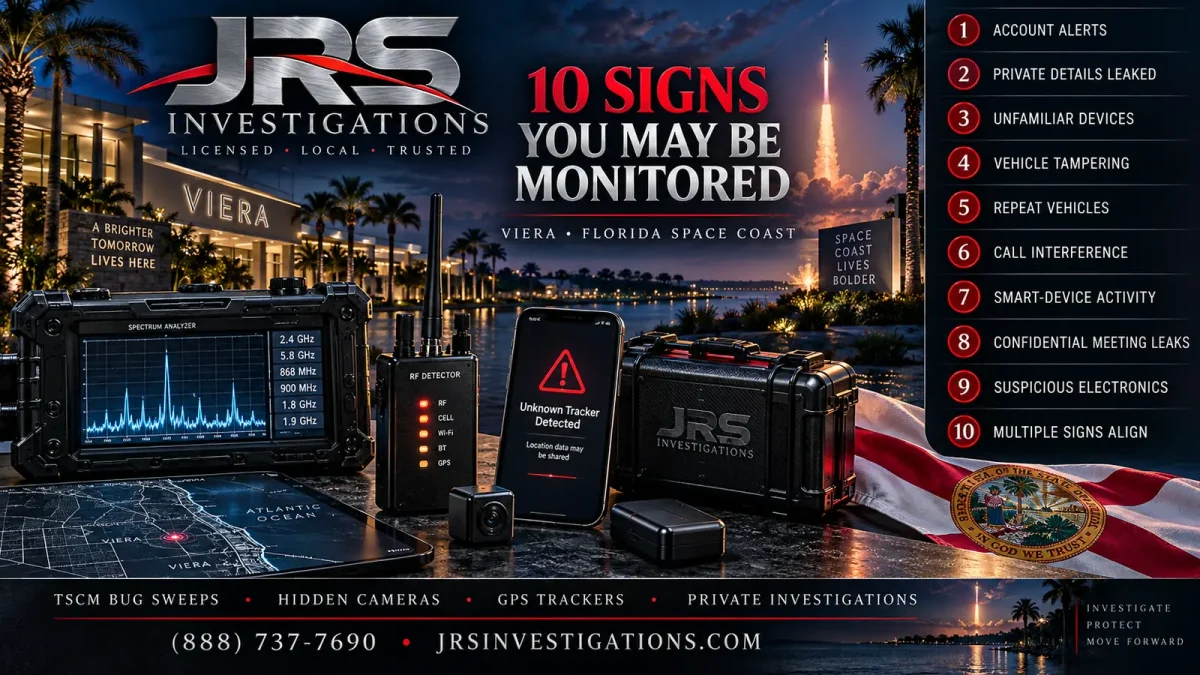
10 Warning Signs You May Be Monitored in Viera, Florida
A strange click on a call, an unfamiliar vehicle near your home, or a phone battery that drains faster than usual can feel alarming. But no single clue proves surveillance. In Viera, Florida, the most useful approach is calm, evidence-led, and proportional: document what you observe, rule out common explanations, and bring in a qualified professional when several credible indicators form a pattern.
JRS Investigations helps individuals, attorneys, executives, and businesses evaluate suspected monitoring through discreet private investigative support and technical surveillance countermeasures. The goal is not to confirm a fear without evidence. It is to separate ordinary technology problems from genuine security concerns and give the client a clear next step.
1. Unexplained changes to phones, laptops, or accounts
Unexpected password resets, unfamiliar login alerts, new administrator profiles, disabled security settings, or applications you do not recognize deserve attention. The same is true when a device repeatedly activates its camera or microphone indicator without an obvious reason.
Many of these events have harmless causes, including software updates, syncing errors, battery degradation, or forgotten account sessions. Start by reviewing account activity, installed applications, device permissions, and recent updates. Preserve screenshots and dates before changing settings. A professional assessment becomes more appropriate when the same unexplained activity appears across several devices or follows a personal, legal, or business conflict.
2. Repeated signs that someone knows private details
A stronger warning sign is when another person repeatedly knows information that was shared only in a private room, confidential call, vehicle, or closed meeting. One coincidence may mean little. A pattern tied to specific locations or conversations is more significant.
What to document
Record exactly what was said, where the conversation occurred, who was present, and when the information later surfaced. Avoid confronting a suspected person or posting allegations online. A clean timeline gives an investigator something objective to evaluate and protects the integrity of any later inquiry.
3. Unfamiliar objects or changes inside a room
Small items that appear without explanation, displaced ceiling tiles, altered outlets, new chargers, unfamiliar USB adapters, or disturbed fixtures may justify a closer look. Modern listening and video devices can be concealed in ordinary consumer products, but ordinary maintenance work can create similar changes.
Do not dismantle or discard a suspicious object. Photograph it in place, limit unnecessary handling, and note who had access to the area. If the object may be relevant evidence, preserving its condition and location matters.
4. A vehicle shows signs of unauthorized access
Loose trim, a disturbed diagnostic port, adhesive residue, unfamiliar wiring, or an object attached beneath a vehicle can raise concern about GPS tracking or audio monitoring. Some legitimate accessories, service work, toll devices, and insurance telematics can look suspicious, so identification should come before conclusions.
Vehicle examinations require the right tools
A professional inspection may combine a physical search with radio-frequency analysis and a review of likely power sources and concealment points. Because some trackers transmit intermittently, a quick visual check alone may not resolve the question.
5. The same person or vehicle appears repeatedly
Seeing the same vehicle once or twice near a home, office, school, courthouse, or restaurant is not proof of surveillance. Repeated appearances at unrelated destinations, however, may be worth documenting—especially when timing and positioning are consistent.
Write down the date, time, public location, vehicle description, and direction of travel. Take photographs only when safe and lawful. Do not follow, approach, block, or challenge anyone. If there is an immediate safety threat, contact law enforcement rather than attempting to investigate it yourself.
6. Calls contain persistent interference or unusual routing
Clicks, echoes, delays, and dropped calls are commonly caused by cellular coverage, Bluetooth devices, Wi-Fi calling, network congestion, or damaged hardware. They are weak indicators by themselves.
Concern becomes more credible when call anomalies occur alongside unauthorized account access, unexplained forwarding settings, suspicious configuration profiles, or private information being repeated elsewhere. A competent review considers the entire pattern instead of treating ordinary audio noise as proof of interception.
7. Smart-home or office devices behave unpredictably
Cameras changing position, unknown users appearing in access logs, microphones activating, locks receiving unexpected commands, or smart speakers responding at odd times may indicate poor configuration or unauthorized access. Shared passwords and old employee accounts are common explanations.
Secure the records before resetting everything
Export logs when possible, photograph device screens, list authorized users, and note the exact time of each event. Immediately resetting every device can erase useful information. If the risk is urgent, disconnect the affected device from the network while preserving it for review.
8. Confidential business information leaks after specific meetings
In a corporate or professional setting, repeated leaks after discussions held in one conference room, office, vehicle, or remote-work space can justify a technical sweep. The issue may be electronic surveillance, but it may also be weak access control, compromised credentials, insider disclosure, or unsecured documents.
A well-scoped TSCM assignment examines the physical environment while coordinating with cybersecurity and internal controls when needed. The objective is to identify the source of exposure, not simply scan a room and declare it clear.
9. Gifts, chargers, power strips, or electronics arrive unexpectedly
Surveillance devices may be concealed inside objects that have power, a useful viewing angle, or a reason to remain in place. Unexpected electronics, promotional devices, chargers, clocks, smoke detectors, or adapters should be treated thoughtfully when their origin cannot be confirmed.
That does not make every unfamiliar device dangerous. Verify ownership, purchasing records, installation history, and serial information. If an item remains suspicious, leave it in place when safe and request professional guidance before opening it.
10. Several weak indicators form one consistent pattern
The most meaningful warning sign is rarely a single noise, battery issue, or parked car. It is the convergence of multiple facts: unauthorized logins, confidential details leaking, unexplained objects, repeated vehicle sightings, and a known motive or opportunity.
A structured review weighs credibility, frequency, access, timing, and alternative explanations. This reduces false alarms while ensuring that legitimate threats receive the right response.
What a professional TSCM bug sweep may include
A technical surveillance countermeasures inspection is a planned examination of a defined location or vehicle. Depending on the circumstances, it may include a detailed physical search, radio-frequency spectrum analysis, inspection for hidden cameras, examination of telephone and network connections, nonlinear junction detection, thermal or optical checks, and review of suspicious devices.
No honest professional should promise that a single tool detects every possible threat. Equipment selection, operator experience, a reliable threat assessment, and proper documentation all matter. The sweep should be scheduled and scoped so that the environment is examined under useful conditions and unnecessary disclosure is minimized.
How to prepare before contacting an investigator
- Create a factual timeline with dates, times, locations, and witnesses.
- Preserve screenshots, alerts, access logs, photographs, and original messages.
- List people who had legitimate access to the property, vehicle, accounts, or devices.
- Avoid discussing the planned inspection in the potentially compromised space.
- Do not destroy, move, or publicly display a suspicious device.
- Identify the rooms, vehicles, devices, and business risks that matter most.
For clients in Viera and Florida’s Space Coast, JRS Investigations can discuss the situation confidentially, define a practical scope, and explain whether investigative work, a TSCM inspection, digital-forensic support, or law-enforcement involvement is the appropriate next step.
Private investigative and TSCM support in Viera
JRS Investigations provides discreet support for suspected surveillance, infidelity and domestic matters, corporate investigations, background research, hidden-asset inquiries, and evidence documentation. Each assignment begins with the client’s objective and a realistic assessment of what can be lawfully and ethically established.
If you believe you may be monitored in Viera, do not rely on internet myths or a consumer “bug detector” alone. Call (888) 737-7690 or contact JRS Investigations to discuss the warning signs, the location, and the most appropriate next step.
Frequently asked questions
Does a fast-draining phone battery mean spyware is installed?
No. Battery age, applications, weak cellular service, updates, and background syncing are common causes. Treat battery drain as one data point, not proof. Review device settings and look for corroborating evidence.
Can I search for a hidden camera or tracker myself?
You can document visible concerns and review authorized account settings, but avoid dismantling suspicious objects or crawling beneath a vehicle in unsafe conditions. Professional inspections use several methods because no single consumer tool finds every device.
How long does a TSCM sweep take?
Timing depends on the size and complexity of the location, the number of rooms or vehicles, the construction, the threat profile, and the documentation requested. A proper scope is established before the inspection.
What should I do if I find a suspected listening device?
Do not destroy or manipulate it. Photograph it in place if safe, limit access, and contact a qualified investigator or law enforcement depending on the immediate risk. Evidence handling can affect what is learned later.
Is every unusual event evidence that I am being watched?
No. Most isolated technical glitches and chance encounters have ordinary explanations. Concern rises when several specific indicators repeat, align with access and motive, and can be documented objectively.