(888) 737-7690

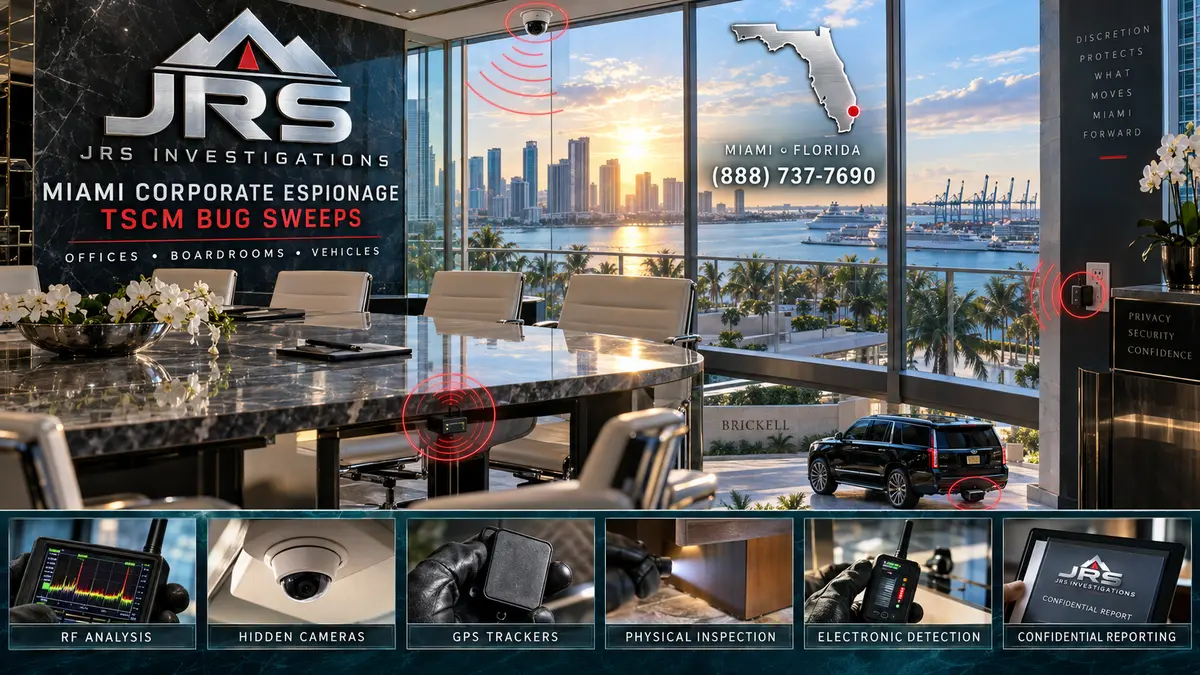
Miami Corporate Espionage TSCM Bug Sweeps
Miami companies move quickly, host confidential meetings, manage international relationships, and often operate across offices, residences, hotels, marinas, airports, and vehicles. When a business has a credible concern about unauthorized listening, covert video, or location tracking, a professional Miami corporate espionage TSCM sweep can help determine what should be inspected, what evidence should be preserved, and where technical or physical security gaps may exist.
Technical Surveillance Countermeasures, commonly called TSCM or a bug sweep, is not a single pass with one detector. A defensible inspection combines advance planning, lawful authorization, physical examination, radio-frequency analysis, electronic detection, and clear reporting. The goal is to evaluate a defined environment methodically without exaggerating what any instrument can prove.
Why Miami businesses request corporate-espionage TSCM sweeps
Miami-Dade is a hub for finance, real estate, hospitality, healthcare, professional services, aviation, logistics, technology, and international trade. Sensitive conversations may occur in Brickell executive suites, Downtown Miami conference rooms, Coral Gables professional offices, Doral industrial and logistics facilities, Miami Beach hotels, private residences, or vehicles traveling between locations. PortMiami also connects Miami with international cargo and passenger operations, adding to the region’s constant movement of people, vendors, and devices.
A company may request a sweep before a merger discussion, executive meeting, legal strategy session, product launch, investor presentation, labor matter, internal investigation, or high-value negotiation. Other assignments begin after confidential information appears outside the expected group, an unfamiliar device is found, a workspace has experienced unauthorized access, or a vehicle’s movements seem known to an outside party.
These circumstances do not automatically prove espionage. They establish a reason to document the concern, define the scope, and evaluate the relevant spaces without destroying possible evidence.
What a professional TSCM inspection can—and cannot—do
A TSCM inspection can identify suspicious radio-frequency activity, concealed electronics, unauthorized cameras, certain tracking devices, physical tampering, and security weaknesses within the agreed scope. Findings may include an actual surveillance device, an ordinary device that was misunderstood, an installation anomaly requiring further review, or no confirmed device at the time of inspection.
No ethical provider should promise that a quick scan will find every possible threat. Some devices transmit intermittently, store data locally, use cellular or Wi-Fi connections, remain dormant, or resemble ordinary electronics. Building systems, neighboring offices, access points, Bluetooth devices, wireless presentation equipment, smart televisions, and legitimate security equipment can also create signals that require careful interpretation.
TSCM is also different from cybersecurity incident response. A sweep may identify network-connected equipment or a suspicious access point, but compromised email, cloud accounts, malware, unauthorized account access, and mobile-device intrusion may require a separate qualified cybersecurity or digital-forensics examination.
Miami environments commonly included in the scope
Executive offices and boardrooms
Executive suites, boardrooms, legal conference rooms, finance departments, and shared meeting areas deserve careful attention because confidential discussions and documents concentrate there. An inspection may examine furniture, fixtures, power sources, electronics, ceiling areas, wall penetrations, communications equipment, and items recently introduced into the room.
Temporary and off-site meeting locations
Miami businesses frequently use hotels, private clubs, rented conference rooms, coworking spaces, yachts, and temporary project offices. These environments may have limited access windows and equipment controlled by third parties. Planning should identify when the space becomes available, who can authorize the inspection, what can be moved, and whether the room can remain controlled after the sweep.
Residences and home offices
A corporate concern may extend to an executive’s condominium, waterfront residence, or home office when sensitive business discussions occur there. The scope should separate company-authorized areas from private spaces and clearly identify who owns or controls the property.
Company and executive vehicles
Vehicles may be evaluated for unauthorized GPS trackers, recording equipment, concealed cameras, or unexplained modifications. A proper vehicle inspection requires lawful authority from the owner or authorized controller, safe access to the vehicle, and enough time to examine exterior, interior, power, and storage areas without creating damage.
How JRS Investigations approaches a Miami TSCM bug sweep
1. Threat assessment and lawful authorization
The assignment begins with the reason for concern, the people and information potentially affected, recent access events, relevant dates, known devices, and the locations that matter most. JRS Investigations confirms who can authorize each inspection and defines exclusions before work begins. This prevents an unfocused search and helps protect privacy, business operations, and evidence.
2. Physical inspection
Physical examination remains essential. Inspectors look for altered fixtures, unexpected wiring, new objects, disturbed surfaces, unusual power sources, concealed openings, and electronics that do not match the environment. The condition and placement of an item can be as important as the device itself.
3. Radio-frequency analysis
RF analysis evaluates the local signal environment and investigates transmissions that do not fit the expected baseline. Miami offices can contain dense Wi-Fi, Bluetooth, cellular, building-control, and neighboring-suite activity. The task is not simply to detect signals; it is to distinguish normal activity from anomalies that justify focused inspection.
4. Electronic and non-linear-junction detection
Professional tools may help locate electronic components, including certain devices that are not actively transmitting. Results still require interpretation because ordinary consumer and building electronics contain similar components. Instrument readings guide closer examination rather than serving as proof by themselves.
5. Hidden-camera and optical inspection
Potential camera locations are evaluated from the perspective of sightlines, concealment, power, storage, and connectivity. A credible camera inspection combines optical techniques with physical and electronic methods; it should not depend on a generic phone application or a single handheld scan.
6. Vehicle and GPS-tracker assessment
When included, the vehicle inspection addresses likely mounting points, accessible cavities, interior areas, power connections, and suspicious electronic activity. If an unknown device is located, the next step depends on safety, ownership, legal strategy, and evidence needs. Immediate removal is not always the best first action.
7. Findings and confidential reporting
The client receives a clear explanation of the inspected scope, methods used, conditions affecting the work, observed anomalies, confirmed findings, and recommended next steps. Reporting should distinguish verified facts from possibilities and should not convert an unexplained signal into an unsupported accusation.
Warning signs that justify a measured review
Organizations sometimes consider a TSCM assessment after several events occur together: confidential discussions become known outside the intended group; unfamiliar electronics appear in a controlled room; fixtures show unexplained changes; a restricted area experiences unauthorized access; a former employee, vendor, or contractor retains access; or a vehicle’s movements appear known without an obvious explanation.
One unusual event may have an innocent cause. A documented pattern is more useful than speculation. Record dates, locations, access records, photographs, witness observations, device changes, and the specific information believed to have been exposed. Avoid announcing the planned sweep broadly, conducting repeated amateur searches, or confronting a suspected person before counsel and investigators assess the situation.
Evidence-safe steps before the inspection
- Limit discussion of the concern to people who need to know.
- Preserve access logs, visitor records, video, maintenance records, and device inventories.
- Do not reset, open, disconnect, or discard a suspicious device unless safety requires it.
- Photograph an item in place without touching it when that can be done safely.
- Record who discovered it, when it was seen, and who entered the area afterward.
- Coordinate with company counsel, security leadership, or law enforcement when appropriate.
- Avoid using the potentially affected room or device to discuss the response plan.
If there is an immediate safety concern, contact emergency services. A TSCM provider is not a substitute for emergency response or legal advice.
Florida authorization and privacy considerations
Authorization matters. JRS Investigations performs inspections only where the client or another responsible party has lawful authority to permit access. Florida’s communications-interception provisions are addressed in Florida Statutes § 934.03. Location-tracking restrictions and exceptions appear in Florida Statutes § 934.425.
These laws are fact-specific. Businesses should involve qualified legal counsel when a suspected device, employee investigation, monitoring practice, litigation hold, or law-enforcement referral raises legal questions. The inspection plan should also respect tenant rights, employee privacy, common areas, leased equipment, and third-party property.
Preparing a Miami office for a TSCM sweep
Preparation improves both efficiency and interpretation. Provide a current floor plan when available, a list of rooms and vehicles, known wireless networks, expected electronics, recent construction or maintenance activity, access history, and the specific meetings or information at issue. Arrange authorized access to locked rooms, ceilings, utility areas, telecommunications spaces, and vehicles included in the scope.
Schedule the work when interruptions can be controlled. Normal operations, active meetings, cleaning crews, building vendors, and device movement can complicate the signal environment and physical inspection. For temporary meeting locations, allow time between the sweep and the meeting while keeping the room controlled.
Questions to ask a Miami TSCM provider
- How will you define the authorized scope and threat scenario?
- Which physical, RF, electronic, optical, and vehicle methods are appropriate?
- How will you distinguish normal Miami signal congestion from suspicious activity?
- What happens if an unknown device or installation anomaly is found?
- How will evidence be documented and preserved?
- What are the limitations of the inspection?
- Will the final report separate confirmed findings from recommendations?
- How will confidentiality and scheduling be handled?
A provider should explain the plan in plain language without promising certainty, using fear-based claims, or relying on one tool. Cost should reflect the size and complexity of the environment, number of rooms or vehicles, access conditions, equipment density, travel, timing, and reporting requirements.
Miami corporate TSCM services from JRS Investigations
JRS Investigations provides authorized TSCM planning and bug-sweep services for Miami offices, executive suites, boardrooms, temporary meeting locations, residences, and vehicles. Learn more about our counter-surveillance and TSCM services, our broader Miami private-investigation services, or request a confidential consultation.
Call (305) 428-0890 to discuss the authorized location, immediate concern, timing, and evidence considerations. Initial planning can help determine whether the appropriate next step is TSCM, cybersecurity review, physical-security assessment, legal consultation, or a coordinated response.
Frequently asked questions
Can a TSCM sweep prove that no surveillance device exists?
No. A professional inspection can evaluate defined spaces with multiple methods and document the conditions observed at that time. It cannot guarantee that every possible device, account compromise, or future threat has been eliminated.
Should employees be told before a corporate sweep?
That decision depends on ownership, workplace policy, legal advice, and the investigation plan. Limit advance notice to people who need it and coordinate with company counsel or authorized leadership.
Can JRS inspect a rented conference room or hotel suite?
Only with proper authority and within the limits of the property agreement. Temporary locations require planning because access, furniture, building systems, and third-party equipment may be controlled by the venue.
What should we do if a suspected device is found?
Do not automatically remove, activate, disable, or examine it. Secure the area when safe, document the item in place, limit handling, and coordinate the next step with counsel, investigators, security personnel, or law enforcement as appropriate.
Are hacked phones and email accounts part of a TSCM sweep?
Not necessarily. TSCM focuses on the physical and electronic environment. Suspected malware, account access, cloud compromise, or mobile-device intrusion may require a separate cybersecurity or digital-forensics specialist.
Topics: #MiamiTSCM #CorporateEspionage #BugSweeps #JRSInvestigations
JRS Investigations in Miami: Miami TSCM bug sweeps