(888) 737-7690

TSCM Bug Sweeps in Maui, Hawaii: Hidden Camera and Listening Device Detection
Maui TSCM Bug-Sweep Services
Technical surveillance countermeasures for homes, businesses, meeting spaces, and vehicles
Call JRS Investigations: (888) 737-7690
Free Confidential Maui TSCM Consultation
Maui Residential TSCM Bug Sweeps
JRS Investigations provides discreet technical surveillance countermeasures for authorized assignments on Maui, Hawaii. A TSCM bug sweep is a structured inspection of an agreed property, room, object, or vehicle for signs of unauthorized audio, video, location-tracking, or radio-frequency surveillance. The work begins with the reported events and access history so the inspection addresses a real concern instead of treating every electronic device as suspicious.
Residential assignments may involve a primary home, condominium, vacation property, home office, guest suite, resort residence, or vehicle. Maui properties create distinct planning issues: multi-unit buildings can contain signals from neighboring rooms; resort and rental properties may have frequent housekeeping or maintenance access; coastal conditions can affect equipment and wiring; and travel between Kahului, Wailuku, Kihei, Wailea, Lahaina, Kaanapali, Kapalua, Upcountry, or East Maui can change scheduling and transport requirements.
What a Maui TSCM Assessment Examines
The examiner combines a physical search with technical methods selected for the site and suspected threat. Depending on the scope, the work may evaluate accessible fixtures, furnishings, wiring, power sources, chargers, adapters, smoke detectors, clocks, network hardware, vehicles, and other locations where a concealed camera, recorder, transmitter, or tracking device could be placed. Normal smart-home equipment, security systems, guest Wi-Fi, neighboring wireless networks, and authorized electronics are documented so they are not mistaken for hostile devices.
Follow Maui TSCM Bug Sweeps on Facebook
Residential Access History Matters
A productive consultation should identify who had keys, codes, unsupervised access, maintenance responsibilities, housekeeping privileges, or legitimate access to the vehicle. A recent move, separation, contractor visit, property sale, repair, rental turnover, or dispute may help define the relevant time window. Clients should preserve photographs, messages, access logs, work orders, or other records that explain when the concern began.
What TSCM Does Not Cover
A physical bug sweep is not a guarantee that every possible surveillance method will be detected. It does not automatically include forensic examination of phones or computers, recovery of deleted data, penetration testing, account recovery, or a full cybersecurity audit. Those concerns require separate tools and, in some cases, a different specialist. TSCM also cannot establish who placed an item merely because the item is present.
Authorization, Privacy, and Evidence
JRS accepts work only when the client has appropriate authority to authorize inspection of the location or vehicle. Rental agreements, condominium rules, employer policies, and property-management requirements may affect access. If a suspicious item is found, unnecessary handling should be avoided. Its location, condition, surrounding area, and access history may matter more than immediate removal. When appropriate, the client may need legal advice, law-enforcement assistance, or a qualified digital-forensics provider.
Confidential Maui Consultation
During the initial call, be ready to describe the property, the rooms or vehicle involved, the events that caused concern, the people with access, and any deadline or travel constraint. JRS will explain the proposed scope, practical limitations, preparation steps, and scheduling considerations. Call (888) 737-7690 or use the confidential form on this page.
Commercial, Hospitality, and Executive TSCM on Maui
Maui businesses often operate in spaces where visitors, vendors, maintenance teams, temporary staff, and shared building systems are part of normal activity. Hotels, resort villas, professional offices, real-estate and development meetings, family offices, executive accommodations, and temporary project rooms can all contain sensitive conversations. A Maui TSCM assignment should therefore be planned around the actual access history and information at risk, not a generic checklist.
Business Situations That May Justify a Sweep
- a confidential proposal, pricing plan, legal strategy, guest matter, or personnel decision became known outside the authorized group;
- an office, conference room, suite, or temporary workspace was accessed during renovation, maintenance, a leadership change, or a disputed departure;
- an executive or family is using a residence, resort unit, vehicle, or meeting space for sensitive work;
- a board meeting, transaction, investigation, or crisis response requires a controlled room before or after the event; or
- a physical object, signal, wiring change, or access record creates a reasonable privacy concern.
Property Types and Priority Areas
The agreed scope may include executive and administrative offices, conference rooms, desks and furnishings, accessible fixtures and power sources, hotel or resort meeting spaces, temporary production or project offices, residential work areas, and vehicles. Each location is different. A condominium tower in Kaanapali, a resort property in Wailea, an office in Kahului or Wailuku, and a private residence in Upcountry Maui present different access, construction, neighboring-signal, and scheduling conditions.
Working Around Maui Operations
Discretion often depends on coordination. JRS confirms who will provide access, whether property management or security must be notified, which authorized electronics should remain in place, and when the room can be controlled. In hospitality settings, nearby guest networks, building automation, electronic locks, televisions, smart devices, and normal maintenance equipment can create signals or components that require careful identification rather than assumptions.
For executive travel, the most useful plan may combine a pre-arrival assessment of a meeting area with an access-control review and a post-event check. That approach does not replace protective security, cybersecurity, or digital forensics; it addresses the physical and radio-frequency environment defined in the engagement.
Responsible Findings and Escalation
If an item or condition requires follow-up, JRS can document what was observed and discuss preservation, additional investigation, counsel, law enforcement, property management, or a qualified digital specialist. We do not promise that a sweep will prove who installed a device, guarantee admissibility, or certify regulatory compliance. Work proceeds only with appropriate authorization and within the defined scope.
When a Maui TSCM Consultation Makes Sense
A single dropped call, warm charger, blinking light, battery problem, or unfamiliar radio signal does not prove that a person is being monitored. Modern homes, resorts, offices, vehicles, and neighboring units contain many legitimate devices. A consultation is most useful when there is a concrete access event, repeated disclosure of private information, or a physical condition that can be described and documented.
Concerns Worth Documenting
- private conversations, schedules, or business plans becoming known without a reasonable explanation;
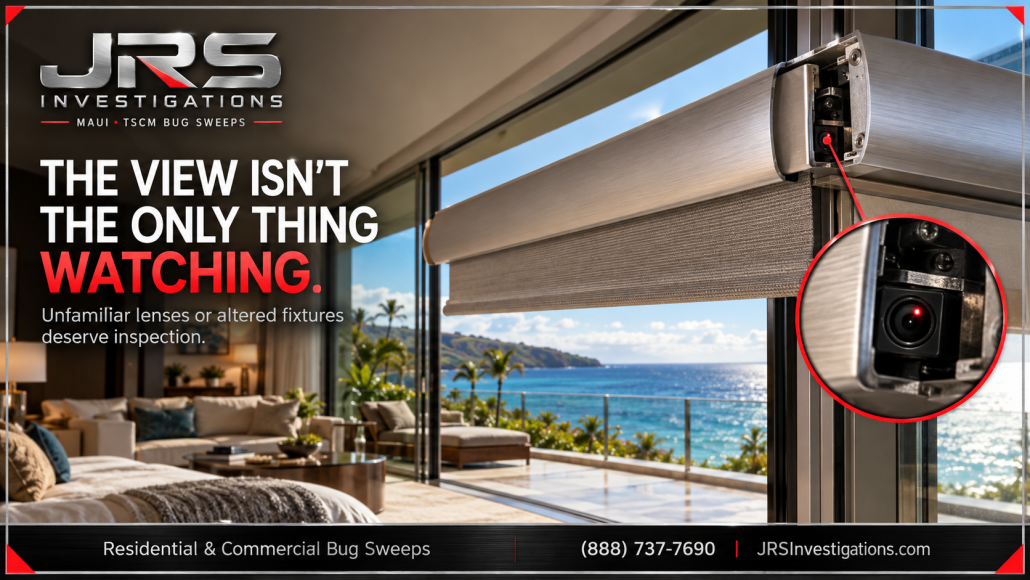
- an unfamiliar charger, adapter, cable, fixture, smoke detector, power strip, or vehicle attachment appearing after another person had access;
- evidence that a secured room, residence, office, rental unit, or vehicle was entered or disturbed;
- a former employee, partner, contractor, guest, housekeeper, maintenance worker, or vendor retaining access that should have ended;
- a credible stalking, domestic-safety, executive-security, or business-privacy concern; or
- a sensitive meeting or property transition that requires a documented privacy assessment.
Safety Comes Before Evidence Collection
If there is an immediate threat, leave the area when it is safe, call 911, and follow law-enforcement instructions. Do not confront a suspected person or dismantle an item simply to see what is inside. Photograph the condition from a safe distance, record the date and location, preserve related messages or access records, and restrict unnecessary handling. The Maui Police Department lists station and non-emergency contact information for situations that do not require 911.
Concerns centered on a phone, email account, cloud account, or computer may require digital-forensics or cybersecurity support instead of, or in addition to, a physical TSCM sweep.
How a Maui TSCM Inspection Is Planned
A useful sweep begins with a specific concern, not a generic promise to scan every object. During the confidential intake, JRS reviews the timeline, the people who had authorized or unauthorized access, the information believed to be exposed, and any recent move, repair, housekeeping visit, employee change, separation, or security incident. That information helps define the property, rooms, fixtures, vehicles, and time window that deserve attention.
1. Confirm Authority and Site Conditions
The client must have lawful authority to authorize work in the location or vehicle. For Maui condominiums, resort properties, vacation rentals, offices, and managed residences, building or property rules may also affect access. The team confirms occupancy, parking, elevators, loading access, power availability, normal wireless equipment, and the best time to reduce interruptions.
2. Establish a Technical Baseline
Before interpreting a signal or unfamiliar component, the examiner documents ordinary conditions. Maui sites can contain neighboring Wi-Fi networks, resort systems, smart-home devices, security cameras, cellular equipment, marine electronics, and authorized maintenance hardware. A baseline reduces false alarms and helps distinguish a normal device from a condition that needs closer review.
3. Conduct the Physical and Technical Examination
The selected methods depend on the site and threat assessment. A professional inspection may include:
- careful visual and physical review of priority rooms, furnishings, fixtures, accessible wiring, and power sources;
- radio-frequency spectrum analysis to identify and evaluate active transmissions;
- non-linear junction detection to locate electronic components that may not be transmitting;
- optical inspection for concealed camera lenses;
- thermal or other specialized review when the construction and circumstances make it useful;
- inspection of accessible vehicle areas when a vehicle is included in the agreed scope; and
- documentation of relevant network hardware without presenting the physical sweep as a full cybersecurity audit.
4. Evaluate, Document, and Explain
Equipment readings are interpreted in context. A signal by itself is not proof of illegal surveillance, and an unfamiliar object may be ordinary building, hospitality, automotive, or communications equipment. JRS documents relevant observations, explains what was and was not examined, and identifies conditions that warrant preservation, a specialist referral, or further investigation.
Maui Travel and Access Planning
Distance on Maui is not measured only in miles. Traffic through Central Maui, resort access in Wailea or Kaanapali, limited loading areas, property-management coordination, and longer routes to Upcountry, Kapalua, or East Maui can affect arrival windows and equipment movement. The consultation confirms the exact location and access plan before scheduling. This keeps the inspection discreet and prevents avoidable delays after the team reaches the property.
Destructive access, electrical repair, mechanical disassembly, and work requiring another licensed trade are not assumed. Learn more about tracking-device concerns in Maui TSCM assignments.
What Happens After a Maui TSCM Sweep
At the close of the inspection, the client receives a practical briefing on the areas examined, the methods used, relevant observations, and any limitations created by access, occupancy, construction, or time. If a suspicious item or condition is identified, the next step depends on what it is and who has lawful control of it. The safest response may be to photograph it in place, restrict access, preserve the surrounding area, consult counsel, or contact law enforcement. Removing or powering down an item without a plan can erase useful evidence or alert the person responsible.
A physical TSCM sweep is only one part of a broader privacy response. Concerns involving a phone, cloud account, email, router configuration, or computer may require separate mobile-device forensics or cybersecurity assistance. JRS Investigations does not describe a property as “completely clean,” guarantee that every possible device can be detected, or promise a particular legal outcome.
Maui TSCM Frequently Asked Questions
Can a sweep be completed in an occupied residence or resort unit?
Sometimes, but a quiet and controlled work area produces better results. The consultation should identify occupants, housekeeping or maintenance access, scheduled visitors, normal wireless devices, and any property-management restrictions. Permission must come from a person with lawful authority over the space.
Do you inspect vehicles on Maui?
A vehicle can be included when lawful access is confirmed and the vehicle is identified in the scope. The inspection plan may address accessible exterior and interior areas, unfamiliar attachments, power sources, and location-tracking concerns. Mechanical disassembly is not assumed and may require another qualified trade.
Does TSCM include phones and computers?
The physical sweep can document devices, cables, network hardware, or circumstances that affect the site assessment. It is not the same as forensic examination of a phone or computer. The Federal Trade Commission’s stalkerware guidance explains why suspected phone monitoring should be handled carefully, especially when personal safety is involved.
Can hotel, condominium, or vacation-rental rooms be inspected?
They may be considered when the client has lawful authority and the property’s rules permit the work. Shared walls, nearby rooms, building automation, maintenance access, and dense wireless traffic can change the inspection plan. JRS confirms the location and access conditions before mobilizing equipment.
What should I do if I find an unfamiliar device?
Do not assume that every unfamiliar object is illegal surveillance equipment. Avoid unnecessary handling. Photograph its location if it is safe to do so, note who had access, preserve messages or events connected to the concern, and obtain advice about evidence handling. For an immediate threat or suspected crime, contact the Maui Police Department or emergency services.
What Hawaii law applies to recording or tracking?
Hawaii Revised Statutes Chapter 803 addresses interception of wire, oral, and electronic communications and the use of mobile tracking devices. The facts and exceptions can matter, so the statute should not be reduced to a slogan. Review the current Hawaii Legislature Chapter 803 and seek legal advice for a specific situation.
How should I prepare for a consultation?
Create a concise timeline of what happened, identify the rooms, property, or vehicle involved, list people with authorized access, and preserve relevant photographs, messages, or maintenance records. Do not conduct a destructive search or confront a suspected person based only on a feeling or an ordinary technical symptom.
Trusted Resources and Next Steps
- Maui Police Department information for public-safety and non-emergency resources
- FTC guidance on stalkerware for suspected phone or account monitoring
- CISA wireless-network guidance for separate network-security concerns
For related JRS information, read the comprehensive Maui TSCM guide, review TSCM bug-sweep services, or request a confidential consultation at (888) 737-7690.