(888) 737-7690

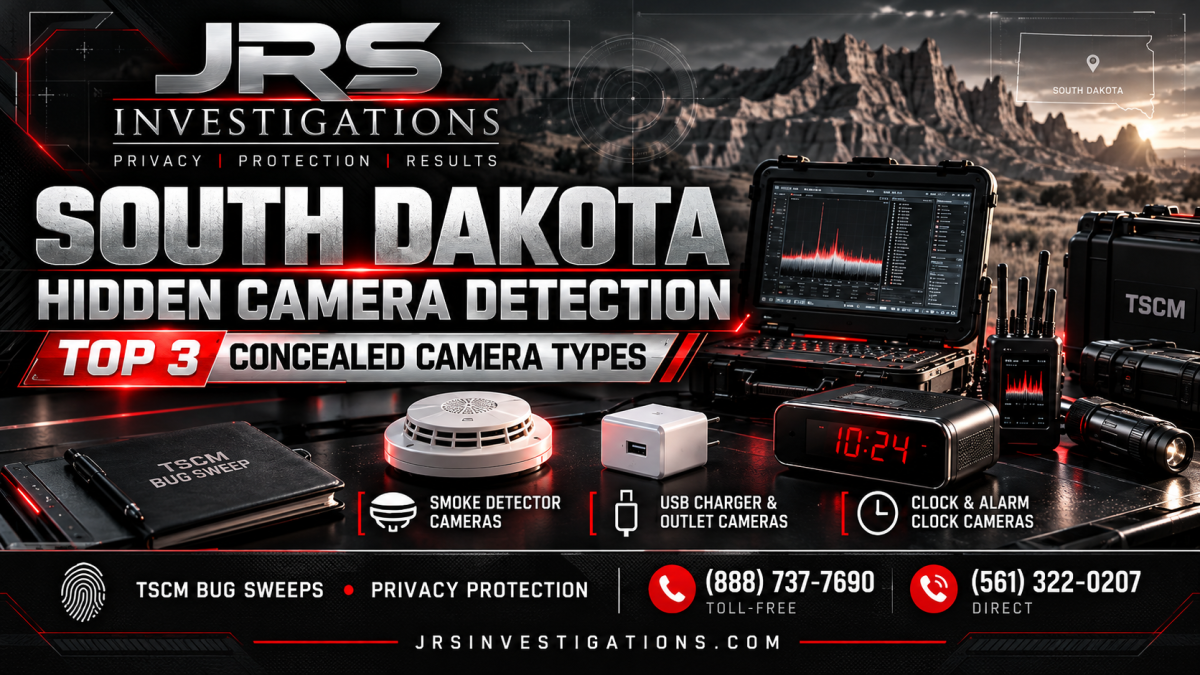
South Dakota Hidden Camera Detection | TSCM Bug Sweeps
Professional TSCM Bug Sweeps and Hidden Camera Detection in South Dakota
Hidden surveillance cameras are becoming increasingly compact and discreet. Some are concealed inside everyday electronics, including smoke detectors, USB chargers, electrical adapters, and digital clocks.
For property owners, families, businesses, executives, and travelers concerned about unauthorized recording, these devices can present serious privacy and security risks.
JRS Investigations provides professional Technical Surveillance Countermeasures (TSCM) services designed to examine concerns involving hidden cameras, listening devices, GPS trackers, and unauthorized electronic surveillance equipment.
If you are concerned about surveillance in South Dakota, learn more about our South Dakota TSCM Bug Detection and Debugging Services.
Call (888) 737-7690 toll-free or (561) 322-0207 directly for a confidential consultation.
What Is a Professional TSCM Bug Sweep?
TSCM stands for Technical Surveillance Countermeasures. These inspections use an organized combination of physical examination, investigative analysis, and appropriate technical detection equipment to identify potential surveillance threats.
A professional inspection may examine:
- Concealed cameras and video recorders
- Covert audio listening devices
- Wireless transmitters
- Unauthorized recording equipment
- GPS and Bluetooth tracking devices
- Suspicious electrical modifications
- Modified household electronics
- Potential surveillance vulnerabilities
Unlike a basic handheld detector, professional TSCM bug-sweep services use a risk-based approach tailored to the property, suspected threat, and authorized inspection scope.
Not every suspicious object is a surveillance device, and no inspection guarantees detection of every possible threat.
Top 3 Hidden Camera Types Examined During TSCM Sweeps
1. Smoke Detector Cameras
A smoke detector is an ordinary fixture commonly found in homes, offices, hotel accommodations, and rental properties.
Unfortunately, covert cameras can be manufactured to resemble smoke detectors and similar ceiling-mounted devices.
A concealed camera may contain:
- A miniature camera lens
- Internal recording storage
- Wireless video capabilities
- A separate battery or power source
- Electronics concealed behind an ordinary-looking housing
Because smoke detectors are routinely positioned above living areas, they are a relevant inspection category when unauthorized surveillance is suspected.
What makes professional inspection important?
Legitimate smoke alarms contain electronic components. A suspicious appearance or electronic signal does not automatically indicate a hidden camera.
JRS Investigations’ counter-surveillance and electronic debugging services can include appropriate examination of authorized spaces and unfamiliar electronic devices.
For safety, functioning fire-detection equipment should never be disabled or dismantled without appropriate authority and professional precautions.
2. USB Charger and Electrical Outlet Cameras
USB chargers, power adapters, and wall-mounted electronics are among the everyday objects that may be modified or manufactured to conceal miniature cameras.
These devices can be especially difficult for an untrained person to evaluate because many legitimate chargers contain circuitry, small openings, indicator lights, and wireless components.
Depending on the equipment, a covert recording device might:
- Record video to internal storage
- Transmit video wirelessly
- Operate while connected to electrical power
- Capture activity from a fixed position
- Resemble a functioning electronic accessory
These concerns may arise in residential properties, offices, conference rooms, or other locations where unfamiliar electronics have been introduced.
A professional TSCM assessment combines an appropriate physical inspection with technical evaluation instead of relying on appearance alone.
Learn more about how JRS Investigations approaches residential and commercial bug-sweep inspections.
3. Digital Clock and Alarm Clock Cameras
Digital clocks and alarm clocks are frequently placed on desks, bedside tables, shelves, and office furniture.
Some concealed-camera products are designed to resemble these ordinary devices.
Potential features include:
- Miniature video components
- Concealed recording storage
- Wireless connectivity
- Internal batteries
- Standard electrical power connections
- Ordinary-looking displays and controls
Because clocks are common in bedrooms, guest rooms, offices, and meeting spaces, they may warrant examination when there is a specific and credible concern about unauthorized monitoring.
A comprehensive inspection considers more than the object itself. Investigators may evaluate recent access to the area, suspicious modifications, unusual equipment placement, and the surrounding electronic environment.
If you believe a room or property has been compromised, consult JRS Investigations about an appropriate South Dakota hidden-camera and TSCM inspection.
Where Hidden Cameras May Present Privacy Concerns
Residential Homes and Apartments
Homeowners and authorized occupants may request professional inspections when an unfamiliar electronic object appears, a room has been accessed without permission, or there is another specific reason to suspect recording equipment.
Inspection plans can be tailored to living rooms, bedrooms, home offices, and other authorized areas.
Hotels and Vacation Rentals
Travelers may also have concerns about recording devices in temporary accommodations.
Airbnb’s published safety policy prohibits hidden cameras and indoor recording cameras in its home listings, even if the device is turned off.
Read the official Airbnb policy on security cameras and recording devices.
Hotel and rental-property investigations must account for the occupant’s lawful access rights and the property’s security and safety rules.
Businesses and Executive Offices
Unauthorized recording can compromise confidential meetings, negotiations, proprietary information, and sensitive business communications.
A professional inspection may be appropriate for:
- Corporate conference rooms
- Executive offices
- Legal consultation spaces
- Private meeting areas
- High-security business environments
- Sensitive negotiation rooms
Our JRS Investigations services directory outlines the broader investigative services that may support privacy, corporate, and security concerns.
South Dakota Privacy Laws and Unauthorized Recording
South Dakota law addresses the use of unauthorized surveillance equipment in private places.
South Dakota Codified Law § 22-21-1 restricts the installation or use of unauthorized observation or recording devices in private places without the consent of persons entitled to privacy, subject to statutory exceptions.
A violation of that section is classified as a Class 1 misdemeanor.
For the exact legal language, refer to the South Dakota Legislature’s official statute.
Legal rights can depend on the setting, consent, recording purpose, and other facts. Anyone who discovers suspected unlawful recording equipment should consider obtaining appropriate legal or law-enforcement guidance.
Warning Signs That May Justify a Hidden Camera Inspection
There is no single symptom that proves an unauthorized camera has been installed.
However, a consultation may be appropriate when concerns involve:
- Unfamiliar electronic devices appearing in sensitive rooms
- Fixtures or electrical equipment showing signs of modification
- Evidence of unauthorized access to a property
- Suspicious objects positioned toward private areas
- An identifiable recording device discovered unexpectedly
- Confidential information becoming known without an apparent legitimate source
- Documented security incidents involving a residence or workplace
Some of these circumstances have ordinary explanations.
The purpose of a professional TSCM investigation is to evaluate available evidence rather than assume wrongdoing.
How JRS Investigations Performs a Professional Bug Sweep
A properly scoped investigation generally follows an organized process.
Confidential Initial Consultation
We review the concern, location, known access, relevant dates, and investigative objectives.
Inspection Planning
The scope is developed around the property, suspected devices, lawful inspection authority, and practical limitations.
Physical and Technical Examination
Depending on the assignment, techniques may include visual and physical examination, radio-frequency analysis, optical examination, and specialized detection equipment.
Documentation and Reporting
Relevant findings, photographs, technical observations, and important limitations may be documented in a professional investigative report.
Privacy and Security Recommendations
Clients may receive recommendations regarding suspicious devices, evidence preservation, physical security, access controls, or follow-up examination.
For a real-world example of JRS Investigations’ work, read about three hidden cameras identified during a Delray Beach TSCM inspection.
Why Hire JRS Investigations?
JRS Investigations has provided investigative services since 1997, emphasizing confidentiality, objective findings, and professional reporting.
A professional TSCM engagement offers advantages over attempting to identify equipment through guesswork.
Discreet investigative handling. Sensitive privacy concerns are handled confidentially according to the engagement.
Methodical inspections. The inspection is tailored to the property and credible threat concerns.
Appropriate technical evaluation. A combination of techniques may provide a broader assessment than relying on a single consumer detector.
Factual reporting. Findings and limitations are documented so the client understands what was and was not established.
Evidence preservation awareness. Suspicious equipment can be documented before any removal or other action is considered.
Learn more about JRS Investigations’ experience and professional credentials.
Frequently Asked Questions About South Dakota Hidden Camera Detection
Can a TSCM sweep find a hidden camera that does not transmit wirelessly?
Some non-transmitting devices may be detectable through physical, optical, or other appropriate examination. Detection depends on accessibility, construction, concealment, equipment, and inspection conditions.
Can hidden cameras operate without Wi-Fi?
Yes. Some recording devices store data internally instead of continuously transmitting wirelessly.
Can a TSCM sweep identify hidden listening devices as well?
Yes. Depending upon the agreed scope, the inspection may address both video and audio surveillance concerns.
What should I do if I discover a suspicious camera?
Photograph the item and its surroundings if safe to do so. Avoid unnecessary handling or destruction, and contact law enforcement when there is an immediate safety concern.
Can JRS Investigations inspect a home, business, or vehicle in South Dakota?
Contact JRS Investigations with the location and requested scope to confirm service arrangements, lawful authority, and availability.
Will a professional inspection guarantee that no hidden camera exists?
No. Any responsible inspection must disclose limitations involving inaccessible areas, powered-off equipment, intermittent transmissions, and devices that are no longer present.
Schedule a Confidential South Dakota TSCM Consultation
Whether your concern involves a smoke detector camera, USB charger camera, concealed clock camera, listening device, GPS tracker, or another surveillance threat, professional assessment can help replace uncertainty with documented information.
JRS INVESTIGATIONS
South Dakota TSCM Bug Sweeps and Hidden Camera Detection
Toll-free: (888) 737-7690
Direct: (561) 322-0207
Learn more about South Dakota TSCM Bug Sweeps
JRS Investigations also covers TSCM bug sweeps in Sioux Falls and TSCM bug sweeps in the Black Hills and Rapid City area.
Your Privacy Matters. Don’t Leave It to Chance.
Knowledge Is Power. Get the Facts.
#SouthDakotaTSCM #SouthDakotaBugSweeps #HiddenCameraDetection #TSCMBugSweeps #SurveillanceDetection #SmokeDetectorCamera #HiddenCameraSweep #CounterSurveillance #ElectronicSecurity #PrivacyProtection #JRSInvestigations