(888) 737-7690

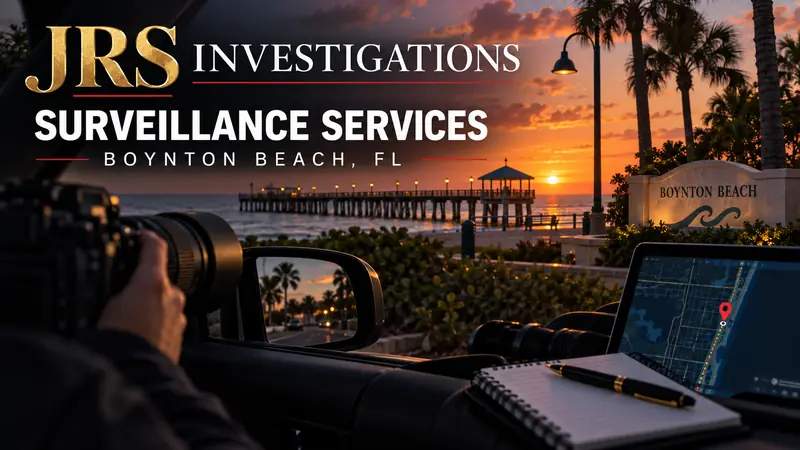
5 Reasons to Hire a Boynton Beach Surveillance Investigator
5 Reasons to Hire a Boynton Beach Surveillance Investigator
Surveillance can answer important questions, but only when it is planned carefully, conducted lawfully, and documented in a way that makes the findings useful. JRS Investigations assists attorneys, businesses, families, and private clients in Boynton Beach with discreet surveillance tailored to a defined case objective.
Boynton Beach cases can involve busy corridors such as Boynton Beach Boulevard, Congress Avenue, Federal Highway, and I-95, along with gated communities, waterfront areas, shopping districts, and neighboring Palm Beach County jurisdictions. Local familiarity helps an investigator plan realistic coverage without making assumptions or disrupting the subject’s lawful activities.
1. Professional planning reduces wasted time
A trained investigator begins by clarifying the question the surveillance must answer. That may involve documenting a pattern of activity, confirming whether a person visits a location, observing compliance with a court order, or gathering facts for an insurance or civil matter. A clear objective helps determine the appropriate dates, times, locations, staffing, and documentation.
Self-directed surveillance often fails because the observer is emotionally involved, recognizable to the subject, or unsure how to record events consistently. Professional planning focuses resources on the periods most likely to produce relevant information.
2. Discreet observation protects the integrity of the case
Effective surveillance depends on remaining unobtrusive. An investigator must adapt to traffic, parking restrictions, building access, lighting, weather, and changing activity without trespassing or creating a confrontation. In Boynton Beach, conditions can shift quickly between residential neighborhoods, commercial centers, beaches, marinas, and major roadways.
JRS Investigations uses a case-specific approach rather than a one-size-fits-all routine. The goal is to observe and document lawful, relevant activity while protecting client confidentiality.
3. Organized documentation is easier to review
Useful surveillance is more than a collection of photographs. The investigator should maintain a clear chronology describing dates, times, locations, observations, and the relationship between recorded media and written notes. Consistent reporting helps a client and counsel understand what was observed, what was not observed, and where uncertainty remains.
No investigator can guarantee a particular result or that evidence will be admitted in court. An attorney should review legal strategy and admissibility. JRS can provide factual reports and preserved media so counsel can evaluate the evidence in context.
4. Licensed professionals understand legal and ethical limits
Florida surveillance work must respect privacy, property, recording, and other applicable laws. A professional investigator should never promise illegal access, trespass, impersonation, harassment, or interception of private communications. The assignment should remain focused on legitimate information needs and proportionate methods.
If a matter involves a restraining order, child custody dispute, workplace concern, insurance claim, or pending litigation, tell the investigator about relevant deadlines and court restrictions before fieldwork begins. JRS may also coordinate with the client’s attorney when appropriate.
5. Local experience supports faster decisions
Knowledge of Boynton Beach and the surrounding Palm Beach County area can improve scheduling and reduce avoidable delays. Travel patterns may extend into Delray Beach, Lake Worth Beach, Boca Raton, West Palm Beach, or other nearby communities. A local plan can account for those possibilities while keeping the assignment within the approved scope and budget.
Clients also benefit from a realistic explanation of what surveillance can establish. A single observation may not prove a broader pattern. When the facts require multiple dates or corroborating records, the investigator should explain that before additional work is authorized.
When surveillance may be useful
- Child custody and parenting-time concerns
- Suspected infidelity or undisclosed cohabitation
- Insurance, injury, and workers’ compensation matters
- Employee misconduct, theft, or policy violations
- Litigation support and activity documentation
- Location verification and pattern-of-life questions
Surveillance is not appropriate for every case. Background research, interviews, records review, asset research, or a different investigative service may answer the question more efficiently.
How to prepare for a confidential consultation
Bring the subject’s correct identifying information, recent photographs, known vehicles, relevant addresses, likely schedules, court dates, and a concise explanation of the decision the evidence will support. Do not exaggerate or omit facts that could change the legal or safety assessment.
For a broader overview of available services, visit the Boynton Beach private investigator page. JRS will explain the proposed scope, practical limitations, and next steps before work begins.
Frequently asked questions
Can surveillance guarantee proof?
No. Surveillance documents observable activity during the authorized coverage period. It may confirm, contradict, or leave a question unresolved.
Will I receive photographs or video?
Deliverables depend on the assignment and lawful opportunities available. Typical reporting may include a written chronology and relevant media captured during the investigation.
Should I conduct surveillance myself first?
Following someone personally can create safety, legal, and case-integrity problems. Discuss the concern with a licensed investigator and, when litigation is involved, your attorney before taking action.
Speak with JRS Investigations
For a discreet review of a Boynton Beach surveillance matter, call (561) 322-0056. Knowledge is power, and the first step is defining exactly what information you need.