(888) 737-7690

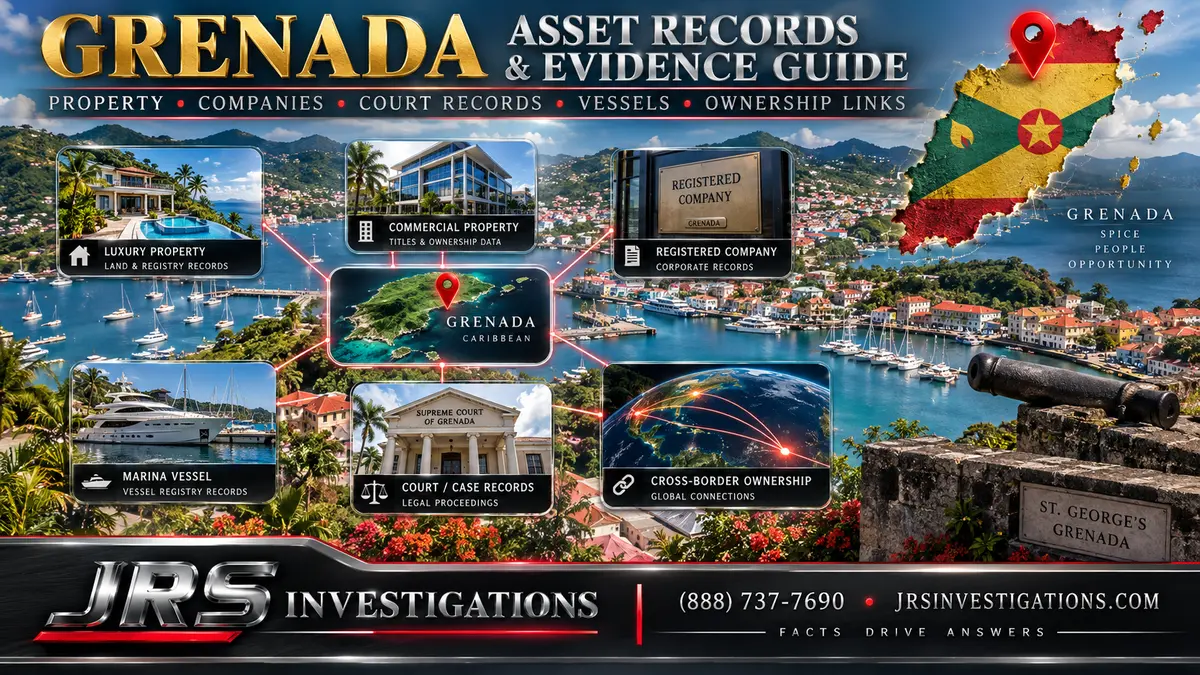
Grenada Asset Records and Evidence Guide | JRS
A hidden-asset inquiry in Grenada should begin with a disciplined records plan—not an assumption that one database will reveal everything. This Grenada asset records and evidence guide explains how lawful public records, corporate filings, court material, property information, vessel leads, and cross-border ownership links can be assembled into an evidence map for attorneys, creditors, businesses, and authorized private clients.
A record is a lead, not automatic proof of ownership or wrongdoing. Names can be shared, addresses can be outdated, entities may act as nominees or intermediaries, and assets may be held through several jurisdictions. Reliable work connects multiple independent sources, documents the source of each fact, and distinguishes verified ownership from an investigative hypothesis.
Caribbean asset investigations often involve linked companies, properties, or litigation in more than one country. For cases with a Jamaican connection, JRS also offers Jamaica judgment recovery investigation services focused on lawful, evidence-based asset and subject research.
1. Define the legal purpose and scope
Start with the decision the research must support. The scope may involve judgment enforcement, litigation support, due diligence, fraud review, estate or probate questions, marital litigation, corporate disputes, or verification of a disclosed asset schedule. The lawful basis, client authority, relevant dates, target names, known aliases, companies, addresses, and jurisdictions should be documented before research begins.
JRS Investigations does not promise access to secret bank accounts, private tax returns, protected credit data, or government systems. Nonpublic financial records generally require consent, a court order, subpoena, or another lawful process handled by qualified counsel. Work in Grenada is conducted or coordinated only where legally permissible and may involve local attorneys, registries, licensed professionals, or other authorized sources.
2. Property and land records
Real-property research can help identify registered interests, transfers, connected parties, mortgages or encumbrances, and the history of a parcel. Grenada’s official online services include eLand Registry access and property-transfer records. Availability, search fields, fees, and the evidentiary status of a result can vary, so an online hit should be checked against the correct registry record or certified document when the matter requires formal proof.
A productive property inquiry may compare names, variations, parcel descriptions, transfer dates, consideration, mailing addresses, lenders, witnesses, and connected entities. The absence of a direct title match does not prove that a person has no property interest; it may indicate spelling differences, a corporate holder, a trust or estate issue, a prior transfer, or a need to search another jurisdiction.
3. Companies, directors, and ownership links
Corporate research looks for entities tied to the subject through names, addresses, directors, officers, registered agents, filing dates, business activities, and related companies. Grenada’s legal framework includes the Corporate Affairs and Intellectual Property Office legislation and corporate registry laws. Registry material should be interpreted in context: a director is not necessarily a beneficial owner, a registered office is not necessarily an operating location, and a historical filing may no longer describe current control.
Useful analysis often comes from linkage rather than a single filing. Repeated addresses, contact details, associates, asset transactions, common officers, related litigation, and payments can reveal a network that deserves further verification. Each connection should be labeled as direct, indirect, historical, or unconfirmed.
4. Court files, judgments, and litigation history
Court information may identify judgments, claims, insolvency issues, property disputes, company relationships, admissions, or enforcement history. The Eastern Caribbean Supreme Court provides official court and judgment resources for Grenada and other member jurisdictions. Search results and published judgments can guide research, but the full file, current docket, or certified order may be needed to establish status.
Names should be searched with spelling variations and entity names, then matched using dates, addresses, parties, counsel, and case context. A similar name alone is not a reliable identity match. Court research should also distinguish allegations from findings and pending proceedings from final orders.
5. Vessels, vehicles, and movable assets
Boats, vehicles, machinery, luxury goods, and business equipment may create useful leads, but visible possession is not the same as legal ownership. For a vessel inquiry, researchers may examine a vessel name, registration or official number, flag, marina history, management company, insurer, financing party, sale listing, and associated entity. Lawful observations from public locations can help verify presence, while official registration or transaction records may be needed to establish title.
A marina sighting, social-media image, or listing should be preserved with its date, source, and context. It should not be overstated. The asset may be chartered, leased, financed, jointly owned, held by a company, or no longer connected to the subject.
6. Cross-border tracing and beneficial-control analysis
Asset structures rarely stop at one border. A Grenada company may connect to a bank, property, counterparty, parent entity, affiliate, vessel, or litigation in another country. Cross-border work begins with identifiers that can be compared consistently: full legal names, date ranges, addresses, corporate numbers, transaction references, email domains, telephone numbers, professional advisers, and counterparties.
The goal is to build a sourced ownership and control map. Direct registration, beneficial control, management authority, economic benefit, and mere association are different conclusions. A defensible report states which one the evidence supports and what additional legal process or local verification may be needed.
7. Preserve a record trail that counsel can use
Every important finding should include the source, access date, search terms, record identifier, jurisdiction, and a copy or capture where lawful. Investigators should retain originals and create working copies for annotation. Conflicts between sources should be highlighted, not hidden. A well-organized chronology and entity chart can help counsel decide whether to seek certified records, disclosure, subpoenas, freezing relief, enforcement steps, or local legal advice.
For a broader overview of the service, read five reasons to use a Grenada hidden-asset investigation. You can also review the Grenada private investigator page and JRS judgment-recovery investigation services.
Questions a useful asset report should answer
- Which assets or interests are directly verified, and by what record?
- Which companies, people, addresses, and transactions connect to the subject?
- Is the information current, historical, disputed, or incomplete?
- What evidence supports ownership, control, possession, or economic benefit?
- Which findings require a certified record, local verification, consent, or legal process?
- What practical next step is available to counsel or the authorized client?
Request a confidential Grenada asset-research review
JRS Investigations can help define a lawful research plan, coordinate appropriate sources, verify leads, and organize findings for counsel or an authorized client. The work is fact-dependent, and no recovery or legal outcome can be guaranteed.
Call toll-free (888) 737-7690 or contact JRS Investigations to discuss the parties, jurisdictions, known assets, available orders, and the decision the evidence needs to support.