(888) 737-7690

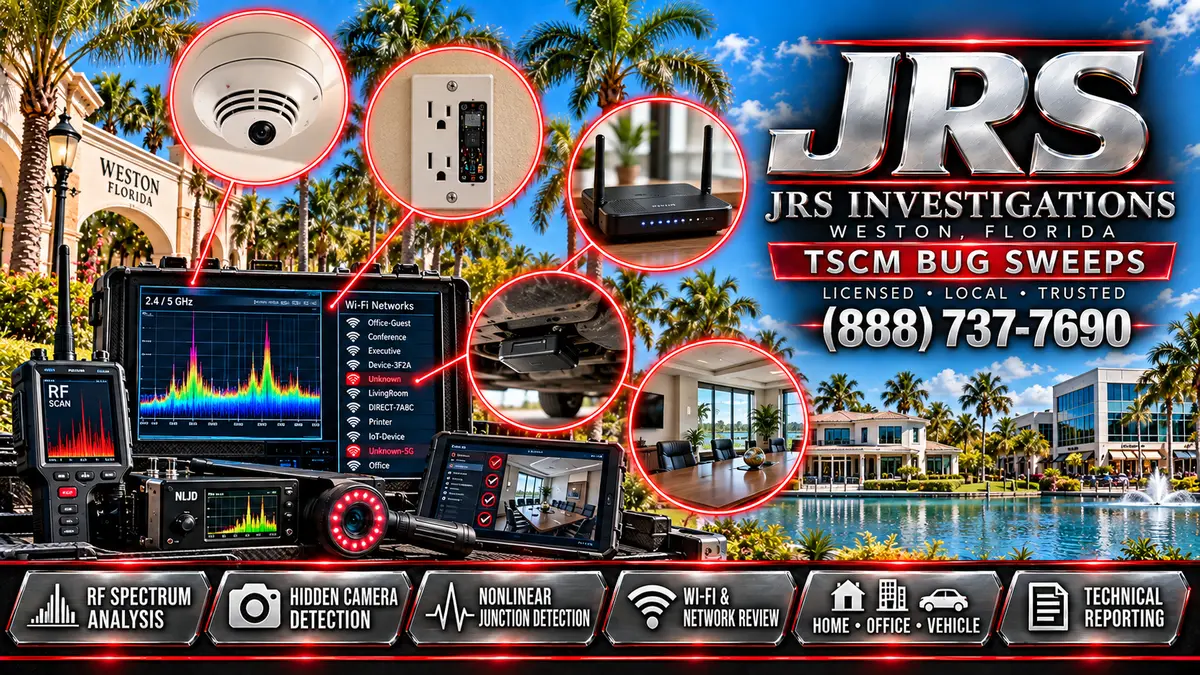
Weston TSCM Bug Sweeps: 5 Reasons to Hire JRS
When private conversations, business plans or personal movements seem to be reaching the wrong people, guessing can make the situation worse. A professional technical surveillance countermeasures inspection creates a structured way to assess the concern. JRS Investigations provides confidential Weston TSCM bug sweeps for authorized homes, offices, meeting spaces and vehicles throughout Weston and Broward County.
TSCM is more than waving a detector around a room. A useful inspection combines technical equipment, physical examination, an understanding of how covert devices may be concealed and disciplined documentation of the findings. The goal is to identify indicators of unauthorized surveillance, explain what was examined and help the client choose a sensible next step.
For a confidential consultation, call (888) 737-7690 or contact JRS Investigations. You can also review our dedicated Weston TSCM bug-sweep service page.
Five reasons to hire JRS for a Weston TSCM bug sweep
1. A multi-method inspection is stronger than a single gadget
No one instrument can identify every possible surveillance threat. Depending on the agreed scope and conditions at the location, a professional sweep may combine radio-frequency spectrum analysis, hidden-camera lens detection, nonlinear-junction detection, inspection of outlets and furnishings, review of visible wiring and electronics, and an inventory of relevant Wi-Fi or Bluetooth activity.
Each method answers a different question. RF analysis can help locate or characterize active transmissions. A nonlinear-junction detector can help identify electronic components even when a device is not currently transmitting. Optical and physical inspection can reveal camera lenses, altered objects, unexpected wiring or equipment that does not belong. A network review can flag unfamiliar devices that deserve closer examination.
That layered approach matters because surveillance equipment can be active, dormant, wired, wireless, locally recording or intermittently transmitting. JRS selects methods based on the property, the reported concern and the client’s lawful authority to authorize the inspection.
2. The inspection begins with a lawful, clearly defined scope
A responsible sweep starts before the equipment is turned on. JRS first establishes who controls the property or vehicle, which areas may be inspected, who has access, what prompted the concern and whether any urgent safety issue is present. This protects the client, limits disruption and keeps the assignment focused on spaces the client has authority to authorize.
Weston assignments may involve a primary residence, gated-community home, home office, professional suite, conference room, executive vehicle or other controlled space. The agreed scope can include specific rooms, access points, furnishings and electronics. If a client wants a broader South Florida assessment, JRS also provides South Florida TSCM services.
TSCM is an inspection and risk-reduction service. It is not permission to enter another person’s property, intercept communications or access accounts without authorization. When ownership, tenancy, employment or litigation creates uncertainty, clients should obtain legal advice before the inspection.
3. Homes, offices, vehicles and meeting spaces present different risks
A residence has different concealment opportunities and access patterns than a commercial office. A vehicle presents power, wiring and tracking concerns that do not exist in a conference room. A professional sweep considers the environment instead of using the same checklist everywhere.
- Residential sweeps: bedrooms, living areas, home offices, network equipment, smoke detectors, chargers, clocks, decorative objects and other items within the authorized scope.
- Business and office sweeps: conference rooms, executive offices, reception areas, shared equipment, communication devices and spaces used for confidential discussions.
- Vehicle sweeps: accessible interior and exterior areas, power sources, ports, aftermarket wiring and indicators associated with unauthorized tracking or recording devices.
- Meeting-space assessments: controlled spaces used for negotiations, legal strategy, financial discussions, personnel matters or other sensitive conversations.
Weston’s mix of residences, professional services, medical practices and nearby corporate activity makes careful planning important. JRS can coordinate the inspection to reduce attention and unnecessary interruption. Clients needing broader investigative support can review our Weston private-investigator services.
4. Findings are documented so the client can act intelligently
A sweep should leave the client with more than a verbal “all clear.” JRS documents the areas examined, the methods used, material observations and any item that requires follow-up. Depending on the assignment, documentation may include photographs, location notes, equipment identifiers, signal observations and practical recommendations.
Not every anomaly is a covert device. Ordinary routers, wireless speakers, smart-home products, chargers, building systems and nearby transmitters can produce signals or components that deserve evaluation. The investigator’s job is to separate normal environmental activity from findings that warrant closer attention.
If a suspicious device is located, do not immediately destroy, disconnect or circulate photographs of it. Handling can alter evidence, alert the person responsible or create a safety concern. JRS can help document the condition and location, preserve the scene and discuss whether the client should contact counsel, property management, corporate security or law enforcement. In an emergency or immediate danger, call 911.
5. Confidentiality and investigative judgment matter
Privacy concerns can involve relationships, employment, litigation, business negotiations or personal safety. Discretion is therefore part of the service, not an afterthought. JRS limits the discussion to the people needed to plan and complete the assignment, coordinates arrival and access with the client and communicates findings through an agreed channel.
Technical readings also need context. A signal, unfamiliar device name or electronic component does not automatically prove malicious surveillance. Experienced investigative judgment helps determine what is ordinary, what can be explained and what deserves escalation. That reduces panic and supports decisions based on documented facts.
What Weston TSCM bug sweeps can—and cannot—establish
A TSCM inspection can identify suspicious transmitters, hidden-camera indicators, unexpected electronic components, unauthorized tracking-device indicators, altered objects, unexplained wiring and relevant network anomalies within the defined scope. It can also create a baseline for improving physical and electronic privacy practices.
However, no ethical provider should guarantee that every possible device will be found. A device may be powered off, deeply integrated, removed before the inspection, activated only at certain times or designed to record locally without transmitting. A physical TSCM sweep also is not the same as a forensic examination of a phone, computer, cloud account or email system. Those concerns may require separate digital-forensics or cybersecurity support.
The most defensible conclusion is therefore tied to the time, place, access and methods used. JRS explains those limitations so the client understands what the inspection supports and what it does not.
How the JRS TSCM process works
- Confidential consultation: We discuss the concern, location, access, timing and people who know about the assignment.
- Scope and authorization: We identify the property, rooms, vehicles and systems the client has lawful authority to inspect.
- Pre-sweep preparation: JRS gives practical instructions for access and environmental conditions while avoiding steps that could alert a suspected party.
- On-site inspection: The investigator applies appropriate technical and physical methods to the agreed areas.
- Findings and documentation: Material observations are explained, documented and separated from common electronic activity.
- Follow-up plan: When needed, JRS discusses preservation, additional inspection, policy changes, counsel or law-enforcement contact.
When should you consider a professional sweep?
A sweep may be appropriate after repeated disclosure of information known to only a small group; discovery of unfamiliar electronics, wiring or tracking-device alerts; a break-in or unexplained access event; a high-conflict separation or business dispute; turnover involving people with access to sensitive spaces; or before and after a confidential meeting. It may also be useful when taking control of a new executive office, residence or vehicle with an uncertain access history.
One unusual event does not prove surveillance. The strongest starting point is a clear description of what happened, who had legitimate access, what technology is normally present and whether the concern involves a room, vehicle, network or personal device.
Florida privacy law and responsible evidence handling
Florida law regulates the interception and disclosure of wire, oral and electronic communications. Clients can review Florida Statute 934.03. Florida also prohibits specified forms of secret visual recording under its digital-voyeurism statute. These links are general resources, not legal advice. An attorney should address questions about ownership, consent, workplace policy, evidence or litigation.
Frequently asked questions
How long does a Weston TSCM sweep take?
Timing depends on the size and complexity of the property, the number of rooms or vehicles, the amount of installed technology and the agreed scope. JRS discusses those variables before scheduling.
Does a sweep include phones and computers?
A physical TSCM inspection may include relevant wireless and network observations, but it is not automatically a forensic examination of every phone or computer. Tell JRS if the concern includes account access, stalkerware, email or cloud services so the proper type of support can be discussed.
Can an employee, tenant or family member authorize the inspection?
Only areas and property the client has lawful authority to inspect should be included. Authority can vary with ownership, tenancy, workplace policy and court orders. When the answer is unclear, obtain legal advice first.
Can TSCM equipment find every hidden device?
No. Professional equipment and multiple inspection methods improve coverage, but no provider can honestly promise detection of every possible device under every condition. JRS reports the scope, methods, findings and limitations.
What should I do if I find something suspicious?
Avoid handling, disabling or publicizing it. Photograph the item only if it is safe to do so, restrict unnecessary access and call JRS for guidance. Contact law enforcement immediately if there is a threat, stalking concern or immediate danger.
Schedule a confidential Weston TSCM consultation
JRS Investigations provides professional Florida TSCM bug sweeps with a defined scope, layered inspection methods and clear reporting. For Weston service, call (888) 737-7690 or use the confidential contact form.