(888) 737-7690

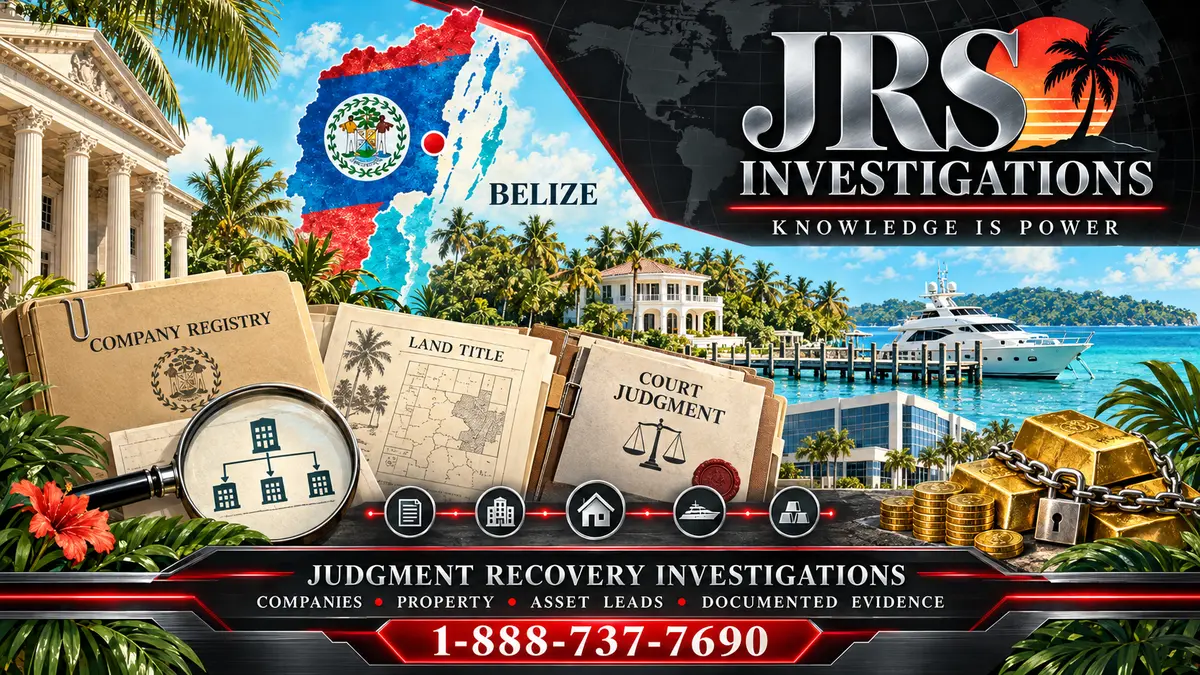
Belize Judgment Recovery Investigations: 7 Services
A court judgment can establish that money is owed, but it does not automatically reveal where a debtor’s assets are located or which leads are worth pursuing. In Belize, that gap often requires careful research, local verification and coordination with qualified counsel. A Belize judgment recovery investigator can help counsel and judgment creditors develop factual leads while respecting privacy, court procedure and local law.
JRS Investigations provides investigative support for lawful post-judgment matters involving individuals, companies, real property, business interests and other potential asset indicators in Belize. We do not enforce judgments, collect debts, freeze accounts or seize property. Instead, our role is to document facts, locate public-record and field-based leads, and deliver organized findings that a client’s attorney can evaluate.
This guide explains seven services that may support a Belize judgment-enforcement strategy, the records that may be relevant and the practical limits every client should understand before an investigation begins.
Cross-border recovery work may require coordinated research in more than one Caribbean jurisdiction. For matters involving offshore ownership, property, or business interests elsewhere in the region, see JRS Investigations’ Anguilla international asset search services.
What a Belize Judgment Recovery Investigation Does
Judgment-related investigation begins with a specific legal objective. Counsel may need to identify an operating company, confirm a property connection, document a business location, locate a subject for lawful service, or test whether information provided during litigation remains accurate. The investigator’s job is to turn those questions into verifiable research tasks.
Belize has official sources that may assist with this work. The Belize Companies and Corporate Affairs Registry administers the country’s business registry, while its public business entity search offers a starting point for company research. The Land Registry and Land Titles Unit records land transactions. Court information is available through the Belize Judiciary, and the Senior Courts Civil Procedure Rules 2025 provide the procedural framework counsel should consult.
Those sources can generate leads, but names alone rarely tell the complete story. Similar names, inactive entities, nominee relationships, outdated addresses and informal business arrangements can all create false assumptions. Effective work combines records with corroboration and clearly labels confirmed facts, reasonable connections and unresolved possibilities.
1. Belize Company and Business-Interest Research
A company search may identify entities connected to the judgment debtor, directors or other relevant parties. Investigators can compare registered names, entity numbers, status, addresses and publicly available filing information with the names and facts already present in the case. The objective is not merely to produce a list of similarly named companies; it is to test whether a documented relationship exists.
Useful indicators can include a shared business address, recurring telephone number, common director, public trading name or a company mentioned in contracts, invoices, websites and promotional materials. Historical and current information should be distinguished because a former role does not prove present ownership or control.
Where a business appears to operate in a regulated financial-services sector, the Belize Financial Services Commission licensing information may provide an additional verification point. Regulatory status should be reported precisely and never treated as proof that an entity holds assets for a particular person.
2. Real-Property Lead Development
Real property may be relevant after a judgment, but a social-media photograph, mailing address or family connection does not establish ownership. Investigators can organize possible property leads from pleadings, prior addresses, company records, advertisements, local observations and client-supplied documents. Appropriate official searches can then be requested or coordinated according to Belize’s registry procedures.
Each lead should be tied to an exact location, parcel reference or other reliable identifier wherever possible. A professional report should explain whether the information shows ownership, occupancy, management, a mailing connection or merely an unconfirmed association. These distinctions help counsel avoid overreaching conclusions.
Property research can also reveal practical questions for follow-up: Is the address residential or commercial? Does a named company advertise from the location? Is the premises occupied by an unrelated tenant? Local field verification may answer those questions without entering private property or misrepresenting the investigator’s purpose.
3. Court-Record and Litigation Research
Current and prior litigation can add context to a judgment-enforcement matter. Researchers may look for published decisions, related proceedings, insolvency indicators, ownership disputes or statements about a party’s business affairs. The relevant court, case number, party spelling and date range should be confirmed before conclusions are drawn.
The Belize Judiciary publishes court information and judgments, but not every fact needed for an investigation will necessarily appear online. Counsel may need to determine whether a registry request, certified record or separate court application is appropriate. JRS can organize the factual research; Belize-qualified counsel should decide how procedural rules apply and whether a particular step is legally available.
For broader pre-enforcement review, our due diligence investigations can help compare litigation history with corporate, professional and reputational information.
4. Address, Employment and Business-Activity Verification
A reliable location can be essential for counsel, process professionals or further lawful inquiries. Investigators may verify whether an address is current, whether a business is visibly operating, whether signage matches corporate records and whether publicly advertised contact details remain active. Depending on the assignment, discreet observation from lawful public vantage points may document ordinary activity at a location.
Employment or business-activity research must be handled carefully. A website profile, conference listing or old directory entry may be outdated. Good reporting records the source and date for each indicator and avoids presenting unverified information as current fact. Investigators should not impersonate government officials, obtain protected employment records or use deceptive pretexts to acquire confidential data.
When the subject is outside Belize, an international strategy may be necessary. JRS also conducts international asset research across Caribbean jurisdictions, with each country treated according to its own records and laws.
5. Vessel, Vehicle and High-Value Asset Leads
Boats, aircraft, vehicles, equipment and luxury goods sometimes appear in business websites, marina activity, advertisements, photographs or litigation records. Such material can be useful as a lead, but possession does not necessarily equal ownership. A vessel used by a subject may be chartered; a vehicle may belong to a company, lender or family member.
Investigators can document identifying details visible from lawful sources, compare them with available records and preserve the date and origin of each observation. Counsel can then decide whether further official research is justified. Reports should avoid declaring an asset recoverable or available for execution because priority interests, ownership structures, exemptions and court requirements are legal issues.
6. Open-Source and Digital-Footprint Analysis
Public websites, professional profiles, online marketplaces, press coverage and social platforms can show business affiliations, travel patterns, development projects or items offered for sale. Digital material is most useful when it is preserved with a URL, access date, screenshot and explanation of why it matters.
Open-source findings require skepticism. Profiles may be promotional, photos may be old and names may be shared by multiple people. Investigators should corroborate significant claims with an independent source before including them as findings. JRS can combine this work with lawful background investigations when identity, history or cross-border associations need closer review.
This service does not include hacking, password recovery, unauthorized access to private messages or obtaining protected financial records. A private investigator cannot lawfully provide a hidden view into bank transactions simply because a civil judgment exists.
7. Field Investigation and Evidence Documentation
Records tell part of the story; local fieldwork can test whether the real-world situation matches them. Depending on the lawful assignment, a Belize investigator may confirm an address, photograph publicly visible conditions, identify operating names on signage, document advertised business hours or conduct appropriate interviews.
Every observation should be recorded with time, place, method and limitations. Photographs should preserve original files and basic metadata. Interview notes should distinguish direct statements from the investigator’s interpretation. When litigation is anticipated, counsel should explain any jurisdiction-specific evidence or affidavit requirements before fieldwork begins.
Clients who need broader investigative support can review our private investigation services or our guide to hiring a private investigator in Belize.
How JRS Structures a Belize Judgment Investigation
A focused investigation generally starts with the judgment, party names, known aliases, entity names, last-known addresses and counsel’s priority questions. We first define the jurisdictions and time period, then create a research plan that avoids duplicate work and unnecessary cost.
- Conflict and scope review: We confirm the parties, lawful purpose, target questions and reporting needs.
- Identity resolution: We separate the correct individual or company from similar names using dates, addresses and known associations.
- Records research: We examine relevant public and properly available corporate, property, court and regulatory sources.
- Corroboration: Material leads are compared across sources or tested through lawful local fieldwork.
- Evidence organization: Findings are delivered with source references, dates, images where appropriate and clear confidence levels.
- Counsel review: The attorney determines which findings may support disclosure, examination, registration or other lawful enforcement steps.
A narrow question usually produces a stronger investigation than a request to “find everything.” For example, counsel may ask whether a named Belize company remains active at a stated address, whether a specific property lead has documentary support, or whether a subject is still operating a particular business. Those questions can be researched and answered with defined evidence.
Important Legal and Practical Limits
A judgment does not eliminate privacy rules or give an investigator authority reserved for courts, attorneys, regulators or enforcement officers. JRS does not issue subpoenas, compel testimony, enter private land without permission, misrepresent legal authority or obtain confidential bank records. We also do not promise that an investigation will identify executable assets or produce payment.
Cross-border judgments may involve questions about recognition, registration, limitation periods, priority, service and local procedure. Those are legal issues. Clients should retain Belize-qualified counsel, and counsel in the originating jurisdiction when appropriate, before taking enforcement action. Investigative findings are information for professional evaluation, not legal advice.
The most useful reports are transparent about limitations. A company connection may warrant further inquiry without proving beneficial ownership. An address may show occupancy without establishing title. A photographed item may indicate use without proving ownership. Stating those distinctions makes the work more credible and more useful to counsel.
Frequently Asked Questions
Can a private investigator collect a Belize judgment?
No. An investigator can develop and document factual leads. Attorneys and the appropriate legal authorities handle recognition, court applications, execution and other enforcement measures.
Can JRS identify a debtor’s Belize bank balance?
No. We do not access confidential bank accounts, balances or transaction histories. We may research public business and regulatory information, while counsel decides whether a lawful court process is available for protected records.
Does a company directorship prove that the person owns its assets?
No. A director, officer, shareholder, beneficial owner and asset owner are different concepts. Public records and corroborating evidence must be evaluated carefully, and legal conclusions belong to counsel.
How long does a Belize investigation take?
Timing depends on the number of subjects, record availability, location, fieldwork and the specificity of the request. JRS defines the first phase and reporting schedule before work begins, then flags delays or additional leads for client approval.
What should I provide at intake?
Provide the judgment or case details, exact names and aliases, dates of birth when lawfully held, company names, known addresses, asset clues, relevant contracts and previous search results. Redacting unrelated sensitive information helps keep the inquiry focused.
Discuss a Belize Judgment-Related Investigation
If you or your attorney need documented leads in Belize, JRS can design a proportionate investigation around specific questions. We will explain the proposed sources, fieldwork, limits and reporting format before the assignment begins.
For broader local case support, review our Belize private investigation services and discuss the information and lawful scope needed for your inquiry.
Contact JRS Investigations or call 1-888-737-7690 to discuss a lawful Belize judgment-recovery investigation.