(888) 737-7690

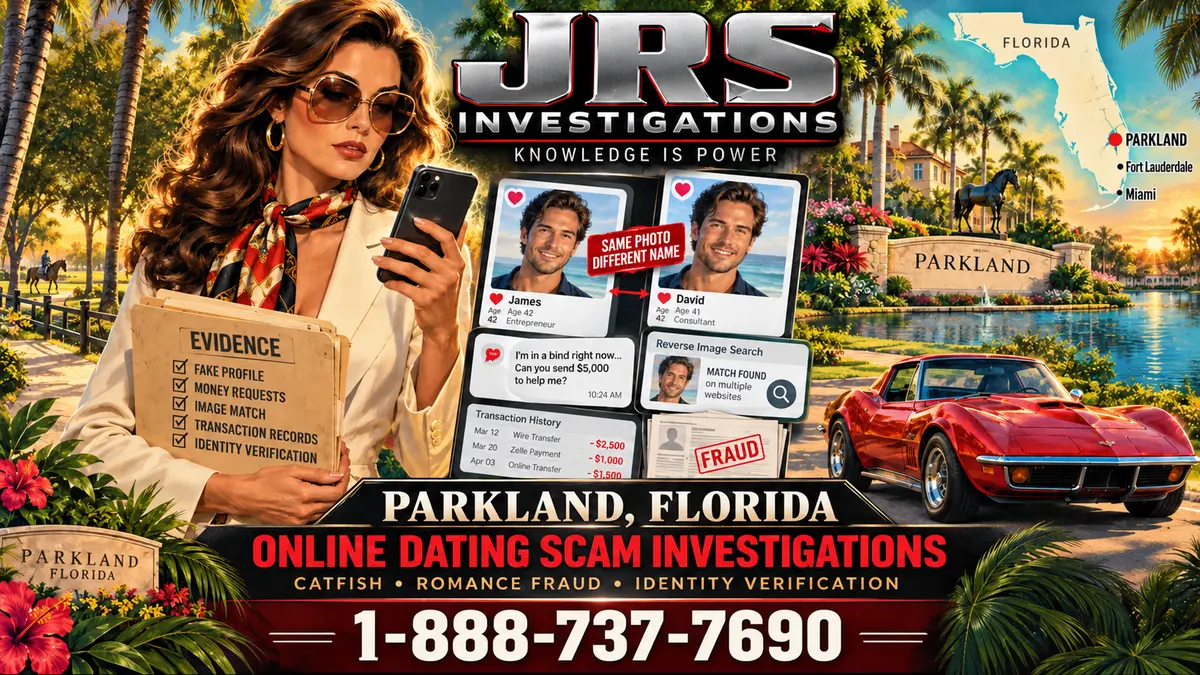
Parkland Online Dating Scam Investigations: 7 Warning Signs
An online relationship can become emotionally serious before the people involved ever meet. Messages may arrive every morning and evening, personal histories are exchanged and future plans begin to feel real. Then the pattern changes. A sudden emergency requires money, a promised meeting is cancelled, a cryptocurrency opportunity appears or the person asks for sensitive information.
For someone in Parkland, the distance between a believable story and a fabricated identity can be difficult to judge. A Parkland online dating scam investigator can compare profile claims with lawful sources, preserve relevant communications and document significant inconsistencies. The purpose is not to hack an account or promise that lost funds will be recovered. It is to establish what can be verified so the client can make a safer decision.
JRS Investigations approaches these cases discreetly and without judgment. If someone you met through a dating app, social network or messaging service is pressuring you for money, personal documents, investment funds or secrecy, pause before providing anything further.
How online romance scams develop
The Federal Trade Commission describes a familiar pattern: a scammer creates a false profile, builds trust over time, avoids meeting in person and eventually asks for money. The claimed reason may involve medical care, travel, customs fees, military service, a frozen business account or another urgent problem. Requests often shift toward payment methods that can be difficult to reverse, including wire transfers, gift cards, payment apps and cryptocurrency.
Not every cancelled meeting, long-distance relationship or request for help proves fraud. The concern grows when several facts conflict: photographs appear under unrelated names, employment cannot be confirmed, locations keep changing, video calls never happen and financial pressure escalates.
JRS explains the broader service on our online dating scam investigations page. Clients can also review our Parkland private investigator services.
Seven warning signs that deserve verification
1. The relationship becomes intense unusually fast
A scammer may use constant attention, affectionate language and detailed future plans to create emotional commitment before basic facts are verified. The person may describe the relationship as fate, insist on exclusivity or say that no one else understands the connection. Rapid intimacy alone is not proof, but it can make later requests feel harder to question.
Preserve early messages as well as recent ones. A complete timeline can show when affection, secrecy, emergencies and financial requests were introduced.
2. Every meeting or live video call fails
The person may claim to be working offshore, serving overseas, managing an international project or facing repeated travel problems. A scheduled video call may fail because of a broken camera, poor connection or sudden emergency. Individual explanations can be reasonable. A repeated pattern without any independent confirmation is more concerning.
Parkland residents may be told that a contact is temporarily in Boca Raton, Fort Lauderdale, Miami or another nearby city yet remains unable to meet. An investigator examines whether the stated timeline and location claims remain internally consistent. JRS does not obtain protected location or subscriber information without lawful authority.
3. Photographs or identity details do not match
False profiles often use images copied from an unrelated person. Reverse-image research may reveal the same photograph under different names, occupations, ages or countries. Usernames, telephone numbers, email addresses and public profile history may also expose conflicting identities when the information is legally available.
A single image match is a lead rather than automatic proof. Photographs are sometimes reposted legitimately, and unrelated people can share names. Responsible reporting explains the source of each connection, the supporting evidence and any limitation.
4. The person introduces an emergency or money request
Common stories include a medical crisis, travel delay, customs charge, legal problem, equipment failure, frozen account or family emergency. The amount may begin small and grow after the first payment. The person may ask the client to keep the transfer secret or provide a misleading explanation to the bank.
Do not send another payment merely because money has already been sent. Preserve the request, payment instructions, account names, receipts and transaction identifiers. Contact the financial institution or payment service quickly and describe the suspected fraud accurately.
5. The romance shifts into an investment opportunity
Some schemes combine emotional grooming with cryptocurrency, foreign exchange, precious metals or a supposed private trading platform. The account may display impressive profits and may even allow a small withdrawal. Later, the client is pressured to deposit more money or pay taxes, verification costs and release fees before a larger withdrawal can occur.
The Commodity Futures Trading Commission warns about relationships that direct victims to fraudulent trading platforms. A professional-looking website, dashboard balance or customer-service chat does not prove that funds are held in a legitimate account.
6. Secrecy and isolation become part of the story
The person may say that family members are jealous, banks are interfering or friends do not understand the relationship. They may coach the client on what to tell a financial institution or demand immediate action before anyone else can review the request.
Urgency and secrecy reduce the chance of independent verification. A confidential case review gives the client a structured way to assess the facts without public embarrassment or confrontation.
7. A recovery service appears after the loss
People who have already sent money may later be contacted by a supposed attorney, government agent, blockchain specialist or recovery company. The new contact claims the funds have been located but requires an advance payment. This may be a second fraud using information from the original scheme.
Verify the identity, organization, address, licensing claims and payment instructions before engaging. JRS can document public indicators and connections but cannot guarantee asset recovery or compel a bank, exchange or platform to release protected information.
Why Parkland cases require careful local context
Parkland is a predominantly residential community in northwest Broward County. The Broward Sheriff’s Office Parkland District describes a community with residential neighborhoods, parks, trails and regular movement throughout the surrounding region. A genuine contact may reasonably travel between Parkland, Coral Springs, Coconut Creek, Boca Raton and Fort Lauderdale.
That mobility means a location claim should not be judged in isolation. Investigators consider the whole pattern: where the person says they live, where they claim to work, dates they were supposedly nearby, public business or professional records and whether promised meetings repeatedly fail. A Parkland address or local telephone number is not proof that the person actually lives or works there.
Online research and real-world surveillance are different services. If the concern involves a spouse or partner’s physical conduct rather than a remote profile, JRS offers separate infidelity and cheating-spouse investigations.
What a dating-scam investigator can examine
A properly scoped investigation may compare the names, ages, photographs, occupations, businesses, addresses and travel claims supplied by the other person. Research can include lawful public records, open-source material, reverse-image searches, business and professional records, domain history and client-provided communications.
Broader identity questions may require background investigation services. Claims involving investments, business ownership or foreign entities may call for due diligence research.
An investigator cannot lawfully hack email or social-media accounts, steal passwords, intercept private communications, impersonate law enforcement or obtain protected banking, tax, credit, telecommunications or platform records without consent or legal authority. IP-address and subscriber information are not automatically available to private investigators. An attorney may need to evaluate subpoenas or other legal process.
Preserve the evidence before confronting or blocking
Profiles and messages can disappear quickly after a scammer realizes the target has doubts. Before blocking the account, preserve what you lawfully possess:
- The complete dating-profile URL, platform name and username.
- Every known name, alias, telephone number and email address.
- Original profile photographs and later images received.
- Chat exports or complete screenshots that include dates and account names.
- Email files with header information when available.
- Dates of promised meetings, cancellations, travel and emergencies.
- Employment, military, family, property and business claims.
- Bank, wire, payment-app, gift-card or cryptocurrency instructions.
- Receipts, transaction identifiers and wallet addresses.
- Names of supposed brokers, agents, attorneys or recovery services.
Keep original files whenever possible. Avoid cropping or repeatedly resaving screenshots when the original can be preserved. Do not enter the other person’s account, guess passwords or install tracking software.
What to do if money or sensitive information was sent
- Stop additional payments. Do not pay another emergency fee, tax, verification charge or recovery deposit.
- Contact the payment provider immediately. Tell the bank, card issuer, wire company, payment app, gift-card company or cryptocurrency platform that the transaction may involve fraud. Ask what protective steps are still available.
- Secure your accounts. Change affected passwords through the legitimate service, enable multifactor authentication and review account settings. Never share verification codes.
- Preserve the communications. Save messages, profiles, images, payment details and transaction records before reporting or blocking the account.
- Notify the platform. Report the dating or social-media profile through its official process.
- Use official reporting channels. File with the FTC through ReportFraud.ftc.gov. Cyber-enabled fraud can be reported to the FBI through the Internet Crime Complaint Center.
- Address immediate safety concerns. Contact 911 for an emergency or the appropriate local law-enforcement agency for suspected criminal activity.
The Florida Department of Agriculture and Consumer Services provides Florida-focused romance-scam guidance. The Federal Communications Commission also explains how long-term communication and stolen identities can be used to build trust.
Reporting promptly is important, but neither a report nor an investigation guarantees that an agency will open a case or that a payment will be reversed.
How JRS handles a Parkland case
Confidential consultation and scope
The process begins with the decision the client faces, the available identifiers and any immediate financial or safety issue. JRS identifies the questions that can realistically be researched, explains limitations and proposes a focused scope.
Evidence organization and chronology
Client-provided records are organized by source and date. The chronology shows when identities changed, meetings failed, financial requests appeared and investment claims developed. Missing information and time-sensitive profiles are identified early.
Identity and claim verification
Research focuses on names, photographs, contact details, location, employment, business interests, travel claims and payment narratives. Each finding is assessed for corroboration and possible innocent explanations rather than treated as automatic proof.
Clear reporting and practical next steps
The client receives a factual summary of verified information, meaningful inconsistencies, unresolved questions and supporting sources. When appropriate, the next step may involve counsel, a financial institution, the platform or an official reporting channel. JRS does not guarantee a predetermined outcome.
Timing and cost considerations
The time and cost depend on the number of identities, profiles and countries involved; the quality of the available identifiers; the volume of messages; the number of payments or entities; urgency; and whether any lawful fieldwork is justified. A focused identity review is typically narrower than a matter involving multiple businesses, trading platforms and international payment channels.
JRS discusses the proposed scope, rates and authorized expenses before work begins. The investigation cannot guarantee that a subject will be identified, that authorities will act or that funds will be recovered.
Frequently asked questions
Can JRS prove that a dating profile is fake?
Sometimes the available evidence establishes strong inconsistencies, such as one photograph being used under unrelated identities. Other cases remain inconclusive. The report should explain what is supported and what could not be verified.
Can an investigator trace an IP address from a message?
Not automatically. Platforms and service providers control protected technical and subscriber data. Legal process may be required, and JRS does not promise access to private platform records.
Can JRS recover money sent to a scammer?
JRS can document payment instructions and related investigative leads, but recovery cannot be guaranteed. Contact the payment provider quickly and use appropriate official reporting channels.
Should I confront the person?
Preserve evidence first. Confrontation may cause profiles and communications to disappear or lead to more pressure. Consider the safest sequence with the investigator and, when appropriate, counsel or law enforcement.
Will the case be handled discreetly?
Yes. Romance fraud is designed to exploit trust and emotion. JRS provides a confidential, factual review without judgment.
Request a confidential Parkland case review
JRS serves clients throughout Broward County and across Florida. Review our Florida investigation coverage or contact JRS Investigations to discuss the situation.
Knowledge is power. If you need help verifying an online relationship or organizing evidence of suspected romance fraud in Parkland, call JRS Investigations at 1-888-737-7690 for a confidential consultation.
For broader case-planning and investigator-selection guidance in Palm Beach County, review our Boca Raton private investigator hiring guide.
JRS Investigations in Parkland: Parkland TSCM bug sweeps