(888) 737-7690

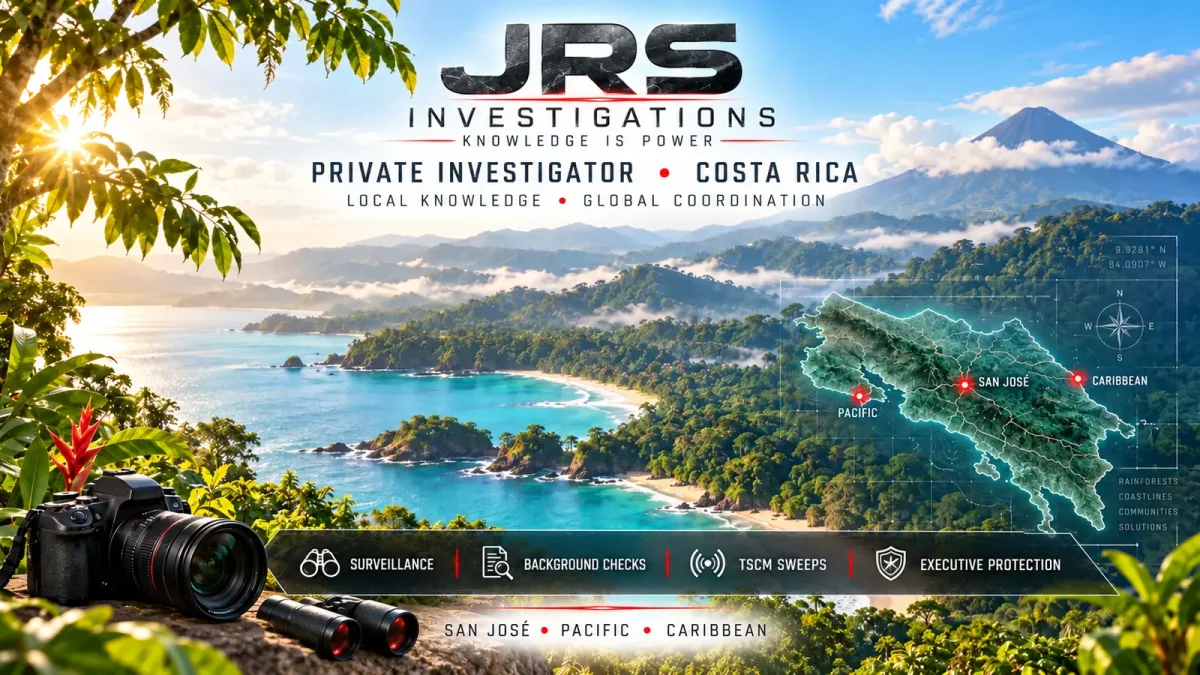
How to Hire a Private Investigator in Costa Rica: A Professional Guide
Hiring a private investigator in Costa Rica can involve more than finding someone who owns a camera or advertises local contacts. The assignment may cross borders, languages, legal systems, travel routes, and different rules governing privacy and personal data. Whether the concern involves a relationship, a background inquiry, a missing person, a business transaction, assets, security, or potential litigation, the investigation should begin with a clear objective and a lawful plan.
A professional agency should explain what can reasonably be verified, who will perform the work, how evidence will be documented, and which limitations may affect the result. It should never promise certainty before reviewing the facts. This guide explains how to evaluate an investigator, prepare the case, protect confidential information, and coordinate a Costa Rica assignment with JRS Investigations.
Start With the Decision the Investigation Must Support
“Find out everything” is not a practical scope. Begin by identifying the decision you need to make or the question you need answered. A focused objective helps the investigator select appropriate methods, estimate time and cost, and separate useful evidence from unrelated information.
Your objective may be to:
- Document activity relevant to an infidelity, cohabitation, custody, or family-law matter
- Locate a person, witness, family member, debtor, heir, or business contact
- Verify identity, employment, education, companies, property interests, or other background claims
- Investigate suspected fraud, theft, conflicts of interest, counterfeit activity, or business misconduct
- Develop lawful public-record leads involving companies, real estate, vehicles, liens, or litigation
- Assess concerns involving hidden cameras, microphones, transmitters, trackers, or other surveillance devices
- Support an attorney with documented field observations, witness location, or fact development
Tell the investigator why the information is needed, where the relevant events occurred, who is involved, what is already known, and whether a court, transaction, or travel deadline applies. A careful intake process is a sign that the agency is designing the work around your actual purpose.
Confirm Who Will Perform the Work in Costa Rica
International assignments require clear responsibility. Ask whether the agency will send an investigator, coordinate qualified resources in Costa Rica, or use a combination of international case management and local field support. Confirm who supervises the case, who communicates with you, and which person or entity is responsible for each task.
Do not rely on vague claims about “global reach.” Ask for a written explanation of the operational structure. The investigator should be able to describe how local authority, privacy restrictions, travel, language, records access, and evidence handling will be addressed without disclosing another client’s confidential information.
JRS evaluates Costa Rica assignments according to the requested service, location, legal purpose, timing, and availability of appropriate resources. Visit the JRS Costa Rica private investigator page for an overview of the service area. Availability and methods always depend on the facts and applicable law.
Understand Costa Rica’s Privacy and Data-Protection Environment
An investigation must respect the laws that apply where the work occurs. Costa Rica’s personal-data framework includes Law No. 8968, the Law for the Protection of Individuals Regarding the Processing of Personal Data. The national data-protection authority, PRODHAB, publishes the official data-protection law and related regulations.
This matters because a client’s interest in information does not automatically create a right to obtain it. Protected databases, private communications, account credentials, medical information, financial records, and other personal data may be restricted. A responsible investigator should ask about your lawful purpose, the subject’s relationship to you, consent or authorization where relevant, and whether an attorney is directing the assignment.
Be cautious if anyone proposes unauthorized access to email, social-media accounts, cloud storage, banking information, telephone records, hotel systems, or private databases. The same warning applies to unlawful entry, illegal recording, impersonating an official, or placing a tracking device without proper authority. The investigator should decline improper requests and recommend a lawful alternative when one exists.
Match the Investigator’s Experience to the Case
General experience is useful, but relevant experience is more important. Surveillance, background research, witness location, technical surveillance countermeasures, fraud inquiries, digital forensics, and executive protection require different skills. Ask how the agency has handled similar assignments and what obstacles are common in that type of case.
A useful answer should describe the process, reporting, supervision, and limitations rather than reveal details about another client. Be wary of a provider who uses confidential case information as a sales presentation. That behavior may indicate how your own matter will be treated.
Review JRS’s broader private investigation services and discuss which discipline fits your objective. A service should not be added simply because it is available. The proposed work should be reasonably designed to answer the defined question.
Plan for Costa Rica’s Geography and Travel Conditions
Costa Rica is visually beautiful, but its terrain and transportation conditions can make fieldwork demanding. An assignment in metropolitan San José differs from one in Guanacaste, the Central Pacific, the Caribbean coast, or a remote mountain community. Distance alone does not show how long travel will take.
Ask how the investigator will account for road conditions, weather, seasonal traffic, secure transportation, lodging, language, access, and the subject’s travel pattern. Surveillance near a gated community, resort, marina, rural property, airport, border area, or densely populated city may require different preparation.
Good planning also considers the possibility that a subject will move between provinces or leave the country. The agreement should explain how the agency will handle material changes in location, whether additional authorization will be required, and how travel expenses will be approved.
Use Reliable Records and Understand Their Limits
Not every record is public, current, complete, or available through one search. A database result should be treated as a lead until important facts are verified through an appropriate source. Names can be shared by several people, addresses can be outdated, and translated identifiers can be entered inconsistently.
Costa Rica’s National Registry offers online consultation and certification services involving legal entities, real property, movable property, intellectual property, and other registered interests. The record needed, access method, fee, and evidentiary value depend on the inquiry. A registry result may identify a useful connection, but it does not by itself explain beneficial ownership, control, current possession, or the purpose of a transaction.
Criminal-record certificates also require care. Costa Rica’s Judicial Branch explains that the “hoja de delincuencia” may be requested electronically by the person through its online system and may be obtained physically under specified procedures. Its official guidance describes personal identification, authenticated authorization in certain circumstances, and procedures for people outside Costa Rica. Review the Judicial Branch guidance for criminal-record certificates rather than assuming that another person’s complete criminal history is openly available.
If the case involves a potential employee, partner, tenant, vendor, investment, or romantic relationship, discuss what the background-check process can lawfully confirm. Proper identity matching and source verification are essential.
Define Evidence and Reporting Requirements Early
If the investigation may support litigation, an insurance claim, an employment decision, or another formal proceeding, tell the agency before work begins. An attorney may need to define relevance, privilege, preservation, local procedure, or testimony requirements.
Ask what the final work product will contain. Depending on the assignment, it may include:
- A chronology of investigative activity
- Dates, times, locations, observations, and source descriptions
- Photographs or video obtained through lawful fieldwork
- Public-record results with identifiers and limitations
- Interview summaries or statements where appropriate
- An explanation of what was verified, what remains unconfirmed, and why
Good reporting distinguishes direct observations from third-party statements and database leads. Ask how original media will be stored, how files will be transferred, whether timestamps and metadata will be preserved, and how long the agency retains its case materials. If testimony or affidavits may be requested, clarify availability and fees in advance.
Protect Confidentiality Across Borders
International investigations often involve passports, itineraries, addresses, family information, business records, financial concerns, photographs, and private communications. Confirm how the agency protects intake materials, reports, recordings, passwords, and case updates.
Ask who will have access to the file and whether interpreters, local investigators, drivers, technical specialists, or other contractors may participate. Sensitive information should be limited to personnel with an operational need. If you are represented by counsel, ask whether communication and reports should be routed through the attorney.
Clients also play an important role. Do not confront the subject, announce the investigation, alter potential evidence, or post about the matter online. Avoid beginning your own surveillance or contacting witnesses after the agency starts unless the investigator and counsel advise that a specific step is appropriate.
Understand Retainers, Rates, and International Expenses
Costs depend on the service, location, urgency, duration, staffing, travel, records, equipment, reporting, and legal requirements. Some research may be quoted at a fixed price. Surveillance and field assignments are commonly billed by time against a retainer.
Before authorizing work, request a written agreement that identifies:
- The objective and authorized scope
- Hourly rates, minimum time, or fixed fees
- The retainer and replenishment terms
- Travel, mileage, flights, lodging, tolls, parking, records, translation, and equipment expenses
- Currency and payment arrangements
- Report, media, attorney-coordination, affidavit, and testimony fees
- Cancellation terms and the approval process for material scope changes
The lowest quote is not necessarily the best value, but a high price does not prove quality. Compare the method, supervision, reporting, relevant experience, and realistic chance of answering your question.
Set a Communication Plan
Confirm who will be your case contact, how updates will be delivered, and what decisions require your approval. Time zones, active surveillance, remote locations, and rapidly changing travel can affect communication. Agree on reasonable reporting intervals and an urgent-contact process before fieldwork begins.
A professional investigator should also explain what cannot be predicted. No one can guarantee that a subject will appear at a particular place, that a hidden asset exists, that every record contains current information, or that a person will remain in Costa Rica during the assignment.
Warning Signs When Hiring an Investigator
Pause before retaining a provider that:
- Guarantees a specific result before reviewing the facts
- Will not identify who performs or supervises the work
- Claims unrestricted access to government, telephone, banking, or immigration databases
- Suggests hacking, illegal recordings, trespass, impersonation, or unauthorized tracking
- Refuses to provide a written scope and fee structure
- Uses fear or urgency to sell unnecessary services
- Cannot explain how findings will be documented
- Shares private details about other clients
- Promises that evidence will automatically be admissible in court
Questions to Ask During the Consultation
- Who will perform the work in Costa Rica, and who will supervise the case?
- What experience do you have with this type of assignment?
- Which methods are appropriate, and what legal or practical limits apply?
- What information and documents do you need from me?
- How will identity and record matches be verified?
- What will the report contain, and how will evidence be preserved?
- Who will have access to my case information?
- What is the estimated budget, and which expenses are separate?
- What conditions could change the scope, timing, or cost?
- Can you coordinate with my attorney if the matter may lead to litigation?
Prepare for the Initial Case Review
Organize the facts before contacting an agency. Prepare a concise timeline, correct names and identifiers, photographs, addresses, known travel plans, vehicle information, companies, property details, documents, court dates, and examples of relevant communications. Label what you personally observed and what someone else reported.
Provide the general location, objective, deadline, and intended use of the findings. Do not send highly sensitive records until you have verified the agency and agreed on a secure delivery method. If anyone faces an immediate threat or emergency, contact Costa Rican emergency services or the appropriate local authority before seeking private investigative assistance.
How JRS Approaches Costa Rica Assignments
JRS begins with a confidential consultation to understand the objective, people involved, locations, timing, and intended use of the information. We evaluate lawful options, explain material limitations, and recommend a scope suited to the case. Work begins only after the client authorizes the agreement and required retainer or fee.
When an assignment requires local support, counsel, translation, digital forensics, cybersecurity, or another specialist, JRS evaluates the appropriate coordination rather than presenting one service as the answer to every problem. Findings are documented according to the authorized scope, and material changes are discussed with the client.
Costa Rica Private Investigator FAQs
Can a private investigator guarantee a result?
No responsible investigator should guarantee a particular finding. The agency can explain its plan, level of effort, reporting, and likely obstacles, but it cannot control the facts or the subject’s actions.
Can an investigator obtain any Costa Rican record?
No. Access depends on the type of record, lawful purpose, identity requirements, consent or authorization, and applicable privacy rules. Some information is public, some requires a formal request or certification, and some is restricted.
Can JRS investigate anywhere in Costa Rica?
Assignments are evaluated individually. Availability depends on the requested service, precise location, legal authority, timing, travel, and qualified resources. A consultation is necessary before confirming coverage.
How quickly can fieldwork begin?
Timing depends on location, investigator availability, preparation, travel, lawful authority, and urgency. Early contact allows more time to verify information and build a practical plan.
How do I contact JRS Investigations?
Use the confidential JRS contact form or call (888) 737-7690. Provide the general location, objective, deadline, and whether an attorney is involved. JRS will review the request and explain appropriate next steps.
Choose a Clear, Lawful, and Well-Documented Process
The right private investigator in Costa Rica should help you understand what can be investigated, how the work will be performed, who is responsible, and what the final report will show. A credible agency will define the scope, protect confidential information, respect privacy and data restrictions, document verified facts, and communicate when conditions require a change in strategy.
Take time to compare written proposals and ask direct questions. The strongest investigative plan is not the one that promises the most. It is the one that is lawful, focused, practical, and designed to produce information you can actually use.