(888) 737-7690

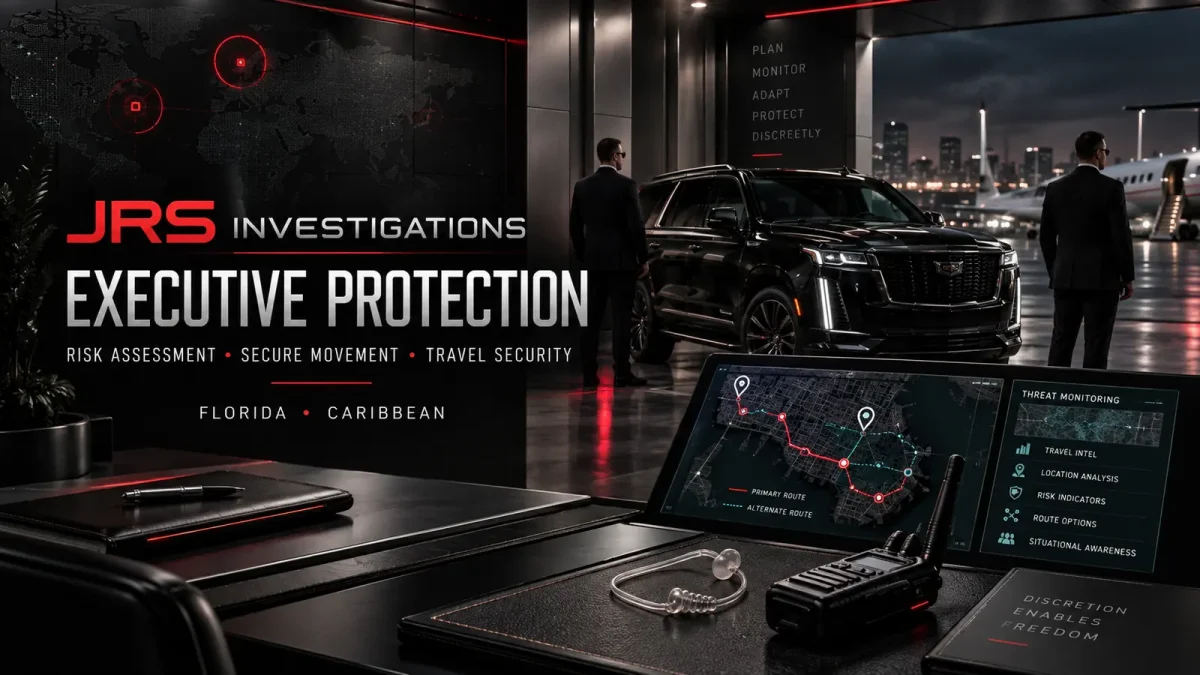
How to Choose Executive Protection Services: A Practical Guide
Choosing executive protection is not the same as hiring a visible bodyguard for a few hours. Effective protection begins before an agent meets the client. It combines a realistic risk assessment, advance planning, secure movement, communications, contingency preparation, and a professional presence that fits the client’s schedule and public profile.
JRS Investigations provides discreet private security and executive protection services for selected assignments in Florida, the Caribbean, and other locations where the work can be performed lawfully. Every engagement is evaluated individually because the risks surrounding a corporate executive, family, public figure, legal professional, or visiting VIP are different.
What Executive Protection Should Accomplish
The purpose of executive protection is to reduce exposure and help the client move through business and personal activities safely. A qualified team should not create unnecessary attention or interfere with the client’s work. The goal is a practical security plan that supports normal movement while preparing for credible risks.
Depending on the assignment, a plan may address:
- Threat, vulnerability, and lifestyle assessment
- Advance review of venues, hotels, residences, offices, and routes
- Airport, hotel, meeting, and event movements
- Secure transportation and alternate-route planning
- Close protection for the principal and, when authorized, family members
- Protective intelligence and monitoring of relevant, lawfully available information
- Medical, communication, evacuation, and emergency contingencies
- Coordination with venue security, drivers, staff, counsel, or local authorities
No provider can eliminate every risk. A credible firm should explain the limits of the assignment, distinguish confirmed facts from assumptions, and tell you when another licensed specialist or local resource is required.
Start With a Case-Specific Risk Assessment
A protection plan should be built around the principal, not copied from a generic package. The initial assessment considers why protection is being requested, whether a specific threat exists, the locations involved, the client’s routine, public visibility, travel schedule, family considerations, and any recent event that changed the risk level.
Relevant questions may include whether the client has received threatening communications, is involved in litigation or a termination, is traveling with valuable property, will attend a high-visibility event, or has personal information exposed online. The answers help determine staffing, timing, transportation, equipment, and coordination needs.
A responsible assessment also avoids exaggeration. Online comments, unusual encounters, and unwanted contact may deserve documentation, but they do not all represent the same threat. Protection resources should be proportionate to the known circumstances and adjusted as new information becomes available.
Verify Licensing, Authority, and Geographic Coverage
Ask who will legally perform the work and which licenses apply in every jurisdiction. In Florida, the Florida Department of Agriculture and Consumer Services licenses and regulates the private-security industry under Chapter 493. Requirements differ for agencies, individual security officers, managers, and armed duties.
Interstate and international assignments require additional care. A license or authorization in one location does not automatically transfer to another. The provider should explain whether the assignment will be handled directly, through properly qualified local personnel, or through coordinated resources. If firearms, controlled access, armored transportation, maritime activity, or another regulated service is proposed, confirm the specific legal authority and operational responsibility before the engagement begins.
JRS evaluates assignments based on location, licensing, scope, and available resources. Services are provided only where authorized and appropriate for the circumstances.
Evaluate Advance Work and Movement Planning
Good protection is often nearly invisible because the preparation occurs before the principal arrives. Advance work may include reviewing entrances and exits, parking, loading areas, elevators, private meeting spaces, medical facilities, communications coverage, and predictable congestion points.
Movement planning should address the primary route and realistic alternatives. The team needs current schedules, transportation details, points of contact, access credentials, and a process for last-minute changes. For international travel, current destination information matters. The U.S. Department of State’s international travel guidance recommends reviewing travel advisories, entry requirements, local laws, and embassy or consulate information before departure.
Ask a prospective provider how it prepares for flight delays, venue changes, severe weather, medical issues, demonstrations, vehicle problems, or an unexpected crowd. A useful answer should describe a planning process without exposing sensitive tactics.
Look Beyond Physical Presence
An experienced agent’s awareness and judgment are more important than an intimidating appearance. Effective protection may involve observing the environment, identifying developing problems, creating distance, changing movement, coordinating with others, and de-escalating when possible.
Protective intelligence can strengthen that work. Depending on legal authority and scope, investigators may review threatening messages, public records, open-source information, known associates, or concerning activity connected to a specific risk. When the concern involves physical or electronic surveillance, JRS can assess whether counter-surveillance or TSCM support is appropriate. TSCM is a specialized inspection service and should not be presented as a substitute for physical protection, cybersecurity, or digital forensics.
Confirm Communication and Emergency Readiness
A protection team needs a clear communication structure. Before the assignment, confirm who has decision-making authority, how schedule changes are shared, which information is restricted, and how the team will communicate if normal cellular service is unreliable.
Emergency planning should include the nearest suitable medical facility, emergency contacts, transportation alternatives, and a simple procedure for separating or relocating the principal. Training and equipment should match the assignment. Ask how the provider verifies personnel qualifications and how it coordinates with venue staff, drivers, medical resources, or law enforcement when necessary.
A provider should never promise that technology will predict every threat. Location tools, secure communications, cameras, and mapping can improve awareness, but they depend on lawful use, reliable connectivity, disciplined personnel, and a clear response plan.
Choose the Right Protection Profile
Some clients need a visible deterrent. Others require a low-profile agent who can blend into a business meeting, family trip, yacht itinerary, or social event. Clothing, vehicles, staffing, and proximity should suit the environment. The right profile protects the client without attracting avoidable attention.
Discretion also includes information handling. Ask who will receive the itinerary, where sensitive details are stored, how vendors are briefed, and when records will be retained or destroyed. A professional provider should collect only the information needed for the assignment and restrict access to personnel with a legitimate operational role.
Questions to Ask Before Hiring
- What licenses and insurance apply? Verify the agency and personnel requirements for the exact location and duty.
- Who is responsible for the assignment? Identify the project lead, field personnel, and any local partners.
- How is risk assessed? Look for a structured intake and planning process rather than an immediate staffing recommendation.
- What advance work is included? Clarify venue, route, hotel, residence, transportation, and contingency planning.
- How are schedule changes handled? Confirm communication, overtime, travel, cancellation, and emergency procedures.
- What does the written scope cover? Staffing, hours, locations, equipment, transportation, reports, expenses, and exclusions should be understandable.
- How is confidentiality protected? Ask about information sharing, records, devices, vendors, and media inquiries.
- What happens when risk changes? The provider should have a process to reassess and obtain authorization before materially expanding the work.
Warning Signs When Comparing Providers
Be cautious when a provider guarantees complete safety, recommends armed personnel without a documented need, refuses to discuss licensing, or offers the same package for every client. Other warning signs include vague pricing, unclear supervision, no written scope, pressure to disclose unnecessary personal information, and dramatic claims that cannot be substantiated.
A credible provider will be comfortable discussing limitations. It should also explain when a request falls outside its authority or requires legal counsel, law enforcement, cybersecurity professionals, medical personnel, or locally licensed security resources.
How JRS Develops an Executive Protection Assignment
JRS begins with a confidential consultation focused on the client’s objective, known concerns, location, schedule, and preferred protection profile. We then evaluate the assignment’s legal and operational requirements and recommend a practical scope. That may include advance planning, secure movement, close protection, investigative support, or coordination with qualified resources.
Our broader investigation and security services can support assignments that involve background research, surveillance concerns, threat-related fact gathering, or other authorized needs. Each service has different methods and limitations, and the proposed work is explained before it begins.
Pricing depends on staffing, duration, urgency, travel, transportation, equipment, location, and coordination requirements. Clients should receive a clear written scope and understand anticipated expenses before authorizing the work.
Executive Protection FAQs
Is executive protection only for celebrities?
No. Corporate leaders, attorneys, witnesses, families, travelers, public figures, and individuals facing a specific concern may need temporary or ongoing protection. The deciding factor is the risk and assignment—not fame.
Can protection be discreet?
Yes. Many assignments use a low-profile approach designed to fit the client’s routine. The appropriate visibility depends on the circumstances and deterrence needs.
How early should planning begin?
As early as practical. Additional time allows for a better assessment, advance work, local coordination, transportation planning, and contingency development. Urgent requests can be evaluated, but availability and options may be more limited.
Does executive protection include cybersecurity?
Not automatically. Physical protection, protective intelligence, TSCM, and cybersecurity are distinct disciplines. JRS defines the authorized scope and recommends qualified specialist support when the concern falls outside that scope.
How do I request a confidential consultation?
Use the JRS contact page or call (888) 737-7690. Share the general location, dates, reason for the request, and any immediate safety concern. If there is an active emergency or imminent danger, contact 911 or the appropriate local emergency service first.
Choose Preparation Over Appearance
The best executive protection is defined by planning, judgment, lawful authority, discretion, and adaptability—not by how imposing an agent looks. Compare providers carefully, verify credentials, insist on a clear scope, and choose a team that can explain how each recommendation addresses the actual risk.
JRS Investigations is available to evaluate executive, VIP, travel, event, and family-protection needs for selected assignments. Contact us for a confidential discussion of the location, schedule, concerns, and appropriate next steps.