(888) 737-7690

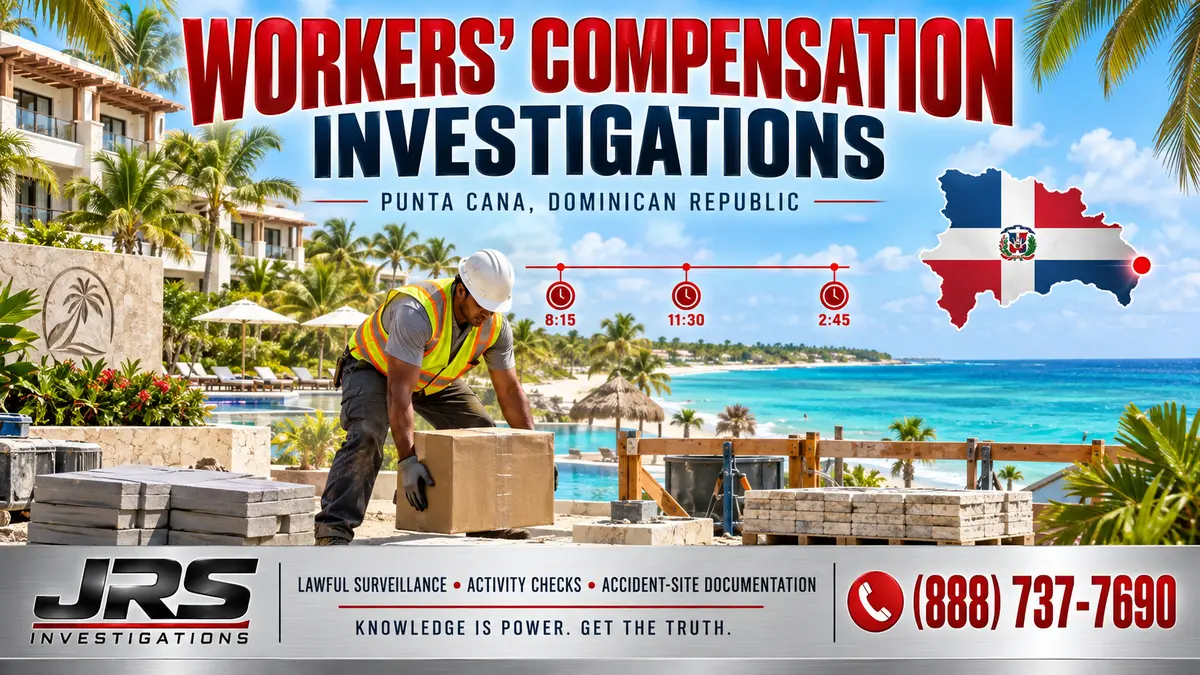
Punta Cana Workers’ Compensation Investigations: Evidence Guide
A Punta Cana workers’ compensation investigator can help insurers, employers, third-party administrators, and attorneys document facts when a claim has a connection to the Dominican Republic. The assignment may involve an employee who lives or travels in Punta Cana, an accident that occurred at a resort or worksite, or a cross-border claim requiring local evidence and organized reporting.
JRS Investigations provides lawful, discreet support tailored to the exact questions in the file. Depending on the authorization and jurisdiction, that support may include activity checks, surveillance from lawful vantage points, accident-site documentation, witness interviews, public-record and social-media research, identity and address verification, and coordination of records. The objective is not to presume fraud. It is to develop accurate evidence that helps the client evaluate the claim fairly.
When a Punta Cana workers’ compensation investigation may help
Cross-border claims can be difficult because the claimant, employer, insurer, medical provider, witnesses, and accident location may be in different countries. Time differences, language, local procedures, travel patterns, and incomplete records can make even a legitimate claim hard to assess.
An investigation may be appropriate when:
- The reported injury occurred in or near Punta Cana, Bávaro, Cap Cana, or another area of La Altagracia Province.
- A claimant receiving benefits is temporarily residing, vacationing, or working in the Dominican Republic.
- The reported physical limitations appear inconsistent with other documented information.
- The client needs current photographs or video of an accident location before conditions change.
- Witnesses, coworkers, supervisors, vendors, or property personnel must be identified or interviewed.
- Employment, business, address, or travel claims require lawful verification.
- Publicly available social-media activity may be relevant to the stated timeline or restrictions.
- Counsel needs a clear chronology and source-organized report for further review.
A concern or inconsistency is a reason to gather facts, not a conclusion. Each observation must be evaluated in context, including medical restrictions, the date and duration of the activity, and information supplied by counsel or the claims professional.
Two different types of cross-border claims
A Punta Cana assignment can arise under a United States insurance or litigation matter, under the Dominican Republic’s occupational-risk system, or through a contract that involves more than one jurisdiction. Those are not interchangeable.
The Dominican Republic’s social security framework includes occupational-risk coverage under Law 87-01 and related regulations. The National Social Security Council’s occupational-risk regulation and the IDOPPRIL occupational-risk guidance provide official information about reporting and benefits in the Dominican system.
JRS does not decide coverage, compensability, disability, or which country’s law applies. Those decisions belong to the appropriate insurer, administrator, agency, or attorney. Before fieldwork begins, the client should identify the governing claim, the permitted scope, and any deadlines or evidentiary requirements.
Lawful activity checks and surveillance
Surveillance can help document observable activity when it is relevant to a stated limitation or claim issue. The work must be conducted from lawful locations, without trespassing, harassment, prohibited tracking, or access to private accounts.
A useful assignment begins with a narrow question. For example: Is the claimant present at the verified address? Is the person performing recurring physical activity in a publicly observable setting? Does the documented activity match the date, time, location, and identity required by the client?
JRS can coordinate:
- Address and identity confirmation before deploying field resources.
- Lawful mobile or stationary observation when conditions permit.
- Time-stamped notes describing activities without exaggeration.
- Photographs or video captured from permissible vantage points.
- Daily summaries that separate observation from interpretation.
- Prompt notice when travel, access, weather, or security conditions affect the assignment.
Short clips can be misleading when separated from the surrounding timeline. A professional report should explain how long the activity lasted, what happened before and afterward, whether the person was continuously observed, and where identification is certain or uncertain.
Accident-site and condition documentation
Punta Cana contains resorts, construction projects, hospitality workplaces, transportation routes, commercial properties, private developments, and marine recreation. Conditions may change quickly after an incident. Equipment may be moved, temporary barriers removed, repairs completed, signs replaced, or witnesses reassigned.
When authorized, an accident-site investigation may document:
- The overall location and approach routes.
- Lighting, visibility, walking surfaces, stairs, handrails, doors, or access points.
- Equipment placement and publicly visible safety information.
- Weather, landscaping, construction, or temporary conditions visible at the time of inspection.
- Potential camera locations without attempting to access private footage.
- Measurements or diagrams requested by counsel and feasible within the authorized access.
- Nearby businesses or individuals who may have relevant knowledge.
Access permission matters. A resort, worksite, gated development, or private business may restrict photography, interviews, or entry. JRS plans the assignment around lawful access and documents any limitation that prevents a requested task.
Witness interviews and statement development
Witnesses can clarify what happened before, during, and after an incident. In a hospitality or tourism setting, the relevant person may be a coworker, supervisor, contractor, driver, security employee, maintenance worker, guest, or medical responder.
An effective interview focuses on personal knowledge. The investigator should identify the witness, establish where the witness was located, record what the person actually saw or heard, and distinguish direct observation from rumor. When a signed or recorded statement is requested, the client should confirm the required format, language, consent rules, and attorney instructions before the interview.
Translation should preserve meaning rather than improve or reshape the account. Reports should identify when an interpreter was used and avoid presenting translated wording as though it were a verbatim English statement.
Records, social media, and digital evidence
Publicly available information may help confirm identities, business interests, employment representations, travel, sports, events, or dates relevant to the claim. The work can complement JRS workers’ compensation investigation services and lawful surveillance investigations.
JRS does not hack accounts, impersonate a claimant, bypass privacy controls, or purchase restricted records without authority. A social-media post also requires context. Upload dates may differ from event dates, captions may be inaccurate, and shared material may belong to someone else. Findings should include the source, access date, profile identifiers, and the reason the material appears connected to the subject.
Official Dominican documentation may be important
For a claim within the Dominican occupational-risk system, official procedures and documents can be essential. IDOPPRIL states that workplace accidents may be reported using its ATR-2 process and lists supporting materials for event qualification. Its official document requirements for occupational accidents include medical and employer materials, with additional documents in some off-premises cases.
A private investigator should not replace an agency process or legal request. JRS can help clients identify, organize, and document available information, while formal records should be requested by the person or representative legally entitled to obtain them.
What a well-organized investigation report should contain
A cross-border report should be useful to someone who was not present in Punta Cana. Clear reporting typically includes:
- The client’s stated objective and authorized scope.
- Verified subject identifiers and known addresses.
- A chronological activity log using local time and the applicable time zone.
- Locations, vantage points, access conditions, and material interruptions.
- Photographs or video referenced by date and sequence.
- Witness names, roles, contact details, and interview limitations when lawfully obtained.
- Public-source links or record references with access dates.
- A distinction between confirmed facts, observations, third-party statements, and unresolved questions.
Files should remain traceable from collection through delivery. The client should communicate retention, transfer, confidentiality, and preferred report-format requirements at the beginning of the assignment.
How JRS coordinates a Punta Cana assignment
- Case intake: We review the claim question, deadlines, known identifiers, medical or activity issues, and the jurisdiction identified by the client.
- Scope and legal boundaries: We define requested tasks, locations, permitted access, reporting needs, and any instructions from counsel.
- Pre-field verification: We confirm usable addresses, subject identifiers, schedules, local conditions, and logistical risks.
- Fieldwork and research: Authorized resources document activity, locations, witnesses, or public information relevant to the question.
- Quality review: Findings are checked for dates, identity, internal consistency, and unsupported conclusions.
- Secure reporting: The client receives organized results, media references, limitations, and recommended follow-up questions.
Clients can also review our Punta Cana private investigator services, Dominican Republic investigation services, and broader Caribbean investigation coverage.
Frequently asked questions
Can surveillance prove workers’ compensation fraud?
Surveillance documents observable conduct. It does not independently determine fraud, medical capacity, coverage, or legal liability. The insurer, claims professional, attorney, agency, or court evaluates the evidence with the rest of the file.
Can you enter a resort or private development?
Only when access is lawful and authorized. Private properties may impose rules or deny entry. Investigators must respect property rights, privacy, and local requirements.
Can you obtain medical or government records?
Only records available through lawful authority, consent, public access, or the proper requesting party. Restricted medical, employment, immigration, or government information is not accessed without authorization.
Do you work with attorneys and insurance professionals?
Yes. A defined objective, verified subject information, medical or claim context, deadlines, and reporting instructions help make the assignment efficient and relevant.
How quickly can a Punta Cana investigation begin?
Timing depends on the scope, location, access, subject information, local conditions, and required coordination. Early contact is helpful when a site may change or a claimant’s travel window is limited.
Discuss a Punta Cana workers’ compensation investigation
JRS Investigations can help organize a lawful, focused plan for activity documentation, surveillance, witness work, accident-site evidence, public research, and cross-border reporting in Punta Cana and the Dominican Republic.
Call toll-free at (888) 737-7690 or email contact@jrsinvestigations.com. Knowledge is power. Get the truth.
This page provides general information, not legal, medical, coverage, or claims-handling advice. Laws and procedures vary by jurisdiction and case. Consult qualified counsel and the appropriate agency for legal requirements.