(888) 737-7690

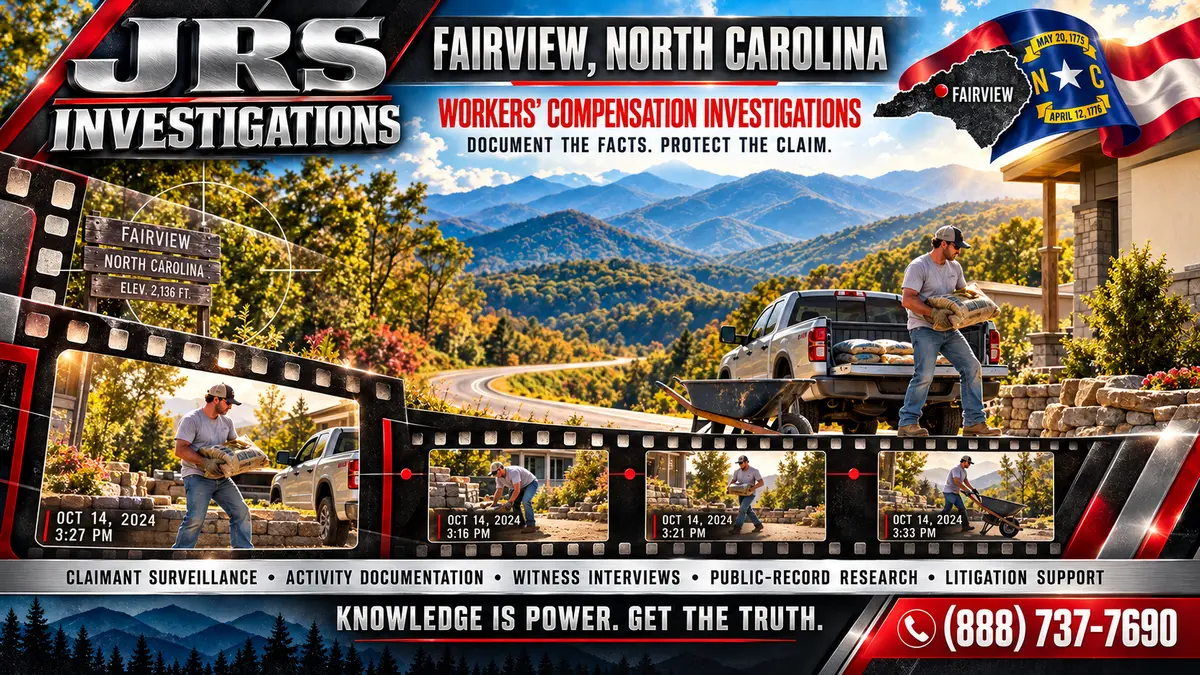
Fairview NC Workers’ Compensation Investigations: Evidence Guide
A Fairview NC workers’ compensation investigator can help turn scattered concerns into a clear, time-stamped record. JRS Investigations supports insurers, third-party administrators, self-insured employers, attorneys, and other authorized clients with discreet fact-finding in Fairview and the greater Asheville area. The purpose is not to assume fraud or decide whether a claim is valid. It is to document relevant facts lawfully, preserve context, and provide a professional report that decision-makers can evaluate alongside medical, employment, and legal records.
Workers’ compensation cases often involve competing descriptions of an injury, changing work restrictions, disputed timelines, or questions about public activity. One photograph rarely answers those questions. A useful investigation considers sequence, duration, repetition, and context. JRS plans each assignment around the specific issue in dispute so the work remains proportionate, focused, and defensible.
What a Fairview workers’ compensation investigation can establish
An investigation may help verify when an incident occurred, identify witnesses, document publicly visible activity, preserve relevant online material, or test whether a reported timeline matches independent facts. The findings can support claim review, litigation preparation, settlement analysis, or counsel’s assessment of the next step.
Investigators do not make medical conclusions. A video showing activity does not, by itself, prove that a person is uninjured or dishonest. Pain can fluctuate, restrictions can be nuanced, and a brief activity may not reflect what someone can sustain over a full workday. That is why JRS reports what was observed without exaggeration and preserves the surrounding context.
Workers’ compensation investigation services
Claimant and activity surveillance
Lawful surveillance can document activity visible from public roads, parking areas, businesses, and other places where there is no reasonable expectation of privacy. Depending on the assignment, investigators may record travel, errands, recreational activity, work-like activity, or repeated physical movements that are relevant to the stated investigative objective.
Effective surveillance is planned around known schedules, appointments, employment leads, weather, traffic, and the local terrain. Fairview combines rural roads, mountain routes, residential areas, farms, and quick access to Asheville. Those conditions affect observation points, travel times, and the amount of coverage required. JRS develops a plan before fieldwork begins and adjusts only when the facts justify it.
Timeline and activity verification
A claim may turn on more than physical capability. Dates, locations, vehicle movements, business activity, secondary employment, and recurring patterns can matter. JRS can compare authorized case information with lawfully obtained observations and public-source research to create a structured chronology. The final report distinguishes confirmed facts from leads that could not be verified.
Witness identification and interviews
When authorized and appropriate, investigators can identify and interview coworkers, supervisors, incident witnesses, or other relevant sources. Interviews are conducted professionally, without intimidation or false claims of government authority. Statements are documented carefully so counsel or the claim professional can understand who said what, when the interview occurred, and whether supporting information exists.
Public-record and open-source research
Public records and open-source information may help confirm addresses, business affiliations, court history, property connections, or publicly advertised work. JRS also can preserve publicly available social-media posts when they are relevant to a legitimate assignment. The goal is verification, not speculation. An isolated post can be misleading, so source, date, context, and authenticity should be recorded whenever possible.
Photographic, video, and written reporting
Clients receive organized documentation designed for efficient review. Depending on the assignment, the work product may include a chronological narrative, photographs, video, observation times, location information, vehicle details, source notes, and a summary of investigative results. Original media and metadata are preserved according to the needs of the case.
When an investigation may be appropriate
Not every workers’ compensation matter needs field investigation. It may be appropriate when a legitimate factual question cannot be resolved from the existing file, such as:
- Reported limitations appear inconsistent with reliable, case-specific information.
- There is a credible lead involving unreported employment or business activity.
- The accident timeline or location is disputed.
- Witness accounts conflict or important witnesses have not been located.
- Upcoming litigation, mediation, or settlement review requires current facts.
- A prior observation produced a meaningful lead that warrants proportionate follow-up.
A suspicion alone is not a finding. Before recommending surveillance, JRS considers the source of the concern, the likely evidentiary value, the budget, and whether a less intrusive research step could answer the question.
What JRS will not do
Lawful methods protect the client, the subject, and the usefulness of the evidence. JRS does not trespass, enter a home or private area without permission, harass a claimant, impersonate law enforcement, use illegal tracking methods, or obtain protected medical or financial records without proper authorization. Investigators do not provoke activity to manufacture evidence.
Surveillance is conducted from lawful vantage points. If a location, weather condition, or traffic pattern makes observation unsafe or intrusive, the investigator may reposition or suspend coverage. JRS reports limitations honestly rather than filling gaps with assumptions.
How the Fairview investigation process works
- Confidential consultation: We identify the client, authority, case status, objective, deadlines, and the precise question the investigation should address.
- Case review: Available facts are reviewed for dates, restrictions, known vehicles, photographs, addresses, appointments, prior leads, and potential conflicts.
- Written scope: JRS recommends a focused plan, budget, reporting format, and any conditions that could affect the assignment.
- Lawful fieldwork and research: Investigators document relevant facts while maintaining professional boundaries and minimizing unnecessary intrusion.
- Quality control and reporting: Notes, time stamps, images, and source information are organized into a clear report. Significant findings can be communicated promptly when requested.
- Follow-up planning: The client decides whether additional work is justified. JRS does not exceed the agreed scope without authorization.
Evidence is strongest when it includes context
A useful workers’ compensation report explains more than what appears in a short clip. It identifies the date and time, observation position, duration, environmental conditions, sequence of activity, and any interruption in visual contact. If a person lifts an object, the report should not guess its weight. If an activity lasts only seconds, the report should not describe it as sustained. Neutral language makes the evidence more credible.
Continuity also matters. A single day may answer a narrow question, but some cases require coverage across different days or times to determine whether an activity is recurring. The correct schedule depends on the objective and available intelligence—not on a one-size-fits-all surveillance package.
Serving Fairview and the Asheville area
Fairview’s mix of mountain terrain, winding roads, residential communities, and connections to Asheville creates practical challenges that should be considered before surveillance begins. Local planning can reduce lost time and improve the likelihood of obtaining relevant documentation. JRS provides regional support through its Fairview private investigator and Asheville private investigator resources.
For a broader explanation of available methods, review our workers’ compensation investigations and surveillance investigations service pages.
North Carolina workers’ compensation resources
North Carolina workers’ compensation claims are administered under the state Workers’ Compensation Act and the rules of the North Carolina Industrial Commission. The Commission—not a private investigator—administers and adjudicates claims. Its official website provides current forms and procedural information. Its Criminal Investigations and Employee Classification Division also explains how suspected employee or employer fraud may be reported.
These links are provided for general information, not legal advice. Deadlines and filing requirements can affect rights. Anyone making a claim, defending a claim, or considering a formal fraud report should consult qualified North Carolina counsel or the Industrial Commission for guidance specific to the matter.
Frequently asked questions
Does surveillance prove workers’ compensation fraud?
No. Surveillance documents observable facts. Claim professionals, attorneys, medical experts, and the appropriate legal authority evaluate those facts in context. JRS does not label a claimant fraudulent based on a single activity or an unverified allegation.
Can an investigator obtain medical records?
JRS does not use deception to obtain protected medical information. Authorized records supplied by the client or counsel may help define the investigative objective, but medical interpretation should be left to qualified professionals.
Can social media be used in an investigation?
Publicly available material may be preserved when relevant and lawful. Investigators should not bypass privacy settings, impersonate another person, or pressure a subject into accepting a connection request. Context and authenticity are important.
How many surveillance hours are needed?
There is no universal answer. The schedule depends on the case objective, reliable leads, expected activity, deadlines, geography, and budget. JRS recommends a defined starting scope and requests authorization before expanding it.
Discuss a Fairview NC workers’ compensation investigation
If you have a legitimate claim question that requires independent documentation, contact JRS Investigations for a confidential case assessment. We will evaluate whether surveillance, interviews, public-record research, or another lawful method is likely to produce useful information.
Knowledge is power. Get the truth. Call (888) 737-7690 or contact JRS Investigations to discuss a Fairview, North Carolina assignment.