(888) 737-7690

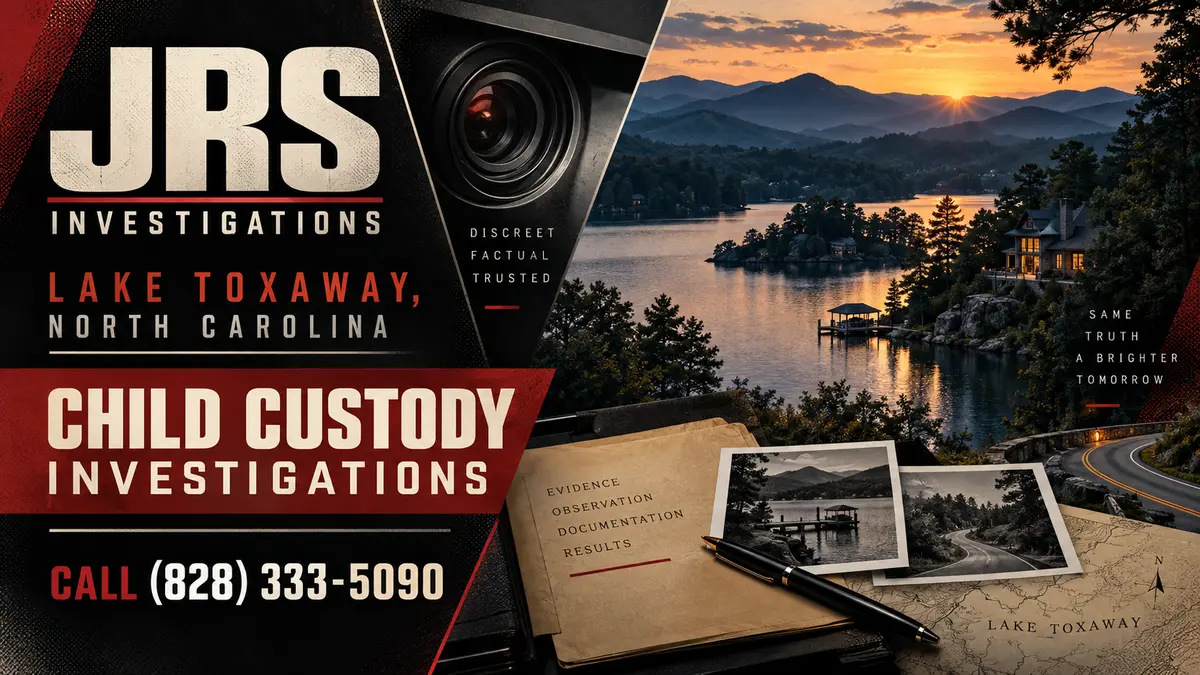
Child Custody Investigations in Lake Toxaway, NC
Child custody disputes are emotionally difficult, but useful investigative work must remain focused on facts. A child custody investigator in Lake Toxaway, NC can document observable conduct, schedules, exchanges, living conditions and other issues that may be relevant to a child’s safety and welfare. The investigator does not decide custody, replace an attorney or guarantee what a court will do.
JRS Investigations approaches each domestic matter with a defined lawful purpose, a written scope and careful reporting. For a confidential consultation, call the Western North Carolina line at (828) 333-5090, call toll-free at (888) 737-7690, or review our child custody and domestic investigation services.
What a child custody investigation can document
A custody investigation should address a specific concern rather than search broadly for damaging information. Depending on the facts and legal guidance, an investigator may document:
- custody exchanges, pickup and drop-off times, and apparent compliance with a parenting schedule;
- observable supervision of the child in public places;
- driving behavior and transportation patterns that can be observed lawfully;
- visits to locations identified as relevant to the case;
- public conduct that may relate to an allegation of neglect, impairment or an unsafe environment;
- the presence of people or vehicles when that fact is relevant to the attorney-defined issue;
- lawfully available records and verified background information; and
- dates, times, photographs, video and detailed investigator notes.
One observation rarely tells the whole story. Professional reports distinguish what the investigator directly saw from what the client reported, what a record shows and what remains unconfirmed. They should avoid diagnosing a person, guessing at motives or presenting speculation as fact.
Start with the child’s welfare and an answerable question
North Carolina courts decide custody based on the best interests of the child. The North Carolina Judicial Branch child custody guidance explains basic custody concepts, mediation and the court process. An attorney can identify which facts are legally relevant in a particular case.
Before fieldwork begins, turn the concern into a question that can be answered through lawful observation or records. Examples include:
- Are scheduled exchanges occurring at the times and locations specified?
- Who is present during a defined visitation period?
- Is the child transported in a manner that can be objectively documented?
- Does observable activity conflict with a specific statement or court-ordered condition?
- Can a named address, vehicle, business or public record be verified?
Broad instructions such as “find anything you can” waste resources and increase the risk of collecting information that has no connection to the child or the case. A focused question produces a more efficient plan and a clearer report.
Planning surveillance in Lake Toxaway
Lake Toxaway and the surrounding mountain communities present practical challenges. Winding roads, limited public observation points, seasonal homes, gated properties, changing weather and lower traffic can make discreet surveillance more difficult than in an urban area. A responsible plan considers where lawful observation is possible, how much travel is required and whether following activity would create an unreasonable safety or detection risk.
Investigators do not gain special authority to enter private property. Observation generally must occur from lawful locations or from property where the client or owner has validly authorized access. A client should never ask an investigator to trespass, bypass a gate, impersonate law enforcement or use access credentials that the client has no right to provide.
Useful surveillance windows are built around reliable information: known exchange times, school or activity schedules, anticipated travel, meaningful dates and verified vehicle details. The goal is not constant monitoring. It is proportionate documentation tied to the issue identified by the client and counsel.
Evidence quality matters more than volume
Hundreds of images are not automatically stronger than a concise, well-organized record. A professional custody report should explain the assignment, dates, times, locations, investigator actions, direct observations, media references and material limitations. Original media should be preserved, and working copies should not replace the original files.
Good documentation also includes negative results when they matter. If a subject did not appear, an address could not be observed lawfully or weather prevented continued coverage, the report should say so. Honest limitations protect the credibility of the work.
If litigation is pending or likely, coordinate with counsel before the investigation whenever possible. The attorney can help define relevance, avoid conflicts with existing orders and establish how reports or media should be delivered and preserved. No investigator should promise that evidence will be admitted or that it will produce a particular custody outcome.
Background research and household concerns
When a concern involves another adult, residence, vehicle or business, lawful research may help verify identifiers and public information. A professional background investigation is more than a name search. Similar names, incomplete records and outdated addresses can create false matches, so findings must be corroborated carefully.
Not every fact about a parent or new partner is relevant to custody. Research should be connected to a legitimate purpose and reviewed with counsel when necessary. Investigators cannot lawfully obtain protected medical, financial, telephone or account information merely because it might be useful.
What JRS will not do
A lawful child custody investigation has firm boundaries. JRS will not hack accounts, obtain passwords without authorization, intercept private communications, trespass, impersonate police, place an unauthorized tracking device, coach a witness to change a statement or create a confrontation for the purpose of recording it.
Clients should not conduct risky surveillance themselves or ask children to collect evidence. Do not enter another person’s accounts, install tracking software or provoke the other parent. Preserve existing messages, photographs, court documents and records in their original form, and tell the investigator how each item was obtained.
Information to prepare for the consultation
Accurate starting information can reduce unnecessary expense. Prepare only materials you are authorized to share, including:
- the current custody or visitation order and any relevant restrictions;
- a concise timeline of the concern;
- full names, recent photographs and reliable physical descriptions;
- vehicle year, make, model, color and tag information;
- verified addresses and regular locations;
- exchange, school, work and activity schedules;
- known travel dates or significant events;
- the name and contact information of counsel, if represented; and
- the exact decision or question the investigation should support.
Identify which details are confirmed and which are assumptions. If there is a protective order, threat, history of violence, firearm concern or immediate safety issue, disclose it at the beginning so the matter can be assessed appropriately.
Verify North Carolina licensing
North Carolina regulates private protective services. Before hiring an investigator, review the North Carolina Private Protective Services Board and its license information. Ask which licensed agency will contract for the case, who will perform or supervise the work and how confidential information will be protected.
Licensing is the minimum threshold. Relevant experience, lawful methods, communication, documentation and realistic expectations are also important. Review the Lake Toxaway private investigator hiring guide for additional provider-selection questions.
Costs and case planning
Child custody investigation costs depend on the schedule, location, travel, number of investigators, duration, urgency, safety considerations, research needs and reporting requirements. Mountain geography or activity spread across multiple counties can add travel time. Surveillance cannot guarantee that a subject will appear or that a specific event will occur within a fixed number of hours.
Ask for a written agreement that identifies the objective, rates, retainer, travel charges, communication schedule, reporting format and process for authorizing additional work. A staged plan can control costs. The first phase may review information and confirm locations; a second phase may cover selected surveillance windows; later work should be authorized only when earlier findings justify it.
Frequently asked questions
Can a private investigator change a custody order?
No. Only the court can enter or modify an order. An investigator gathers and reports facts for the client and attorney to evaluate.
Can an investigator record inside a private home?
Investigators must follow applicable privacy, access and recording laws. Ownership, consent, location and the proposed method matter. JRS evaluates authority before accepting any assignment and will not enter or record in a private area without lawful authorization.
What happens if the investigation finds nothing unusual?
That result should be reported accurately. A lack of observed activity during a defined period is not proof that an allegation is true or false, but it may still help counsel assess the next step.
Can JRS provide photographs, video and a written report?
The deliverable depends on the agreed scope and what can be documented lawfully. Before work begins, confirm the reporting format, update schedule, media handling and whether attorney coordination is required.
What if a child may be in immediate danger?
Do not wait for a private investigation. Contact 911 or the appropriate law-enforcement or child-protection authority. Tell your attorney and disclose the emergency to JRS, but emergency intervention belongs with public authorities.
Discuss a Lake Toxaway child custody investigation
JRS Investigations can review the concern, lawful purpose, available information, safety issues, schedule, reporting needs and a practical first phase. We also provide broader private investigator services in Lake Toxaway.
Knowledge Is Power. Get the facts you need. Call (828) 333-5090, call toll-free at (888) 737-7690, or contact JRS Investigations for a confidential consultation.
This article provides general information and is not legal advice. Laws, licensing rules and court requirements can change. Consult a qualified attorney about a specific legal matter.