(888) 737-7690

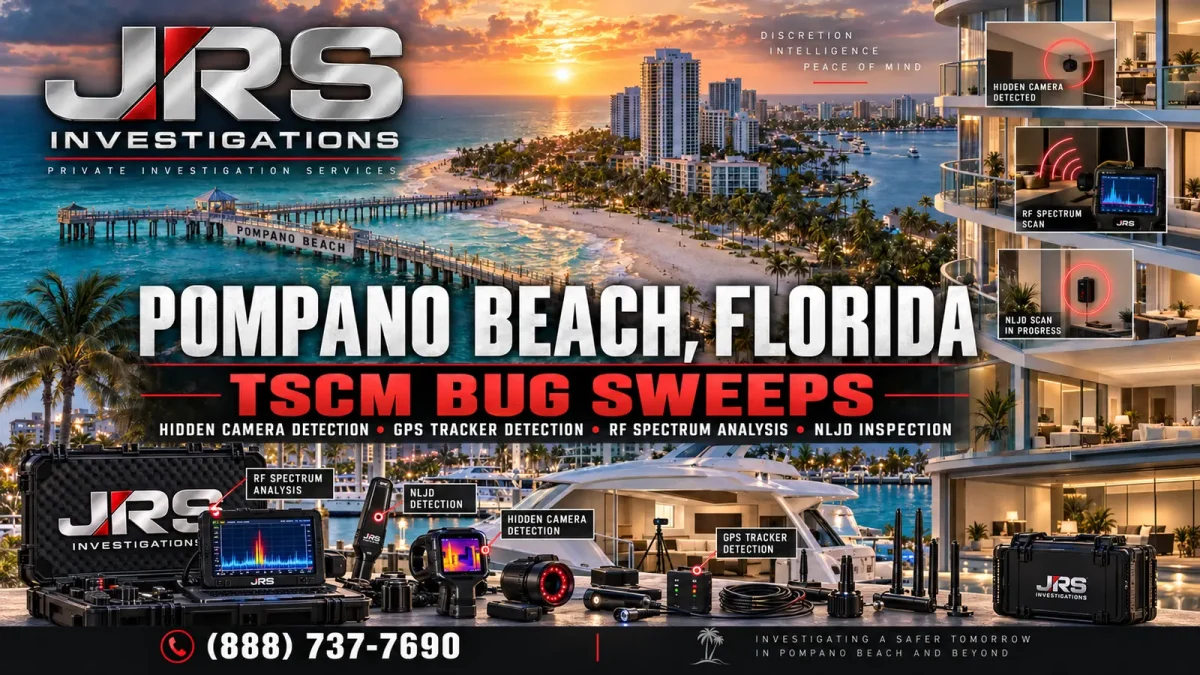
Pompano Beach TSCM Bug Sweeps: Coastal Privacy Guide
A Pompano Beach TSCM bug sweep should fit the property, the threat, and the way the space is used. A waterfront condominium, docked yacht, vacation residence, conference room, and executive vehicle each present a different mix of access points, electronics, shared infrastructure, and radio-frequency activity. JRS Investigations plans technical surveillance countermeasures around those real conditions—not around a generic checklist.
This guide explains when a sweep may be appropriate, what qualified technicians examine, how Pompano Beach’s coastal environment affects planning, and what a client can do before the appointment. If you have an immediate safety concern, contact local law enforcement first. A TSCM inspection is a technical and investigative service; it is not emergency response or legal advice.
Confidential consultation: Call JRS Investigations at (888) 737-7690 or review our Pompano Beach TSCM services.
Why TSCM Planning in Pompano Beach Is Different
Pompano Beach combines high-rise residences, gated communities, commercial offices, hospitality properties, marinas, vessels, and heavily connected vehicles within a busy South Florida radio environment. That variety matters. A sweep must distinguish normal signals from anomalies while accounting for the physical layout, authorized devices, neighboring networks, and the client’s specific concern.
Condominiums and Shared Infrastructure
Condominiums may share walls, utility pathways, telecommunications rooms, Wi-Fi congestion, and building-access systems. Those conditions do not prove surveillance, but they can complicate interpretation. Before arrival, the technician should know whether the inspection includes only the unit, an assigned storage area, a parking space, or any common area for which the client has written authorization. Building management or association coordination may be necessary for access.
Waterfront Homes, Marinas, and Yachts
Waterfront assignments may involve residences with exterior living areas, dock structures, marine electronics, shore power, onboard networks, and vessels that move between locations. A yacht inspection should be planned around vessel access, crew schedules, power state, installed communications systems, and the areas the owner or authorized representative can lawfully open. A marina parking area or dock is not a substitute for a controlled inspection environment.
Vacation Properties and Frequent Turnover
Short stays, vendors, maintenance visits, housekeepers, guests, and changing network credentials can create many innocent explanations for unfamiliar equipment or account activity. They also make an accurate timeline important. Preserve booking records, access logs, device names, and photographs without confronting anyone or dismantling suspected objects.
Offices, Deal Rooms, and Executive Vehicles
Businesses may request a sweep before a sensitive negotiation, executive meeting, litigation strategy session, product launch, or leadership transition. The plan may include conference rooms, private offices, reception areas, wiring pathways, vehicles, and authorized network equipment. JRS can also coordinate broader South Florida TSCM planning for business and executive privacy.
When a Pompano Beach TSCM Bug Sweep May Be Appropriate
A professional sweep is most useful when it begins with specific facts. One unexplained sound, blinking light, battery drain, or dropped call rarely establishes that a device is present. A pattern of access, information leakage, unfamiliar equipment, or credible threats may justify a structured assessment.
Information Appears Outside Its Expected Circle
Consider who knew the information, where it was discussed, which accounts or files contained it, and when the disclosure occurred. An information leak can result from ordinary human disclosure, compromised credentials, visible documents, insecure meetings, or technical surveillance. The intake process should keep multiple explanations open until evidence narrows them.
Unfamiliar Objects or Altered Fixtures Appear
Document new chargers, smoke alarms, clocks, adapters, power strips, décor, wall plates, or vehicle components before moving them. Many common products are harmless, and appearance alone is not a reliable test. Hidden cameras can be built into ordinary objects, which is why optical, electronic, and physical inspection methods may be combined. See JRS’s guide to hidden-camera detection during a South Florida TSCM sweep.
A Vehicle Shows Signs of Unexplained Access or Tracking
Tracking concerns can involve battery-powered units, hardwired devices, or equipment connected to a diagnostic port. A vehicle inspection should consider lawful ownership and access, recent maintenance, shared use, financing or fleet equipment, and any manufacturer-installed telematics. Our overview of three GPS tracker types encountered in vehicle investigations explains why a visual glance is not enough.
A High-Value Event Changes the Risk
A proactive inspection may be appropriate before or after a merger discussion, confidential deposition preparation, board meeting, major real-estate transaction, executive visit, or other event where information has unusual value. The timing matters: conduct the inspection close enough to the event to be relevant while preserving enough time for remediation.
What a Professional TSCM Inspection Examines
No single detector can rule every device in or out. A defensible process uses complementary methods selected for the site and threat model. The technician should be able to explain what was inspected, what limitations applied, and what the observations mean.
Pre-Sweep Threat and Access Assessment
The intake covers the concern, timeline, people with authorized access, sensitive rooms, known electronics, prior incidents, property type, and client authority. This step helps define the scope and prevents time from being spent on areas the client cannot authorize. It also identifies whether digital forensics, a vehicle inspection, or a separate investigative service may be more appropriate.
Radio-Frequency Spectrum Analysis
Spectrum analysis observes radio activity across relevant frequency ranges and helps distinguish ordinary Wi-Fi, Bluetooth, cellular, broadcast, marine, and building signals from activity that warrants investigation. Signal strength, timing, modulation, direction, and correlation with physical locations can all matter. A quick consumer-detector pass cannot provide the same context.
Nonlinear Junction Detection
A nonlinear junction detector can help identify semiconductor components concealed inside furniture, walls, containers, or fixtures—even when a device is not actively transmitting. It also reacts to benign electronics, so results must be interpreted and physically correlated rather than treated as automatic proof of a bug.
Optical and Physical Examination
Technicians inspect likely placement points, wiring, power sources, vents, fixtures, ceiling areas, furniture, and objects introduced into the space. Optical methods may help identify camera lenses. The process should be systematic and minimally disruptive, with any intrusive step authorized in advance.
Authorized Network and Device Review
When included in scope, an authorized review can document connected devices, wireless access points, unexpected network names, account alerts, or configuration concerns. A physical TSCM sweep is not the same as a forensic examination of phones or computers. If the evidence points to account compromise, stalkerware, or malicious software, the case may require a separate specialist and a preservation plan.
How to Prepare Without Disturbing Evidence
Keep the Request Confidential
Do not discuss the planned sweep in the suspected room, on a potentially compromised device, or with people who do not need to know. Use a safer communication channel when possible. Avoid dramatic behavior changes that could alert someone to remove or deactivate equipment.
Preserve a Simple Timeline
Record dates, locations, who had access, what information was exposed, unusual messages, maintenance visits, and photographs of unfamiliar objects. Keep original messages and files. Separate what you directly observed from what you inferred; that distinction makes the intake more useful.
Do Not Buy or Use a Signal Jammer
Jammers can interfere with emergency calls, GPS, cellular service, and other authorized communications. The Federal Communications Commission’s jammer-enforcement guidance states that operating, marketing, or selling jamming equipment in the United States is prohibited. A professional sweep detects and analyzes signals; it does not create unlawful interference.
Arrange Access and Reduce Avoidable Noise
Have keys, alarm information, parking authorization, vessel access, building permissions, and a list of known electronics ready. If practical, schedule the work when employees, guests, contractors, or crew will not interrupt. Do not unplug every device before the technician arrives unless instructed; the normal operating state can provide useful context.
Pompano Beach TSCM Process and Cost Factors
- Confidential intake: Review the concern, timeline, property type, lawful authority, sensitive areas, known electronics, and any vehicle, vessel, or network components that may belong in scope.
- Written scope and access plan: Identify the rooms, exterior areas, vehicles, vessels, or authorized network equipment to be examined, along with building, marina, parking, or security-access requirements.
- On-site inspection: Apply the appropriate combination of physical inspection, radio-frequency analysis, nonlinear-junction detection, optical review, and other authorized methods for the agreed scope.
- Findings and next steps: Document confirmed findings, benign sources, inaccessible areas, limitations, evidence-handling needs, and any recommended follow-up.
What affects the cost of a Pompano Beach TSCM sweep?
A responsible quote depends on the authorized square footage, number of rooms and structures, property type, shared radio-frequency activity, vehicles or vessels included, network-review requirements, access and parking logistics, urgency, travel, reporting detail, and any evidence-preservation or follow-up needs. Clear photographs, floor plans, device lists, access information, and a concise timeline help define the scope before scheduling. A low flat price without a defined scope may omit important areas or methods.
Clients can review JRS’s Florida TSCM bug-sweep services and its core TSCM and counter-surveillance services for broader service information.
What the Client Should Receive
A Clear Scope and Limitations
The client should know which rooms, vehicles, vessels, devices, and networks were included, which areas were inaccessible, and what methods were used. A statement that a property is “100% clean” is not credible because surveillance risk changes after the inspection and every method has limits.
Documented Findings and Practical Next Steps
Reporting should distinguish confirmed devices, items requiring additional examination, security weaknesses, and benign sources. Recommendations may include securing access, changing credentials, replacing equipment, preserving an item, contacting counsel, or involving law enforcement. If a suspicious device is located, the safest next step depends on the circumstances; removal is not always the first action.
Evidence Handling When It Matters
If litigation or a criminal complaint is possible, photography, notes, timestamps, custody records, and controlled handling may become important. A technical report can document observations, but only an attorney can advise whether evidence is admissible or which legal strategy fits the matter.
Florida Privacy and Recording Considerations
Florida law regulates the interception of wire, oral, and electronic communications. The text of Florida Statutes section 934.03 should be reviewed with qualified counsel when a recording or interception issue is involved. Ownership of a home, office, vehicle, or vessel does not automatically answer every consent, access, or privacy question.
JRS requests confirmation that the client has authority to inspect the property and equipment within scope. Common areas, employer-owned devices, leased spaces, shared vehicles, and vessels with multiple owners or operators may require additional authorization. Technical work should support lawful decision-making, not bypass it.
Choosing the Right Pompano Beach TSCM Provider
Ask About Method, Not Just Equipment
A long equipment list does not prove competence. Ask how the provider develops a threat model, establishes a baseline, correlates electronic findings with physical locations, documents limitations, and handles a suspected device. The answer should be understandable and should not rely on fear.
Insist on Confidentiality and Scope Control
Discuss how intake information is stored, who will attend, how the appointment will be described to third parties, and whether subcontractors are involved. For a condo, marina, business, or staffed residence, an access plan can protect discretion as much as the technical process does.
Avoid Guarantees and Sensational Claims
No ethical provider can promise that every possible surveillance method will be found. Be cautious with fabricated “local case studies,” guaranteed courtroom outcomes, immediate conclusions based on one detector, or advice to destroy a device. Good work is measured by a repeatable process, careful interpretation, and honest reporting.
Schedule a Confidential Pompano Beach TSCM Consultation
JRS Investigations provides private-investigation and TSCM planning for Pompano Beach residences, condominiums, businesses, vehicles, marinas, and vessels. We begin with the facts, define the lawful scope, select the appropriate methods, and document the outcome without turning uncertainty into a sales tactic.
Call (888) 737-7690 or visit the JRS Pompano Beach private-investigation service page to discuss a confidential next step.