(888) 737-7690

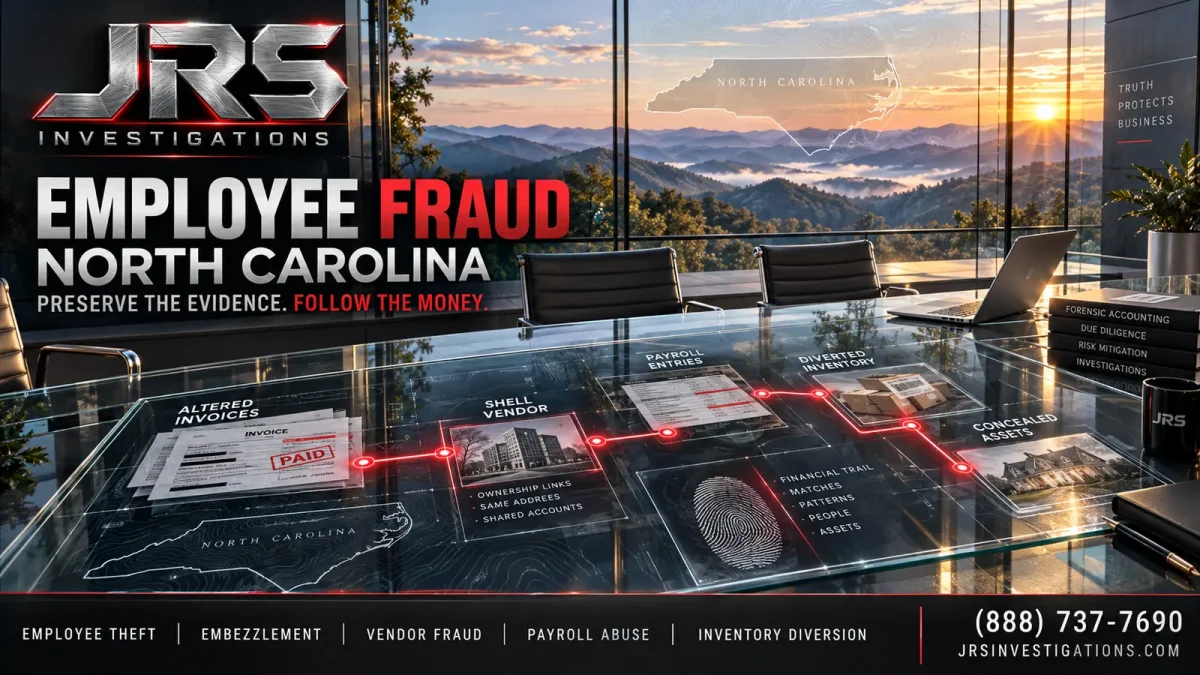
Employee Fraud Investigations in North Carolina: Response Guide
When a North Carolina business suspects employee theft, embezzlement, vendor collusion, payroll abuse, or another internal fraud scheme, the first decisions can determine whether useful evidence is preserved or lost. A careful response is not about accusing someone quickly. It is about protecting records, defining the concern, and establishing facts through lawful, documented methods.
This guide explains how an employee fraud investigation in North Carolina can be planned, what warning signs deserve attention, which records may help, and when an independent investigator can support business owners, attorneys, insurers, and litigation teams. For a broader overview of corporate cases, see our North Carolina corporate fraud investigation guide.
Why suspected employee fraud requires a disciplined response
A discrepancy is a reason to investigate, not proof that a particular person committed fraud. Duplicate payments may result from a process failure. Missing inventory can reflect poor controls. Unusual overtime may be legitimate. The goal is to separate error, policy violations, conflicts of interest, and intentional misconduct without contaminating the evidence or making unsupported allegations.
An organized response also protects the company. Premature confrontation can prompt a subject to delete messages, alter records, coordinate stories, or transfer assets. An overly broad inquiry can expose private information unrelated to the allegation. Management should therefore identify the business question, preserve relevant materials, limit access to the matter, and coordinate investigative steps with counsel and appropriate internal decision-makers.
Warning signs that may justify an employee fraud investigation
No single indicator proves wrongdoing. A pattern of unexplained exceptions, inconsistent explanations, or transactions that bypass normal controls may justify a closer look.
Accounting and payment irregularities
- Duplicate invoices, round-dollar payments, or invoices just below approval limits
- Checks, refunds, credits, or electronic payments sent to unfamiliar recipients
- Vendor addresses, telephone numbers, bank details, or email domains connected to an employee
- Missing supporting documents or approvals added after payment
- Frequent manual journal entries without a clear business explanation
Vendor and procurement conflicts
- A new vendor repeatedly receives work without competitive review
- Pricing is inconsistent with contracts, bids, or delivery records
- An employee resists supplier changes or refuses ordinary oversight
- Business-registration records reveal undisclosed ownership or relationships
- Purchase orders, receiving records, and invoices do not agree
Payroll, expense, and time abuse
- Unverified employees, altered direct-deposit information, or unusual payroll adjustments
- Repeated mileage, travel, meal, or purchasing-card charges lacking support
- Time entries that conflict with access records, schedules, or documented activity
- Expense descriptions that remain vague after reasonable follow-up
Inventory and company-asset diversion
- Recurring shortages concentrated around one shift, location, product, or employee
- Returns, write-offs, scrap, or damaged-goods entries that do not match physical counts
- Company equipment, materials, or vehicles appearing in unauthorized locations
- Online resale listings that resemble missing company property
The first 24 to 48 hours: preserve before you investigate
The first priority is preservation. Do not alter a workstation, search a personal account, or secretly access a device simply because it may contain useful information. Ownership, consent, company policy, employment law, privacy rights, and litigation obligations all matter. Counsel can help determine what the company may preserve and review.
Potentially relevant materials may include accounting exports, vendor master files, invoices, purchase orders, expense reports, payroll records, access-control logs, authorized company email, company-device data, surveillance footage, shipping records, inventory counts, contracts, and written policies. Preserve original files when possible. Document who collected each item, when it was collected, where it came from, and whether a working copy was created.
A narrow legal hold may be appropriate when litigation is reasonably anticipated. Automatic deletion schedules, camera overwrite cycles, and account deactivation procedures should be reviewed promptly. If law enforcement, an insurer, outside counsel, or a forensic accountant may become involved, ask what format and documentation they require before changing the evidence.
Build an allegation map instead of chasing a theory
A useful investigation starts with a written allegation map. List what is known, what is suspected, the source of each claim, the relevant dates, the people or entities involved, and the records that could confirm or contradict the concern. Separate firsthand observations from assumptions and workplace rumors.
For example, “the controller stole money” is a conclusion. A workable allegation is more specific: “Between January and June, twelve payments totaling a defined amount were sent to a vendor whose address matches a property associated with the controller’s relative, and the receiving records are missing.” That statement identifies a time period, transactions, relationship, and records to test.
The scope should also include alternative explanations. Was the vendor legitimately approved? Was the shared address a mailbox service? Were receiving documents stored in another system? Testing competing explanations helps the final report remain factual and defensible.
What JRS Investigations can examine in a North Carolina business-fraud matter
JRS Investigations can develop lawful facts around people, entities, locations, relationships, business activity, and documented events. The work is tailored to the allegation and coordinated with the client’s attorney, accountant, insurer, or internal team when appropriate.
Background and relationship research
Investigators may verify identities, addresses, employment representations, business affiliations, litigation history, and other legally available records. A targeted background investigation can help determine whether a subject, vendor, or associate has undisclosed connections relevant to the case.
Vendor and ownership mapping
Public business filings, property records, court records, professional-license information, addresses, telephone numbers, and other lawful sources can help map relationships between employees and outside entities. The North Carolina Secretary of State business-registration search is one starting point, but a filing alone does not establish beneficial ownership or misconduct. Investigators compare multiple sources and clearly identify limitations.
Lawful surveillance and field verification
When the allegation involves deliveries, inventory diversion, unauthorized outside work, or use of company property, lawful surveillance or location verification may document observable activity. Surveillance should answer a defined question and remain within legal and ethical limits. It should not become a fishing expedition.
Asset and litigation-support leads
Public records may identify real property, business interests, vehicles, liens, judgments, or other leads relevant to recovery or litigation strategy. Investigators do not obtain private bank records without lawful authority and do not promise that every asset can be found or recovered. Our due-diligence investigation services can also help clients assess people and entities before a transaction or business relationship.
North Carolina public records that may support the inquiry
Public records can confirm dates, entities, filings, lawsuits, property interests, and other facts. They should be treated as leads that require identity matching and context—not as automatic proof of wrongdoing.
The North Carolina Judicial Branch court-records guidance explains how court records and criminal background checks may be obtained. Availability varies by record type, county, and access method. County registers of deeds may maintain real-estate and related records, while professional boards maintain licensing information within their jurisdiction.
Common names, outdated addresses, data-entry errors, expunctions, sealed matters, and incomplete online coverage can create false matches or missing results. A professional review uses multiple identifiers and reports uncertainty instead of overstating a database result.
A practical employee fraud investigation process
1. Confidential intake and conflict review
The client explains the concern, known facts, decision-makers, time pressure, and possible legal or insurance issues. The investigator identifies conflicts, clarifies confidentiality, and determines whether counsel should direct the engagement.
2. Written scope and evidence plan
The engagement defines the questions to answer, approved methods, geographic limits, reporting expectations, budget, and people authorized to receive updates. A preservation plan identifies records at risk of deletion or overwrite.
3. Timeline and transaction analysis
Available records are organized by date, person, vendor, payment, location, or event. Investigators flag gaps and contradictions for follow-up. Forensic accounting should be handled by a qualified accountant when specialized financial analysis or expert testimony is required.
4. Public-record, field, and interview work
Investigators test the allegation using approved sources and methods. Interviews are planned so witnesses are not unnecessarily influenced by earlier conversations. Fieldwork is tied to specific questions and documented contemporaneously.
5. Factual reporting and next-step support
The final report distinguishes confirmed facts, reported statements, investigator observations, unresolved issues, and recommended follow-up. Supporting exhibits should be organized so counsel, management, an insurer, or law enforcement can understand the source of each material fact.
When an internal review should become an independent investigation
Outside assistance may be appropriate when the suspected subject controls records, the allegation involves senior management, multiple locations are involved, a conflict of interest exists, litigation is likely, or internal interviews could compromise objectivity. Independence also matters when management needs a report that explains how conclusions were reached.
An outside investigator does not replace company counsel, HR, a forensic accountant, an IT-forensics specialist, or law enforcement. The strongest response often assigns each professional a defined role. JRS focuses on licensed investigative work and coordinates within the authorized case plan.
Questions to ask before hiring a North Carolina fraud investigator
- Are you properly licensed for the work and jurisdiction?
- How will you separate verified facts from allegations and database leads?
- Which methods are included, and which require additional authorization?
- How will sensitive records and case communications be protected?
- Will the scope coordinate with counsel, HR, accounting, or an insurer?
- What will the final report contain, and how will supporting evidence be organized?
- How are costs, updates, travel, and scope changes approved?
Avoid anyone who guarantees a result, claims access to private financial accounts without lawful authority, or proposes hacking, impersonation, pretexting that violates the law, or other unauthorized access. Read more about JRS and our investigative standards on the About JRS Investigations page.
Frequently asked questions
Should we confront the employee before hiring an investigator?
Usually, the better first step is to preserve records and consult appropriate counsel or decision-makers. An early confrontation may alert the subject, affect witness accounts, or cause evidence to disappear. The correct approach depends on safety, employment, insurance, and legal considerations.
Can a private investigator obtain bank records?
Not simply because a client suspects fraud. Private financial records generally require the account holder’s authorization, legal process, or another lawful basis. Investigators can develop public-record and field leads without misrepresenting access.
Can an investigation prove every loss?
No investigator can guarantee that every transaction, asset, or participant will be identified. The goal is to follow the available evidence, document findings accurately, and explain limitations. Accounting experts may be needed to calculate a loss amount.
What information should we prepare for the first call?
Prepare a short chronology, names and entities involved, the suspected date range, known transaction amounts, relevant policies, locations, available records, and any approaching legal or insurance deadlines. Do not send sensitive records until a secure method and authorized recipient are confirmed.
Discuss a confidential North Carolina employee fraud investigation
If your company needs discreet fact development involving employee theft, embezzlement, vendor fraud, conflicts of interest, inventory diversion, due diligence, or litigation support, contact JRS Investigations. We can help define a lawful, focused investigation and explain what information is needed to begin.
Call (888) 737-7690 or contact JRS Investigations to discuss the matter confidentially.