(888) 737-7690

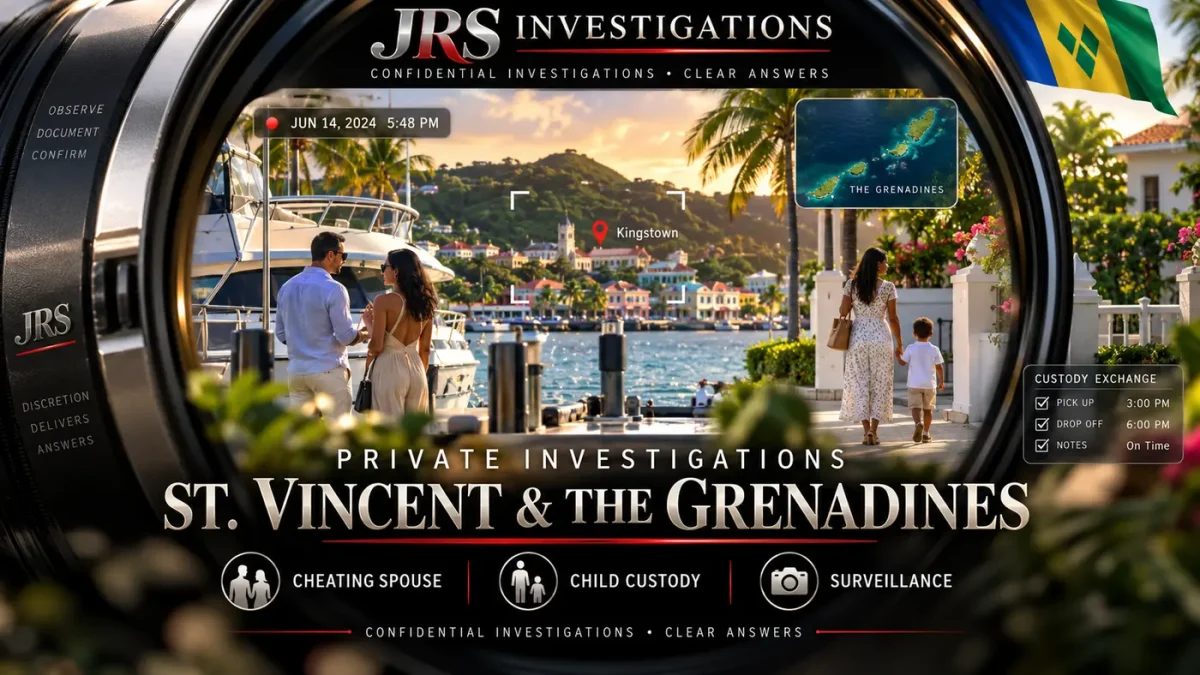
How to Hire a Private Investigator in Saint Vincent and the Grenadines
How to Hire a Private Investigator in Saint Vincent and the Grenadines
Hiring a private investigator in Saint Vincent and the Grenadines requires more than choosing a name from a search result. The country’s island geography, travel logistics, legal boundaries, privacy expectations, and limited windows for observation can shape the entire assignment. A useful investigation begins with a defined objective, reliable identifying information, lawful authority, and a plan for how findings will be documented.
JRS Investigations coordinates confidential investigative support for authorized matters in Saint Vincent and the Grenadines. Work may involve surveillance, infidelity concerns, child-custody support, due diligence, background research, locate work, asset leads, fraud inquiries, technical surveillance countermeasures, and selected security planning. Every request is reviewed for purpose, feasibility, jurisdiction, timing, and scope before fieldwork begins.
Choose an Investigator for the Assignment, Not Just the Location
The first question is not simply whether an investigator serves Saint Vincent and the Grenadines. Ask whether the investigator has experience with the type of matter involved and can explain a realistic method. Surveillance, a background inquiry, an asset search, and a TSCM inspection require different preparation, tools, and reporting.
A responsible investigator should ask what decision the client needs to make. “Find out everything” is not a workable scope. “Document whether a named person visits a specified property during an identified period” or “verify the ownership and litigation history of a proposed business partner” gives the assignment a focused, lawful purpose.
Understand the Multi-Island Setting
Saint Vincent and the Grenadines includes the main island of Saint Vincent and a chain of Grenadine islands. The government’s tourism information identifies Bequia, Mustique, Canouan, and Union Island among the larger and more populated islands, while other assignments may involve Mayreau, Palm Island, Petit Saint Vincent, or nearby cays. See the official Ministry of Tourism information for current destination context.
That geography affects cost and timing. A subject, witness, residence, resort, vessel, or business may be on a different island from the investigator’s starting point. Transfers may depend on scheduled air or sea service, weather, accommodation, vehicle availability, property access, and local operating conditions. The plan should identify the relevant island before fieldwork is priced.
Define the Exact Objective Before Retention
A strong intake starts with the people, places, dates, and events that matter. Provide correct names, known aliases, recent photographs, phone numbers, vehicle information, business names, social-media identifiers, property details, and a concise chronology when those items are lawfully available. Explain what is known, what is suspected, and what evidence would be useful.
Do not withhold facts because they appear unimportant or embarrassing. An incomplete account can send fieldwork in the wrong direction, create duplicate expense, or cause the investigator to misread ordinary activity. The investigator should separate confirmed facts from assumptions and build the plan around verifiable questions.
Confirm Lawful Authority and Local Compliance
International and cross-border assignments require careful boundaries. The investigator should not promise access to private accounts, confidential government records, protected communications, or property the client does not control. Surveillance must be planned around lawful observation and reasonable privacy expectations. Recording, tracking, data access, and evidence handling can raise jurisdiction-specific issues.
JRS Investigations evaluates the requested scope and may coordinate with appropriately qualified local professionals when necessary. Clients with questions about admissibility, consent, employment action, family proceedings, or cross-border evidence should consult counsel. The Ministry of Legal Affairs and Justice is an official government resource, but it does not replace advice from the client’s attorney.
Ask Who Will Perform and Supervise the Work
Clients should know who is responsible for planning, field coordination, quality control, and reporting. When local resources are required, ask how they are selected and supervised, how information will be transmitted, and who remains accountable to the client. A professional engagement should not rely on vague claims about “connections.”
It is also reasonable to ask about experience, licensing in the investigator’s home jurisdiction, insurance where applicable, confidentiality procedures, conflicts, and the proposed communication schedule. Credentials matter, but the investigator’s explanation of method and limitations is equally important.
Surveillance and Infidelity Assignments
Surveillance can document observable conduct from public places or other lawful vantage points. It should not be described as constant, invisible, or guaranteed. Island size does not make surveillance simple. Familiar communities, limited roads, resort access controls, ferry schedules, gated properties, and recognizable rental vehicles can make poor planning obvious.
For relationship concerns, the objective should be factual documentation rather than confrontation. Review JRS Investigations’ infidelity investigation services and surveillance investigation standards for more information about scope and expectations.
Child-Custody and Family Matters
Child-custody support may involve documenting observable conditions, identifying relevant witnesses, preserving client-supplied communications, or verifying specific allegations for counsel to evaluate. The investigator does not decide custody and should not interfere with parenting time, trespass, impersonate an official, or provoke conduct.
Provide current court orders and identify any restrictions that affect contact, travel, residence, or exchanges. If a child may be in immediate danger, contact the appropriate authorities rather than waiting for a private investigation. See the child-custody investigation overview.
Background Research and Due Diligence
A background or due-diligence assignment should be tied to a legitimate decision. A client may need to evaluate a proposed employee, contractor, business partner, investment, vendor, tenant, or personal relationship. Available records and permissible purposes differ by jurisdiction, and international name matching can be difficult without a date of birth, address history, corporate affiliation, or other reliable identifiers.
A useful report distinguishes confirmed records, source limitations, unresolved matches, and information supplied by the client. It should not treat rumor, social-media content, or a similar name as a proven fact. For business matters, review JRS Investigations’ due-diligence investigation services.
Fraud, Asset Leads, and Business Disputes
Fraud and asset inquiries often begin with records: contracts, invoices, payment instructions, corporate names, bank-transfer details, property references, messages, and a timeline. Investigators can help organize leads, research public information, identify relationships, and document inconsistencies. They cannot guarantee recovery or obtain protected financial information without lawful authority.
When companies, property, or ownership interests cross borders, the research plan should identify each relevant jurisdiction. The international asset investigation page explains how documented asset indicators may support an attorney or authorized client without promising that every asset will be found.
Technical Surveillance Countermeasures
TSCM services may be appropriate when an authorized client has a credible concern about hidden cameras, listening devices, unauthorized transmitters, or vehicle trackers. A professional inspection may combine physical examination, radio-frequency analysis, non-linear junction detection, optical searching, and review of accessible wiring or network indicators. No single detector can evaluate every possible threat.
For villas, offices, hotel rooms, meeting spaces, vehicles, or vessels, the client must have authority to request the inspection. Travel, equipment transport, customs, property access, and scheduling should be addressed before mobilization. A TSCM inspection is not a substitute for cybersecurity or digital forensics when the concern involves compromised accounts, malware, or cloud access.
Executive Protection and Security Planning
Selected assignments may require security planning rather than traditional investigation. Executives, families, attorneys, public figures, or business travelers may need transportation coordination, venue assessment, route planning, protective coverage, or liaison with authorized local providers. The plan should be based on the traveler, schedule, locations, known concerns, and current conditions.
Protection services should never be sold through fear or generic claims. Review the private security and executive protection page for a broader explanation of planning and scope.
Fees, Travel Costs, and Case Budgets
Ask for a written explanation of the fee structure. Depending on the assignment, costs may include professional time, research, local coordination, inter-island transportation, lodging, vehicle or vessel expense, equipment movement, communication, and report preparation. A retainer is common for work that requires advance planning or travel.
The least expensive quote may exclude the time and logistics needed to produce useful evidence. The most expensive proposal is not automatically the best. Compare scope, assumptions, reporting, supervision, and likely limitations. Ask how additional work will be authorized and how unused funds, if any, are handled under the agreement.
Reports and Evidence Standards
Before hiring, ask what the final product may include. Depending on the service, JRS Investigations may provide written observations, timelines, photographs, video, record-source summaries, identified limitations, or practical recommendations. Reports should distinguish observed facts from analysis and client-provided information.
For a legal matter, counsel should explain the form of documentation needed and any chain-of-custody concerns. An investigator can preserve and describe material collected during the assignment, but cannot guarantee admissibility or a particular court outcome.
Warning Signs When Evaluating an Investigator
- Promises of guaranteed results, guaranteed court outcomes, or access to any record.
- Claims of being “locally licensed” without a clear explanation of credentials and jurisdiction.
- Requests to hack accounts, intercept communications, trespass, impersonate officials, or install trackers without confirmed legal authority.
- No written scope, fee terms, confidentiality language, or reporting plan.
- Pressure to begin before identities, objectives, locations, and legal purpose are understood.
- Reliance on dramatic equipment claims instead of a case-specific method.
- Fabricated “success stories” offered as proof that the same result is guaranteed.
Information to Gather Before Calling
- The specific question you need answered and how the answer will be used.
- Names, aliases, recent photographs, dates of birth, addresses, vehicles, businesses, and online identifiers that are lawfully available.
- The island or islands involved, likely travel dates, properties, resorts, marinas, or meeting locations.
- A clear chronology with confirmed facts separated from suspicions.
- Relevant court orders, contracts, invoices, communications, or attorney instructions.
- Time-sensitive deadlines and any immediate safety concern.
- A realistic budget and the preferred method for confidential updates.
Request a Confidential Case Review
The main Saint Vincent and the Grenadines private investigator page provides an overview of available support. During the initial review, JRS Investigations will discuss the objective, people and locations involved, lawful scope, timing, island logistics, likely limitations, and the next appropriate step.
Knowledge is power. Call JRS Investigations at (888) 737-7690 or use the confidential contact form to discuss an authorized investigation in Saint Vincent and the Grenadines.