(888) 737-7690

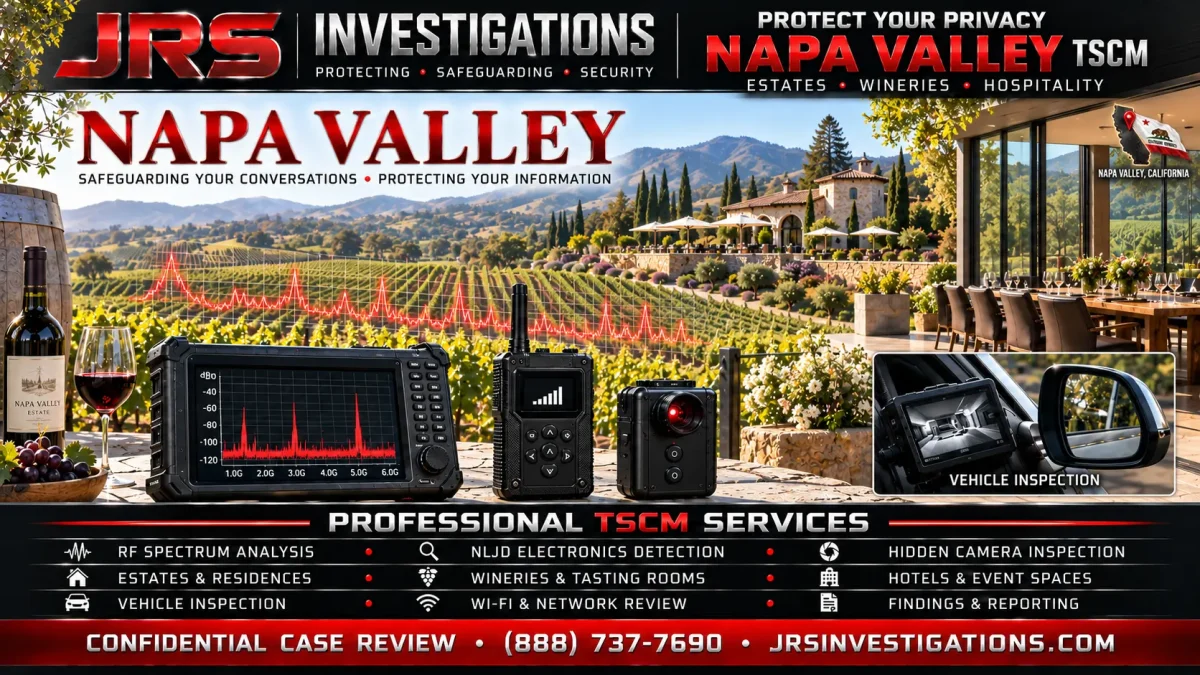
Napa Valley TSCM Planning for Estates, Wineries & Hospitality
Napa Valley TSCM Planning for Estates, Wineries and Hospitality
Napa Valley privacy concerns rarely fit inside one ordinary office. A single assignment may involve a private estate, winery administration building, tasting room, executive suite, guest cottage, vehicle, event space, or hotel meeting room. Effective Napa Valley TSCM planning begins by identifying where sensitive conversations occur, who has legitimate access, and how the locations connect.
JRS Investigations provides professional Technical Surveillance Countermeasures (TSCM) inspections for authorized clients who need a careful, lawful review of spaces, systems, and devices. The goal is not to promise that every threat can be found. It is to combine physical inspection, radio-frequency analysis, nonlinear junction detection, optical inspection, wiring review, and practical reporting into a defensible privacy assessment.
Protecting • Safeguarding • Security. For a confidential consultation, call (888) 737-7690 or contact JRS Investigations.
Why Napa Valley Requires Site-Specific Planning
Napa Valley combines hospitality, agriculture, luxury residences, executive travel, culinary events, and closely held businesses. The valley includes Napa, Yountville, St. Helena, Calistoga, and American Canyon, along with areas such as Oakville and Rutherford. Properties may include historic construction, modern additions, caves, production buildings, detached offices, outdoor gathering spaces, and multiple networks.
That variety matters. A sweep designed for one conference room may be inadequate for a property where confidential conversations move between a residence, vehicle, tasting salon, and remote office. Planning should reflect the actual use of the site, not a generic checklist.
When a TSCM Inspection May Be Appropriate
A professional inspection may be worth considering after unexplained disclosure of confidential information, a contentious separation or employment dispute, unusual access by vendors or former staff, a security incident, a high-value negotiation, a change in ownership, or before an important private meeting. A specific incident is not always required. Some clients schedule an assessment when they acquire a property, renovate a sensitive room, change key personnel, or prepare for a major event.
Concern alone does not prove that surveillance is occurring. TSCM work should begin with facts: what information was exposed, when it was discussed, which rooms or devices were involved, and who could enter those locations.
Estates, Guest Houses and Residential Compounds
Large residential properties create distinct access and coverage questions. Main houses, guest suites, detached offices, garages, gates, staff areas, and vehicles can all have different users and network connections. A useful pre-inspection interview identifies where private calls, legal discussions, financial decisions, and family conversations typically occur.
Inspection priorities may include bedrooms, offices, sitting rooms, meeting areas, telephone and network equipment, power sources, decorative objects, recent repairs, and devices introduced by visitors or contractors. The scope should be agreed in advance so that authorized access, privacy boundaries, and occupied rooms are handled appropriately.
Wineries, Tasting Rooms and Business Offices
Wine businesses may need to protect ownership discussions, distribution terms, pricing, personnel matters, vendor negotiations, acquisition plans, and intellectual property. These conversations may occur in administrative offices, boardrooms, private tasting rooms, production areas, or temporary event spaces.
A winery inspection must account for legitimate electronics and operational equipment. Wireless point-of-sale systems, cameras, sensors, building controls, Wi-Fi access points, production technology, and guest devices can create a busy signal environment. The task is to document and investigate anomalies without disrupting normal operations or misidentifying authorized systems as threats.
Hotels, Resorts and Temporary Meeting Spaces
Hotels and resorts present a different challenge because the client may control the meeting but not the entire property. Room access, housekeeping, maintenance, audiovisual vendors, event staff, and prior occupants all affect planning. The inspection window may also be short.
For a hotel suite, conference room, or private dining space, coordination should cover legal authority, arrival time, room turnover, equipment setup, adjacent areas, and what can be inspected without damaging or altering the property. When possible, the room should remain controlled after the inspection so new people or devices are not introduced before the sensitive meeting.
What a Professional TSCM Inspection Can Include
The exact method depends on the site and the concern. A layered inspection may include:
- Physical and visual examination of accessible surfaces, furnishings, fixtures, electronics, and recent alterations.
- Radio-frequency spectrum analysis to evaluate signals present during the inspection.
- Nonlinear junction detection to help locate electronic components, including devices that may not be transmitting.
- Optical inspection for concealed or disguised camera lenses.
- Review of accessible telephone, low-voltage, network, and power pathways.
- Evaluation of selected Wi-Fi and network conditions within the authorized scope.
- Inspection of vehicles or vessels when they are part of the privacy concern.
- Documentation of findings, limitations, and recommended next steps.
No single detector can provide a complete answer. Reliable work depends on combining instruments with a methodical physical search and a clear understanding of the environment.
RF Spectrum Analysis in a Busy Hospitality Environment
Napa Valley properties can contain many legitimate transmitters: mobile phones, radios, routers, wireless microphones, cameras, access controls, smart televisions, sensors, and guest devices. Spectrum analysis helps an examiner observe and evaluate radio-frequency activity, but a signal is not automatically evidence of an eavesdropping device.
Useful analysis includes comparing expected equipment with observed activity, testing changes under controlled conditions, locating signals when possible, and recording relevant observations. Intermittent, burst, cellular, Bluetooth, or Wi-Fi-based devices may require different techniques and may not transmit continuously.
NLJD, Optical and Physical Inspection
A nonlinear junction detector can assist in locating semiconductor components hidden inside walls, furniture, containers, or other objects. It is especially useful when a device is inactive, sleeping, recording locally, or connected by wire instead of radio. It does not identify every electronic component as malicious; legitimate electronics can also produce a response.
Optical inspection can help identify a concealed lens, while hands-on examination can reveal modified chargers, smoke detectors, clocks, power strips, décor, or other objects. Findings must be interpreted in context and verified before conclusions are drawn.
Wiring, Telephones, Wi-Fi and Network Review
Privacy exposure is not limited to a hidden transmitter. Unauthorized hardware, altered cabling, unmanaged network devices, weak access controls, or improperly configured systems can also create risk. A TSCM engagement may therefore include accessible wiring and device review, but it is not a substitute for a full cybersecurity assessment.
Before the inspection, gather available network diagrams, authorized device lists, recent vendor records, and the names of people who can explain building systems. That information makes it easier to distinguish normal infrastructure from an unexplained addition.
Vehicles and Transportation
Executives, estate residents, hospitality teams, and visiting principals may move sensitive conversations between a property and a vehicle. When authorized and relevant, a vehicle inspection can address accessible interiors, trunk and cargo areas, power connections, common mounting points, and signs of an added tracking or recording device.
A vehicle’s factory electronics, telematics, aftermarket accessories, toll devices, cameras, and fleet equipment should be documented first. The inspection should avoid claims based only on an unfamiliar component; identification and verification matter.
How to Prepare Before the Inspection
- Define the concern. Write down what happened, when it began, and which conversations or information appear affected.
- Confirm authority. Identify the property owner, tenant, employer, vehicle owner, or other person who can authorize access.
- Set priorities. Rank rooms, vehicles, and systems by sensitivity instead of automatically sweeping every space.
- Preserve normal conditions. Do not disconnect, destroy, or publicly confront a suspected device before professional guidance.
- Control access. Limit unnecessary traffic during and after the inspection when practical.
- Collect documentation. Prepare floor plans, device lists, vendor records, network information, and recent maintenance details when available.
Lawful Scope and Evidence Handling
TSCM services should be conducted only with proper authorization. California Penal Code §632 addresses recording or eavesdropping on confidential communications and should be reviewed with qualified counsel when a legal dispute or evidence issue is involved. JRS Investigations does not provide legal advice.
If a suspicious device is located, the next step depends on the circumstances. Photographing and documenting it in place, controlling access, and consulting counsel or law enforcement may be more appropriate than immediate removal. Chain of custody can matter if the item may become evidence.
JRS Investigations focuses on detection and assessment, not interference. The Federal Communications Commission warns that signal jammers are prohibited for public use because they can disrupt authorized and emergency communications.
What the Findings Report Should Explain
A useful report should separate confirmed findings, benign equipment, unresolved anomalies, access limitations, and recommended follow-up. It may include photographs, equipment descriptions, areas examined, relevant signal observations, and steps to improve privacy controls. A report should not imply certainty beyond what the inspection supports.
If no unauthorized device is identified, that result still needs context. It reflects the conditions, access, methods, and time of the inspection. It is not a permanent guarantee that a location will remain free of surveillance threats.
How This Guide Differs From Other Napa Valley Resources
This page focuses on planning a layered assessment across Napa Valley estates, wineries, hospitality properties, vehicles, and temporary meeting locations. For a direct service overview, visit Napa Valley TSCM bug sweep services. For a shorter decision guide, read five reasons to schedule a Napa Valley TSCM sweep.
Request a Confidential Napa Valley TSCM Consultation
When privacy concerns involve a residence, winery, resort, office, meeting space, or vehicle, the first step is a confidential discussion about authorization, timing, locations, and priorities. JRS Investigations can help define a practical inspection scope and explain what the process can—and cannot—establish.
Protect your privacy with JRS Investigations. Call (888) 737-7690 or visit JRSInvestigations.com to request a confidential case review.