(888) 737-7690

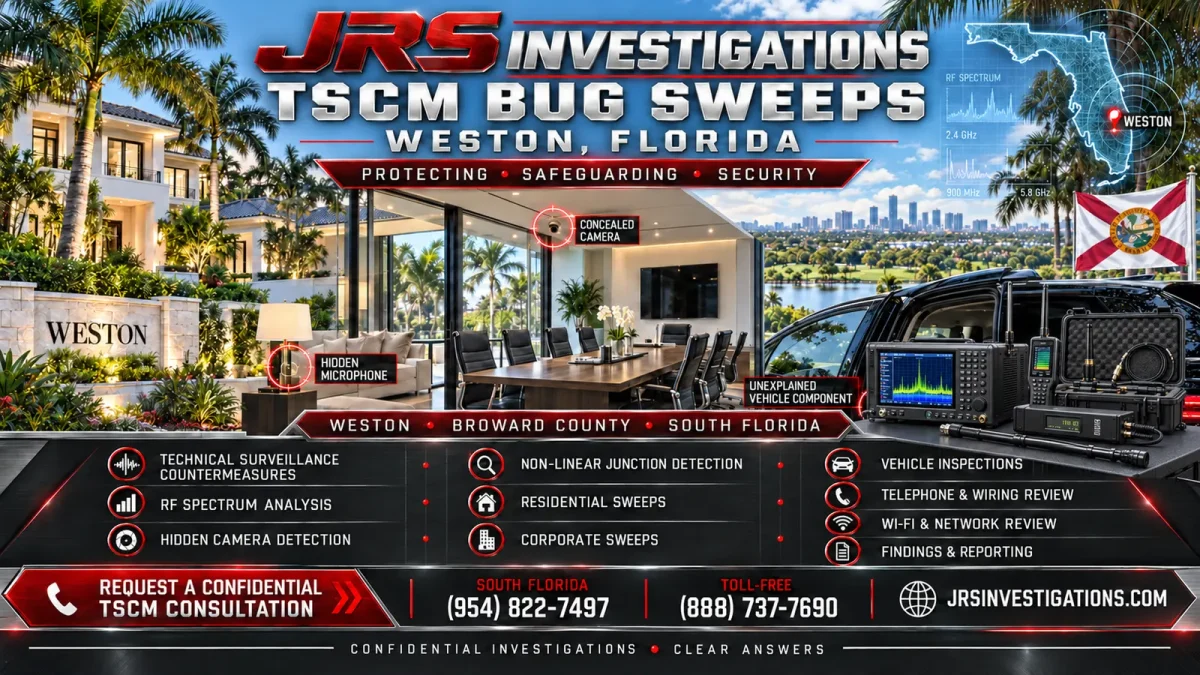
TSCM Bug Sweeps in Weston, Florida: What to Expect
A professional TSCM bug sweep in Weston, Florida is a structured inspection for unauthorized surveillance devices, suspicious radio-frequency activity, concealed electronics, compromised wiring, and other technical security concerns. The goal is not to make dramatic claims or promise that every threat can be found. It is to evaluate a defined space with appropriate equipment, document what is observed, and give the client practical next steps.
JRS Investigations provides Technical Surveillance Countermeasures services for residences, executive offices, professional suites, conference rooms, vehicles, and other approved locations in Weston and South Florida. For broader investigative support, review our Weston private investigator services. Call (888) 737-7690 or request a confidential TSCM consultation before discussing sensitive details through a device or room you believe may be compromised.
Why Weston Clients Request TSCM Inspections
Weston combines gated residential communities, home offices, professional practices, corporate operations, and frequent business travel throughout Broward, Miami-Dade, and Palm Beach counties. The City of Weston describes the community as western Broward County, adjoining the Everglades. That location can make Weston convenient for regional executives and professionals while also creating a mix of residential and business environments where confidential conversations occur.
A request for a sweep may follow a specific event, such as unusual access to an office, an employee departure, a contentious business dispute, sensitive negotiations, a domestic conflict, or unexplained disclosure of private information. Other clients schedule a preventive inspection before a board meeting, merger discussion, legal strategy session, executive visit, or major transaction.
None of those circumstances proves that a listening device or hidden camera is present. A disciplined TSCM process begins by separating verified facts from suspicion and by defining the rooms, systems, vehicles, and time period that matter.
What a Professional TSCM Bug Sweep Can Evaluate
Unauthorized Audio and Video Devices
Modern surveillance devices range from simple recorders to concealed cameras and transmitters integrated into ordinary-looking objects. Some transmit continuously, some activate only when sound or motion is detected, and others store information locally for later retrieval. Because one detection method cannot address every possibility, a professional inspection uses multiple complementary techniques.
A sweep may evaluate likely concealment areas, objects introduced into the space, wall and ceiling fixtures, power sources, furniture, vents, décor, and equipment that does not belong or has been altered. The inspection scope depends on the client’s authority to access the property and devices being examined.
Radio-Frequency Activity
RF spectrum analysis can help identify and characterize signals operating in or near the inspection area. The technician must distinguish ordinary activity from suspicious activity. Weston homes and offices may contain Wi-Fi access points, Bluetooth devices, cellular equipment, security systems, smart televisions, wireless cameras, printers, medical devices, and building-control systems.
A signal is not evidence of eavesdropping simply because it appears on an analyzer. Frequency, signal behavior, location, timing, expected-device inventory, and follow-up testing all matter. Intermittent or burst transmissions may require extended observation or a second phase of work.
Concealed or Inactive Electronics
Some devices may not be transmitting during the inspection. A non-linear junction detector can assist with locating semiconductor components concealed in objects or structures, including electronics that are powered off. Results must still be interpreted carefully because many harmless consumer products contain electronic components.
Physical inspection remains important. Equipment should support the technician’s judgment rather than replace it.
Telephone, Wiring, and Network Concerns
Depending on the agreed scope, a TSCM inspection may include accessible telephone components, cabling, network equipment, power distribution, and other infrastructure. Network-security concerns sometimes overlap with TSCM, but they are not identical. A suspected compromised account, infected computer, cloud-access issue, or stolen credential may require qualified cybersecurity or digital-forensics work in addition to a physical sweep.
JRS defines those boundaries during intake so the client understands what the inspection will and will not cover.
The JRS TSCM Process
1. Confidential Intake and Threat Assessment
The first step is a controlled discussion of the concern. Useful information includes who has access, what information appears to have leaked, when the problem began, whether construction or maintenance occurred, whether furniture or electronics were recently added, and whether there is an active legal, employment, business, or domestic dispute.
The technician also identifies the inspection location, square footage, number of rooms, vehicles or systems involved, building access requirements, and any scheduling limitations. A large residence or multi-suite office should not be priced or scheduled as though it were a single conference room.
2. Operational-Security Planning
Advance discussion should take place through a device and location the client reasonably believes are secure. Avoid announcing the sweep in the target room, circulating the schedule broadly, or using a potentially compromised company email account for sensitive details.
JRS coordinates arrival, access, parking, building-management requirements, alarms, keys, and authorized contacts. In gated Weston communities and controlled commercial properties, access planning can be as important as the technical work because unnecessary attention can undermine confidentiality.
3. Baseline and Physical Inspection
The inspection begins by understanding the space and identifying expected equipment. The technician looks for inconsistencies, recent changes, unusual wiring, concealment opportunities, and devices that require closer examination. A current equipment inventory can help distinguish authorized technology from unexplained items.
4. Electronic Testing
Testing may involve RF spectrum analysis, signal localization, non-linear junction detection, optical examination, and evaluation of accessible wiring or telephony components. The exact combination depends on the site, threat model, and conditions encountered.
No responsible provider should claim that one handheld detector can perform a complete professional sweep. Consumer “bug detectors” may react to ordinary wireless devices and can miss inactive, wired, stored-data, or technically sophisticated threats.
5. Findings, Documentation, and Remediation
At the end of the inspection, the client should receive a clear explanation of what was examined, noteworthy observations, any limitations, and recommended next steps. If an unfamiliar device or component is located, it should not automatically be removed, powered down, or destroyed. The client may need to preserve evidence, notify counsel, coordinate with law enforcement, or document the condition before any action is taken.
A written report may include the scope, areas inspected, equipment categories used, findings, images, and recommendations. Reporting should distinguish confirmed facts from anomalies that require additional work.
Common Weston TSCM Environments
Executive and Professional Offices
Executive suites, legal and financial offices, medical practices, real-estate operations, and conference rooms may contain sensitive discussions and valuable business information. A sweep can be planned around a leadership transition, sensitive meeting, suspected access event, office renovation, or unexplained disclosure.
For occupied offices, scheduling must account for employees, cleaning personnel, vendors, shared walls, neighboring wireless activity, and building systems. After-hours access may reduce disruption but requires coordination with property management and security.
Gated Residences and Home Offices
Residential assignments often involve a home office, primary bedroom, living area, guest room, or vehicle rather than the entire property. The client should identify who owns or controls the space and who has had access. Domestic disputes can raise significant legal and safety issues, so the investigator must stay within the authorized scope.
Smart-home systems can create confusion because cameras, voice assistants, doorbells, routers, sensors, and automation hubs generate legitimate signals and network traffic. A useful inspection documents expected devices and focuses on unexplained equipment or behavior.
Vehicles and Mobile Workspaces
Vehicle inspections may address concerns about concealed recorders, cameras, trackers, or unfamiliar electronics. The make, model, modifications, aftermarket systems, and ownership or authorization should be confirmed in advance. Factory telematics, toll devices, Bluetooth systems, dash cameras, and fleet equipment must be distinguished from unauthorized components.
Pre-Meeting and Travel Security
Some clients request a room inspection before a confidential meeting or executive visit. Timing matters because a room that is secured and then left uncontrolled may no longer reflect the inspected condition. JRS can help define who maintains control of the space after the sweep and what procedures reduce the chance of later access.
Legal and Ethical Boundaries
TSCM work should protect privacy without encouraging unlawful interception or interference. Florida’s security-of-communications statute addresses the interception and disclosure of wire, oral, and electronic communications. Federal law also governs interception under 18 U.S.C. § 2511.
JRS does not advise clients to intercept communications, access accounts without authorization, trespass, or use signal jammers. The Federal Communications Commission warns that operating devices designed to block authorized radio communications is illegal. A sweep is intended to identify and assess possible threats, not to create new legal exposure.
Clients should consult qualified counsel when ownership, consent, employment policy, litigation, evidence preservation, or law-enforcement reporting is involved.
How to Choose a TSCM Provider
Ask the provider to explain the inspection methodology, equipment categories, reporting format, confidentiality procedures, experience, insurance, and what circumstances may require additional work. The answer should be specific enough to show a layered process without revealing security-sensitive tactics.
Be cautious of providers who guarantee that a property is “100 percent clean,” quote a complex site without learning the scope, rely on a single consumer detector, recommend illegal jamming, or treat every ordinary wireless signal as proof of surveillance.
JRS offers dedicated Weston TSCM services, broader South Florida TSCM coverage, and information about the firm’s technical surveillance countermeasures process.
Frequently Asked Questions
How long does a bug sweep take?
Timing depends on square footage, room count, furnishings, device density, wiring, vehicles, access, and findings. A responsible estimate follows a scope discussion rather than a universal time promise.
Should I turn off Wi-Fi before the sweep?
Do not make major changes without discussing them with the technician. The normal operating environment can provide useful context, and equipment may be evaluated in more than one state during the inspection.
Can a sweep find every surveillance device?
No ethical provider can guarantee detection of every possible device under every condition. Layered methods, proper access, sufficient time, an accurate threat assessment, and control of the space improve the value of the inspection.
What should I do if I find something suspicious?
Photograph it only if that can be done safely, limit handling, and contact JRS from a separate trusted device. Do not confront a suspected person or destroy a potential evidence source.
For broader local casework and office information, see our Weston private-investigation office.
Request a Confidential Weston TSCM Consultation
JRS Investigations provides professional bug-sweep and technical surveillance countermeasures services in Weston and throughout South Florida. Each assignment is scoped around the property, authorized access, threat indicators, sensitive information, and the client’s reporting needs.
Call (888) 737-7690 or request a confidential consultation. If you believe a room or device may be compromised, communicate from another location and a trusted device whenever practical.