(888) 737-7690

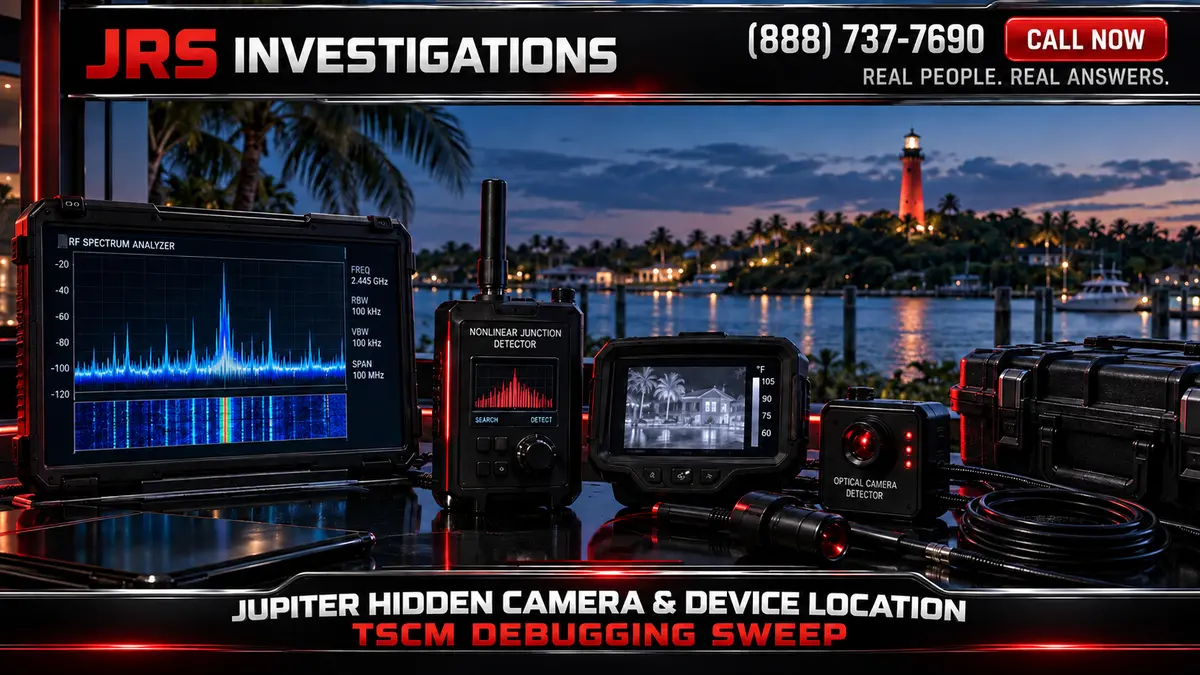
TSCM Bug Sweeps in Jupiter, Florida: A Practical Guide
Concerns about hidden cameras, unauthorized audio devices, or covert tracking can arise in homes, offices, vehicles, rental properties, and other private spaces. A professional technical surveillance countermeasures inspection provides a structured way to examine those concerns. For clients in northern Palm Beach County, TSCM bug sweeps in Jupiter, Florida should combine electronic testing, physical inspection, careful signal analysis, and clear reporting—not a quick pass with a consumer detector.
This guide explains what a professional sweep can and cannot do, how the inspection process works, how to prepare, and what to ask before hiring a provider. For another Florida coastal-property perspective, compare our Naples TSCM inspection guide. For local service details, visit the Jupiter TSCM bug-sweep service page.
What a TSCM bug sweep is designed to examine
TSCM is a disciplined process for identifying technical surveillance risks. The scope may include unauthorized radio-frequency transmitters, hidden cameras, audio recorders, cellular devices, GPS trackers, altered electronics, suspicious wiring, and physical concealment points. The exact approach depends on the location, the concern, the available access, and the equipment already present.
A professional sweep is not a guarantee that every possible device will be found. Some devices transmit intermittently, store data locally, resemble ordinary electronics, or remain powered off. That is why a credible inspection uses multiple methods and explains limitations instead of relying on a single handheld scanner.
Common reasons Jupiter clients request an inspection
- A confidential business meeting, transaction, negotiation, or personnel matter is approaching.
- An unfamiliar object, wiring change, charger, adapter, smoke detector, or network device appears in a private space.
- A vehicle shows signs of unexplained access or a suspected tracking device.
- A residence, condominium, office, rental, boat, or meeting space has recently been accessed by contractors, guests, employees, or other third parties.
- A client wants a baseline inspection after a move, renovation, ownership change, relationship dispute, or security incident.
These circumstances do not prove surveillance is occurring. They help define the inspection scope and determine which areas deserve closer attention.
Why Jupiter environments require a layered approach
Jupiter includes waterfront residences, gated communities, condominiums, professional offices, hospitality properties, marinas, vehicles, and vessels. Each environment creates a different mix of legitimate electronics and access risks. A condo may contain overlapping Wi-Fi and Bluetooth signals from nearby units. An office may have access-control systems, wireless presentation equipment, cameras, and network hardware. A vehicle or boat presents tighter concealment spaces and different power sources.
A technician first has to distinguish normal activity from an unexplained anomaly. That work depends on context: what equipment belongs in the space, who controls it, when it was installed, and how it behaves during testing. Signal strength alone is not proof of a covert device.
Local conditions that affect the inspection plan
The size and construction of the property, neighboring electronic activity, number of rooms, ceiling and wall access, occupancy, network complexity, vehicles, and exterior areas can all affect the time and methods required. Before the appointment, the provider should ask enough questions to define an achievable scope rather than quoting a generic “whole property” sweep without details.
Bug sweeping and counter-surveillance services in Jupiter
People searching for bug sweeping or counter-surveillance in Jupiter usually need one of three things: a check of a home or waterfront residence after a suspected leak, an inspection of an office or conference room before sensitive meetings, or a vehicle or vessel check for hidden GPS trackers. A professional technical surveillance countermeasures (TSCM) inspection combines a physical search with radio-frequency, hidden-camera lens and device-specific checks, rather than relying on a single handheld detector.
JRS Investigations handles sweeps in Jupiter, Tequesta, Juno Beach, Jupiter Island and nearby Palm Beach Gardens. Details on scope and scheduling are on our Jupiter TSCM bug-sweep service page, or call (888) 737-7690 from a phone you trust.
How professional TSCM bug sweeps work
A thorough inspection normally progresses from planning to electronic testing, physical examination, validation, and reporting. The order may change to protect evidence or respond to an active signal, but the methods should support one another.
1. Confidential intake and authorization
The process begins with a private discussion about the location, the client’s authority to request the inspection, recent access, unusual observations, sensitive areas, and the desired outcome. The technician should confirm which rooms, vehicles, devices, or vessels are included and identify anything that cannot be lawfully or safely examined.
2. Environmental and radio-frequency baseline
RF spectrum analysis surveys the signal environment and helps identify transmissions that merit investigation. The technician correlates signals with known Wi-Fi, Bluetooth, cellular, broadcast, security, and building systems. Measurements may be repeated from different positions or while authorized equipment is switched on and off to narrow the source.
A spectrum analyzer provides information; it does not label a signal “spy device.” Professional judgment is required to compare frequency, bandwidth, signal behavior, location, and the electronics expected in the space.
3. Nonlinear junction detection
A nonlinear junction detector, commonly called an NLJD, can help locate semiconductor components concealed inside objects or structures. This is useful because some electronic devices may be powered off or may not transmit during the inspection. NLJD responses still require interpretation: ordinary electronics, corroded metal, and other materials can produce indications that must be checked physically.
4. Hidden-camera and optical inspection
Camera detection can include lens-reflection techniques, controlled lighting, close physical examination, and review of objects positioned toward private areas. The technician may examine chargers, clocks, sensors, décor, vents, electronics, and other items with a plausible line of sight. Thermal imaging can support the process by highlighting temperature differences, but heat alone does not establish that a surveillance device is present.
5. Physical and technical inspection
The physical search is essential. Investigators compare screws, seams, wiring, power supplies, ceiling fixtures, outlets, furniture, network hardware, and recently introduced objects for signs of alteration or concealment. Accessible technology may be reviewed for unfamiliar devices or connections when that review is within the agreed scope and the client has authority.
6. Validation, documentation, and next steps
If an anomaly is identified, the technician should attempt to validate it before drawing a conclusion. Findings may be documented through photographs, location notes, signal information, and an explanation of the method used. When a suspicious device could be evidence, preserve the scene and discuss the next step before touching, powering down, or removing it.
For a shorter overview, see the related article on the Jupiter TSCM four-step process.
Homes, offices, vehicles, rentals, and vessels
The objective stays consistent, but the inspection plan changes with the environment.
Residential properties
A home inspection may prioritize bedrooms, home offices, living areas, entry points, network equipment, and objects introduced by people with recent access. Condominiums require careful differentiation between signals originating inside the unit and normal activity from neighboring residences or shared building systems.
Commercial and professional offices
Office sweeps may focus on conference rooms, executive spaces, legal or financial work areas, reception points, telecommunications closets, and devices used for remote meetings. Scheduling outside normal business hours can reduce disruption and make it easier to control authorized electronics during testing.
Vehicles, rental properties, and boats
Vehicles may be inspected for tracking devices, unauthorized wiring, concealed electronics, and components connected to power or diagnostic systems. Rental properties and hospitality spaces require clear permission from the person or entity with legal control. Boats can include dense wiring, navigation equipment, communications systems, battery banks, and compact compartments, so the scope should be established in advance.
JRS also provides broader South Florida TSCM bug-sweep services when a matter extends beyond Jupiter.
Legal authorization and evidence preservation
The client should have authority to inspect the property, vehicle, vessel, network, or device included in the assignment. Ownership, tenancy, employer policies, shared spaces, and third-party property can create different legal questions. A TSCM professional should not bypass locks, accounts, or access restrictions without proper authorization.
Florida law regulates the interception and disclosure of wire, oral, and electronic communications. The current text of Florida Statutes § 934.03 is an important starting point, but it is not a substitute for legal advice about a specific situation.
If a suspected surveillance device is found, avoid experimenting with it. Unplugging, opening, moving, or transmitting from the device may affect evidence, alert another party, or create safety and legal problems. Document what is visible, restrict access, and coordinate with counsel or law enforcement when appropriate.
How to prepare for a Jupiter TSCM inspection
- Limit discussion of the appointment. Use a trusted phone or in-person conversation if the suspected environment may be compromised.
- Preserve normal conditions. Do not rearrange rooms, discard unfamiliar objects, reset networks, or disconnect equipment unless safety requires it.
- Prepare an access list. Identify the rooms, vehicles, vessels, cabinets, ceiling spaces, devices, and accounts the technician is authorized to examine.
- Gather useful context. Note recent visitors, contractors, maintenance work, unexplained access, technology changes, and when unusual activity began.
- Identify authorized electronics. A list of routers, access points, cameras, smart-home devices, conferencing systems, and trackers can speed signal correlation.
- Arrange privacy and time. Reduce unnecessary occupants and allow enough uninterrupted time for a systematic inspection.
How to evaluate a TSCM provider
Ask specific questions before scheduling. A qualified provider should be able to describe the process without making absolute promises or revealing sensitive operational details.
- Which inspection methods are included beyond basic RF detection?
- How will you separate authorized signals from unexplained activity?
- Does the scope include physical inspection, hidden-camera checks, NLJD work, vehicles, networks, or vessels?
- What access and authorization are required from the client?
- How are possible findings validated, documented, and preserved?
- What limitations or inaccessible areas will appear in the final report?
- How is client information protected before, during, and after the assignment?
Price and duration depend on scope, not a universal flat formula. Property size, construction, signal density, number of vehicles or vessels, access conditions, travel, and the level of documentation all matter. A responsible estimate should define what is included.
What a useful report should contain
At the conclusion, the client should understand what was inspected, which methods were used, what was observed, what could not be accessed, and what actions are recommended. The report should distinguish confirmed findings from benign electronics, unresolved anomalies, and general security weaknesses.
No finding of a covert device does not mean that surveillance was impossible at every time. It means the inspection did not confirm one within the tested scope and conditions. Follow-up may be appropriate after a new access event, before a high-sensitivity meeting, after a change in threat level, or when the environment materially changes.
Frequently asked questions
Can a sweep find a device that is turned off?
Sometimes. Physical inspection and NLJD testing can identify certain electronics that are not transmitting, but no method detects every device in every concealment condition. Layered inspection improves coverage.
Should I buy a consumer RF detector first?
Consumer tools may react to ordinary wireless activity and can create false confidence or unnecessary alarm. If the concern is serious, preserve the environment and speak privately with a professional before conducting an improvised search.
Can an inspection cover both a property and a vehicle?
Yes, when both are included in the agreed scope and the client has authority. Tell the provider in advance so the schedule and equipment plan account for each environment.
How often should a business schedule sweeps?
Frequency should follow risk. Many organizations use event-driven inspections after unauthorized access, staffing disputes, renovations, equipment changes, or before especially sensitive meetings. A provider can help build a schedule based on exposure rather than an arbitrary calendar.
What should I do if I find a suspicious device?
Do not dismantle or test it. Photograph it in place if that can be done safely, prevent unnecessary access, and obtain guidance from the investigator, legal counsel, or law enforcement as appropriate.
Schedule a confidential Jupiter TSCM consultation
A well-planned TSCM inspection replaces speculation with a documented technical process. JRS Investigations can discuss the location, authorization, concerns, timing, and level of reporting needed for a Jupiter residence, office, vehicle, rental, or vessel.
Call JRS Investigations at (888) 737-7690 or request a confidential consultation. Do not use a device or network you believe may be compromised to discuss sensitive details.
JRS Investigations in Jupiter: Jupiter private investigator