(888) 737-7690

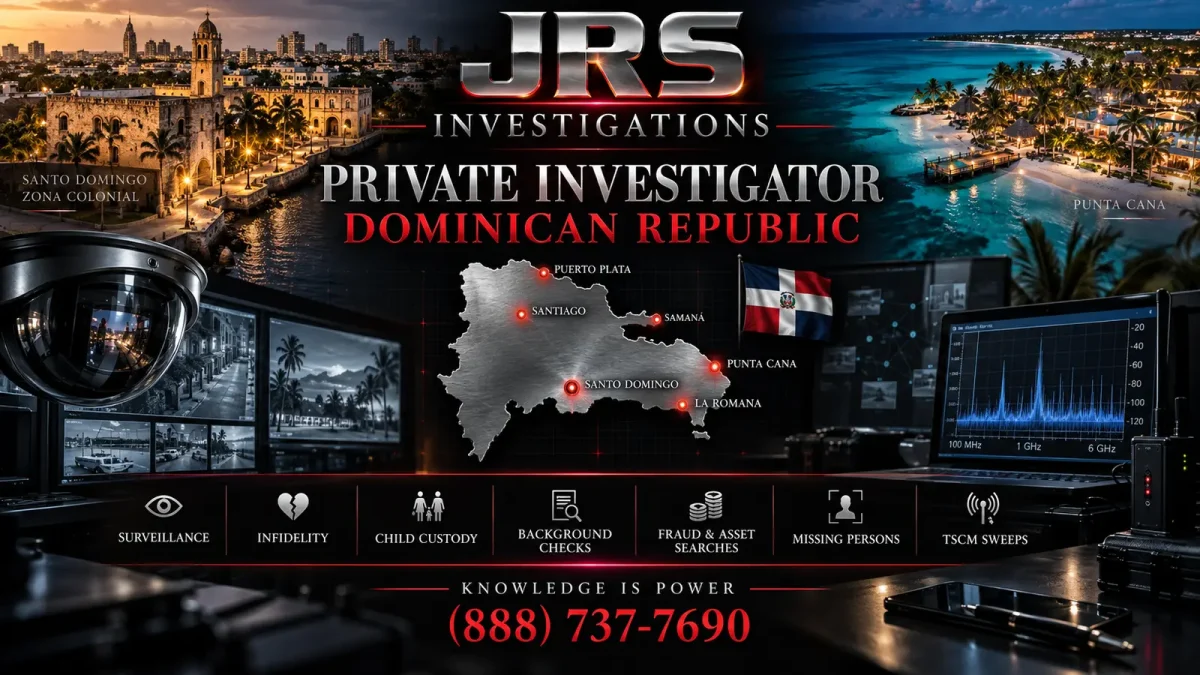
How to Hire a Private Investigator in the Dominican Republic
How to Hire a Private Investigator in the Dominican Republic
Hiring a private investigator in the Dominican Republic requires more than choosing a name from an online directory. A useful investigation depends on lawful methods, reliable local knowledge, clear communication, and evidence that can withstand scrutiny. Those details matter whether the case involves a relationship concern in Punta Cana, a business problem in Santo Domingo, a missing person in Santiago, or asset research connected to Puerto Plata.
JRS Investigations coordinates discreet investigative services throughout the Dominican Republic for private clients, attorneys, insurers, corporations, and families. Assignments are planned around the client’s lawful objective, the location, the available identifying information, and the type of documentation required. Call (888) 737-7690 for a confidential case review.
Why Dominican Republic investigations require local planning
The Dominican Republic is not one uniform operating environment. Santo Domingo is a dense capital with government offices, courts, commercial districts, gated communities, and heavy traffic. Santiago has its own business and residential patterns. Punta Cana, Bávaro, Cap Cana, and La Romana combine resort properties, private developments, tourism traffic, and rotating workforces. Puerto Plata, Sosúa, Cabarete, Samaná, and Las Terrenas can involve long travel distances and very different road conditions.
An investigator must account for access restrictions, travel time, language, local customs, and the difference between public space and private property. A plan that works near a Santo Domingo office may be ineffective inside a controlled resort or rural community. Good preparation identifies the locations, likely schedule, transportation, lawful observation points, and decision thresholds before fieldwork begins.
JRS uses that local context to build a case-specific plan rather than selling a one-size-fits-all package. When local contacts or specialists are needed, their role should be clear, properly coordinated, and limited to lawful work.
Private investigation services in the Dominican Republic
Surveillance and activity documentation
Lawful surveillance can document movements, meetings, routines, and activities visible from places where the investigator is legally permitted to be. It may support domestic matters, civil litigation, workplace concerns, insurance cases, or business disputes. Useful surveillance is not simply following someone. It requires advance intelligence, safe positioning, accurate time logs, professional photographs or video when conditions allow, and a factual report that separates observation from assumption.
Infidelity and relationship investigations
Relationship concerns often involve limited travel dates, resort reservations, unfamiliar companions, or unexplained changes in routine. A focused investigation can document observable conduct without harassment, trespass, impersonation, or access to private accounts. Clients should provide known itineraries, recent photographs, vehicle details, hotel or property information, and specific questions. JRS will explain what can realistically be established and what cannot.
Child custody and family matters
Child custody and domestic investigations may document living conditions, supervision, risky conduct, travel patterns, or compliance with a court order. The child’s safety comes first. The investigator should work from the actual order and the attorney’s objective, avoid unnecessary contact, and record only relevant facts. Cross-border cases may require coordination with counsel in more than one jurisdiction; an investigator does not replace a lawyer or decide custody rights.
Background checks and due diligence
Background investigations can help evaluate a prospective partner, executive, vendor, investment promoter, employee candidate, or online relationship. A Dominican Republic inquiry may combine identity confirmation, address and employment checks, public-record research, company affiliations, litigation indicators, reference development, and onsite verification.
Official sources can strengthen due diligence. The Dirección General de Impuestos Internos (DGII) provides taxpayer and RNC resources. The National Office of Industrial Property (ONAPI) provides business-name, trademark, and intellectual-property services. The Dominican Judiciary’s consultation portal provides access to court-related search tools. A database result is only one piece of evidence; spelling variations, incomplete identifiers, and records held outside a public portal can change the scope.
Fraud, corporate, and investment investigations
Cross-border business disputes can involve false credentials, concealed ownership, misleading project claims, supplier fraud, diverted funds, or a company that exists on paper but not in practice. An investigation may verify people, addresses, facilities, permits or registrations, litigation history, reputation, and whether the represented operation matches observable facts.
For real-estate or development matters, the Registro Inmobiliario virtual-services catalog identifies official services for property products, case status, cadastral information, and title-registry processes. Access and evidentiary requirements vary. JRS can gather and organize lawful findings, while Dominican counsel or a qualified title professional should interpret ownership rights and legal effect.
Asset and property research
Hidden-asset investigations may examine known entities, business interests, publicly available property indicators, vehicles, litigation, and connections that warrant further verification. No ethical investigator should promise to find every asset or obtain protected bank information without legal authority. The objective is to develop documented leads that counsel can evaluate and, when appropriate, pursue through formal discovery or a court process.
Missing persons and skip tracing
Missing-person and skip-tracing work may combine public records, interviews, address development, social-media research, local inquiries, and field verification. The best starting information includes the subject’s full legal name, aliases, date of birth, recent photograph, phone numbers, email addresses, relatives, employers, known locations, and the last confirmed contact.
If someone may be in immediate danger, contact the proper authorities rather than waiting for a private investigation. The Dominican Republic National Police publishes official contact information, and the National 9-1-1 System explains emergency-service use and coverage. A private investigator can supplement—not replace—law-enforcement response.
TSCM bug sweeps and privacy assessments
Technical Surveillance Countermeasures, commonly called a TSCM sweep, can be appropriate for offices, conference rooms, residences, vehicles, and executive travel environments in the Caribbean. A professional examination may look for unauthorized transmitting devices, concealed recording equipment, suspicious wiring, physical tampering, and radio-frequency activity. The scope should identify the spaces, devices, access conditions, and known incident history.
TSCM is not a theatrical scan with a single gadget. Results depend on trained examination, appropriate instrumentation, physical inspection, documentation, and an understanding of legitimate electronics already present. A sweep also cannot guarantee that a space will remain secure after the inspection. JRS can discuss a lawful, authorized assessment for property the client owns, controls, or has permission to examine.
Private security and executive protection support
Travel, public appearances, business disputes, valuable cargo, or a credible threat may call for more than investigative work. JRS can help assess security needs and coordinate private security and executive protection support in the Dominican Republic. The plan should address the client’s itinerary, destinations, transportation, medical concerns, exposure points, and the difference between protective services and investigative surveillance.
What a professional investigator will ask before accepting a case
A serious consultation should define the purpose of the investigation before discussing tactics. Expect questions such as:
- Who is the subject, and how has the identity been confirmed?
- What precise question must the investigation answer?
- Which cities, properties, resorts, employers, or businesses are involved?
- What dates, deadlines, hearings, or travel windows control the schedule?
- What records, photographs, itineraries, messages, or prior reports already exist?
- Who will use the findings: the client, an attorney, an insurer, or a corporate decision-maker?
- Is there any immediate safety issue or active law-enforcement matter?
These questions protect the client as much as the investigator. They help prevent mistaken identity, duplicated work, unrealistic expectations, and activity that does not serve the case.
How to evaluate a private investigator
Ask who will actually perform the work
Cross-border cases may involve a lead investigator, local field contacts, record researchers, translators, security personnel, or technical specialists. Ask who coordinates the team, who receives confidential information, and how findings are reviewed before delivery. “We have contacts” is not enough; the client should understand the chain of responsibility.
Demand a written scope
The engagement should identify the objective, geographic area, authorized methods, reporting format, fees, expenses, communication schedule, and conditions that could require additional authorization. Surveillance cases should address minimum operational windows and what happens if the subject changes locations. Research cases should distinguish a preliminary database search from verified fieldwork.
Review privacy and evidence practices
Personal information must be handled carefully. Dominican Republic legal resources include Law 172-13 concerning protection of personal data in files, public records, databases, and other technical means. Depending on the case, other local laws and the client’s home-jurisdiction rules may also apply. Ask how information is collected, stored, transmitted, retained, and shared.
Reports should state dates, times, locations, sources, steps taken, and limitations. Photographs and video should be preserved in their original form when evidentiary use is anticipated. Attorneys should be involved early when litigation, privilege, discovery, or admissibility may be at issue.
Watch for red flags
Avoid anyone who promises guaranteed results, claims instant access to private bank or phone records, offers to hack accounts, proposes trespass or illegal tracking, refuses to provide a written agreement, or cannot explain who will perform the work. Ethical investigators set limits. They do not manufacture certainty where the evidence is incomplete.
What information helps an investigation succeed
Good intake information saves field time and reduces the risk of following the wrong person. Depending on the assignment, useful material can include:
- full legal names, aliases, dates of birth, and recent clear photographs;
- known addresses, workplaces, vehicles, telephone numbers, and email addresses;
- flight details, hotel reservations, meeting schedules, and expected travel routes;
- company names, registration numbers, contracts, invoices, websites, and marketing material;
- court orders, pleadings, prior investigative reports, and attorney instructions;
- a concise timeline separating confirmed facts from suspicions.
Do not obtain evidence illegally or send passwords to private accounts. Preserve original messages, photographs, documents, and metadata when possible. Tell the investigator what has already been searched and who knows about the inquiry.
From intake to final report
- Confidential consultation: JRS reviews the objective, identities, locations, deadlines, and safety concerns.
- Conflict and feasibility review: The team evaluates whether the assignment can be accepted and what lawful resources are available.
- Written plan: The client receives the proposed scope, priorities, reporting method, and financial terms.
- Investigation: Approved research, fieldwork, surveillance, interviews, technical examination, or coordination is performed.
- Updates: Time-sensitive developments are communicated according to the agreed protocol.
- Reporting: The client receives organized findings, supporting documentation, and clearly stated limitations.
The investigation may change as new facts emerge. The important point is that material scope changes are discussed rather than assumed.
Frequently asked questions
Can a U.S. client hire JRS for a Dominican Republic case?
Yes. JRS works with clients who are outside the Dominican Republic and need local investigation or coordination. Intake can be handled remotely, but the client must provide sufficient identification, a lawful purpose, and a reliable way to communicate.
Can an investigator access private messages or bank accounts?
No ethical investigator should offer unauthorized access to private accounts, communications, or protected financial data. Lawful public records, consent-based information, field investigation, interviews, and attorney-led legal processes are different from hacking or pretexting for restricted records.
How long does a Dominican Republic investigation take?
Timing depends on the objective, location, subject’s schedule, available identifiers, record-access process, travel, and whether the case requires several operational days. A narrow address verification may move faster than surveillance across multiple cities or a layered corporate inquiry. JRS explains the initial plan and the factors that may change it.
Will the evidence be usable in court?
That determination belongs to the attorney and court. Investigators can improve usefulness by following lawful methods, preserving original files, keeping contemporaneous notes, and providing a factual report. If litigation is expected, counsel should define the evidentiary objective before work begins.
Which areas does JRS serve?
Cases may be coordinated in Santo Domingo, Santiago, Punta Cana, Bávaro, Cap Cana, La Romana, Puerto Plata, Sosúa, Cabarete, Samaná, Las Terrenas, and other Dominican Republic locations when the assignment is feasible. See the Dominican Republic private investigator service page and JRS Investigations’ broader private investigation services.
Speak with JRS Investigations
The first goal is to determine whether a lawful investigation can answer the question that brought you here. JRS Investigations will review the facts, identify missing information, explain realistic options, and define a focused scope for work in the Dominican Republic.
Knowledge is power. Call (888) 737-7690 for a confidential consultation about surveillance, infidelity, child custody, background checks, fraud, hidden assets, missing persons, TSCM sweeps, or security support.