(888) 737-7690

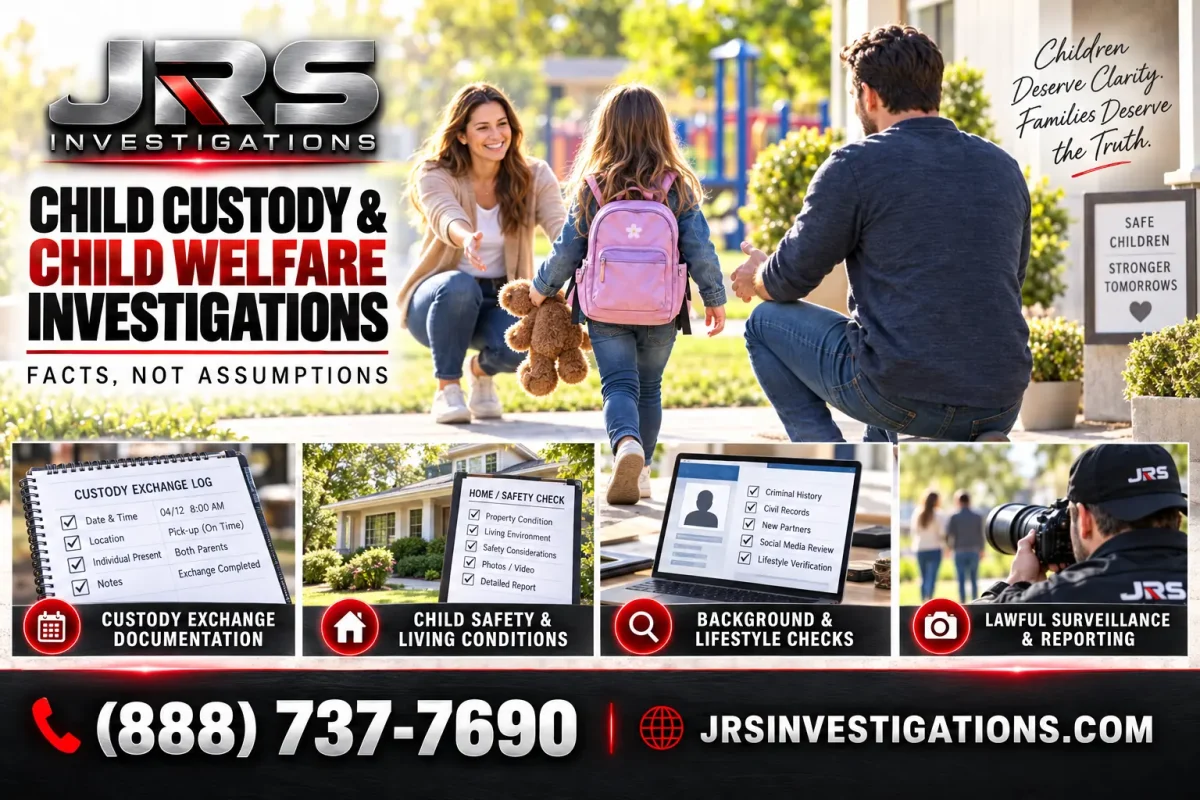
Child Custody Investigation Evidence Guide | JRS
When a parenting dispute raises concerns about a child’s safety, routine, supervision or living conditions, a child custody investigator can help replace conflicting allegations with carefully documented facts. The purpose is not to “win” a family case or label either parent. It is to answer a defined question through lawful observation, verified records and clear reporting that a client and attorney can evaluate.
JRS Investigations approaches these matters with the child’s welfare, privacy and emotional safety at the center of the plan. Every assignment is different. Investigation does not replace legal advice, emergency services, a court-ordered evaluation or a child-protection agency, and no investigator can promise how a judge will interpret particular evidence.
What a child custody investigation can establish
Family-law disputes often involve two very different accounts of the same events. A useful investigation narrows the dispute to behavior that can be observed, timed, corroborated and reported. Depending on the facts and lawful scope, the work may address whether a parenting schedule is being followed, whether a child is left without appropriate supervision, who is regularly present during parenting time, or whether observable conduct is consistent with specific safety concerns.
In Florida, courts decide parenting and time-sharing matters according to the child’s best interests. Florida Statutes section 61.13 identifies multiple factors, including stability, consistent routines, each parent’s involvement in school and activities, an environment free from substance abuse, and evidence of domestic violence, abuse, abandonment or neglect. An investigator does not decide those factors. The investigator may document facts that an attorney can compare with the parenting plan, court orders and issues legally relevant to the case.
Evidence a private investigator may lawfully document
Parenting-time exchanges and schedule compliance
Repeated late pickups, missed exchanges or deviations from an ordered schedule can be difficult to prove through memory alone. When surveillance is lawful and appropriate, an investigator may document arrival and departure times, exchange locations, vehicles, accompanying adults and other conduct visible from lawful vantage points. A dated activity log helps distinguish a single inconvenience from a recurring pattern.
The goal is accurate reporting, not provoking a confrontation. JRS does not interfere with an exchange, question a child during surveillance or direct a client to violate a parenting plan. If an exchange presents an immediate safety risk, the proper response may involve law enforcement, counsel or a court-approved safe-exchange arrangement rather than routine investigative observation.
Supervision, routines and observable safety concerns
A case may involve a specific concern that a young child is being left alone, placed with an undisclosed caregiver or exposed to unsafe conditions. An investigator can document what is visible and corroborable: who arrives or leaves, how long a child appears to be without an identified adult, whether a vehicle is operated in an apparently dangerous manner, or whether an adult’s public conduct raises an objective concern.
Reports should separate observation from inference. “The vehicle crossed the center line three times” is an observation. “The driver was intoxicated” is a conclusion that usually requires more evidence. Careful language protects the integrity of the report and allows the client’s attorney to decide what the facts may mean.
Associates, residences and lawful background research
When a child is regularly exposed to an adult whose identity or history is genuinely relevant, JRS may conduct lawful identity and public-record research. The scope can include verifying a name, address history, business affiliation or publicly available court record when there is a legitimate purpose. Record availability varies by jurisdiction, and a background investigation is not unlimited access to private databases.
A criminal record alone does not resolve a parenting issue. Identity must be matched carefully, records must be interpreted in context, and outdated or incomplete information should not be presented as certainty. JRS distinguishes verified findings from unresolved leads and does not obtain protected medical, school, financial or communications records without proper authority.
Public social-media and open-source evidence
Public posts can sometimes document dates, travel, associates, statements or conduct relevant to a case. Useful preservation includes the visible account name, full post, date, URL when available and enough context to understand what was actually displayed. A cropped screenshot without attribution or surrounding context can be easy to challenge.
JRS uses lawful open-source methods. We do not impersonate a minor, defeat privacy controls, guess passwords or access a private account without authorization. Clients should avoid engaging with the subject through a false identity or altering original files before discussing preservation with counsel.
Witness identification and interviews
Teachers, neighbors, caregivers, coaches or other adults may have relevant firsthand knowledge, but interviews require discretion. The investigator first considers whether contact is appropriate, whether counsel should approve it and whether the witness actually observed the issue rather than heard about it from someone else.
A professional interview records the source’s identity, relationship to the events, basis of knowledge and exact distinctions between what the person saw, heard and assumed. JRS does not coach witnesses, pressure a child to make a statement or represent an interview as independent when it is not.
What a child custody investigator should not do
Family cases are emotionally charged, which makes boundaries especially important. A responsible investigator should not enter a home or private property without permission, place a tracking device on a vehicle without clear lawful authority, intercept calls or messages, hack an account, trespass for a better camera angle or record where the law creates an expectation of privacy.
An investigator also should not promise “court-admissible evidence,” guarantee a custody result or treat a child as a surveillance target. Admissibility and the weight given to evidence are legal decisions. The investigator’s role is to use lawful methods, preserve the work product and explain how each finding was obtained.
A practical child custody evidence checklist
Before hiring an investigator, organize the information that can turn a broad concern into a focused assignment. Do not send passwords, unlawfully obtained recordings or protected records. Start with materials you are permitted to possess.
- Current orders and parenting plan: Highlight the schedule, exchange terms and provisions tied to the concern.
- A concise chronology: List dates, times, locations and what happened without adding conclusions.
- The specific question: Define what the investigation needs to verify or disprove.
- Accurate identifiers: Provide current photographs, lawful vehicle details, known addresses and the names of relevant adults.
- Original communications: Preserve complete messages and emails with timestamps rather than edited excerpts.
- Existing incident information: Include report numbers, court filings or agency contacts that your attorney authorizes JRS to review.
- Known schedule: Identify exchanges, school events, appointments or travel that are directly relevant.
- Urgency and deadlines: Tell JRS about hearings, attorney deadlines or immediate safety concerns at the first consultation.
How JRS scopes a child custody investigation
1. Define the decision the evidence must support
“Prove the other parent is unfit” is not an investigative plan. A workable objective is narrower: document whether the child is repeatedly left at a particular residence during scheduled parenting time, confirm whether exchanges occur as ordered, or determine whether a named adult is regularly present. A precise question controls cost and reduces unnecessary intrusion.
2. Review authority, safety and legal limits
JRS identifies who is retaining the firm, what information the client is authorized to provide and which methods are appropriate. When litigation is pending, coordination with the client’s family-law attorney can help align the scope with the court order and avoid duplicating discovery or creating avoidable problems.
Florida regulates private investigators and private investigative agencies through the Department of Agriculture and Consumer Services. Clients should verify licensing, ask who will perform the fieldwork and understand how subcontractors or out-of-area resources will be supervised.
3. Build a proportionate field plan
Surveillance is not automatically the answer. A matter may call for targeted public-record research, a short period of observation around scheduled exchanges, a witness interview, or a combination of methods. JRS selects the least intrusive lawful approach reasonably suited to the question and discusses how added hours or changed circumstances will be authorized.
4. Preserve notes, media and source details
Good evidence is traceable. Activity logs should use consistent times; photographs and video should remain associated with the original assignment; and research should identify the source and date accessed. The final report should make clear which facts were personally observed, which came from records and which were supplied by a client or witness.
5. Deliver findings without exaggeration
A useful report is chronological, restrained and specific. It does not turn an ambiguous moment into a dramatic accusation. When the investigation does not confirm the allegation, that is also a finding. Objective reporting gives counsel a more reliable basis for deciding whether follow-up work, discovery or court action is justified.
Child safety comes before evidence gathering
If a child is in immediate danger, call 911. Suspected abuse, abandonment or neglect in Florida can be reported to the Florida Abuse Hotline. Do not delay an emergency report so an investigator can obtain photographs or video. JRS is not an emergency response agency and does not replace law enforcement or the Department of Children and Families.
Parents should also avoid involving a child in evidence collection. Do not ask the child to secretly record a parent, search a home or repeat a rehearsed account. Those actions can increase stress and may affect the reliability of the information. Questions about interviews, evaluations or disclosures should be handled with counsel and qualified child-welfare professionals.
Questions to ask before hiring a child custody investigator
- Are the investigator and agency properly licensed for the work?
- How will the scope connect to the parenting plan or attorney’s case strategy?
- Which methods are proposed, and what will not be done?
- Who will conduct surveillance or research?
- How are notes, photographs, video and digital files preserved?
- What triggers added hours, travel or a change in scope?
- How will confirmed facts be separated from allegations and unresolved leads?
- Can the investigator explain the report and methods if testimony is later requested?
Frequently asked questions
Can a private investigator guarantee that I will receive custody?
No. Courts decide parenting and time-sharing issues. An investigator can document relevant facts but cannot guarantee a legal outcome or predict the weight a judge will give any particular finding.
Can JRS investigate the other parent’s new partner?
Potentially, when there is a legitimate, case-related purpose and a lawful scope. Research is limited by jurisdiction, permissible access and the quality of available records. JRS does not conduct curiosity searches or obtain protected information without authority.
Will surveillance include the child?
The assignment may document public activity involving the family when it is directly relevant, but the child is not treated as a target. Planning is designed to minimize intrusion, avoid contact and protect the child’s dignity.
Is social-media evidence enough by itself?
Sometimes a public post is useful, but identity, date, context and authenticity matter. Social content is stronger when preserved properly and corroborated by other reliable facts.
Should I hire an investigator before speaking with an attorney?
You may contact JRS for an initial consultation, but pending family litigation often benefits from attorney coordination. Counsel can identify the legal issues, deadlines and court-order provisions most relevant to the investigative scope.
Discuss a focused child custody investigation with JRS
JRS Investigations provides child custody and domestic investigations, lawful surveillance and related private investigation services. We begin with the question that needs an answer, the authority for the work and the least intrusive reasonable way to document it.
For a confidential consultation, call (888) 737-7690. Bring the parenting plan or court order, a concise timeline and the specific conduct you need evaluated. JRS will explain what can be investigated, what cannot and what information is needed before fieldwork begins.