
(888) 737-7690

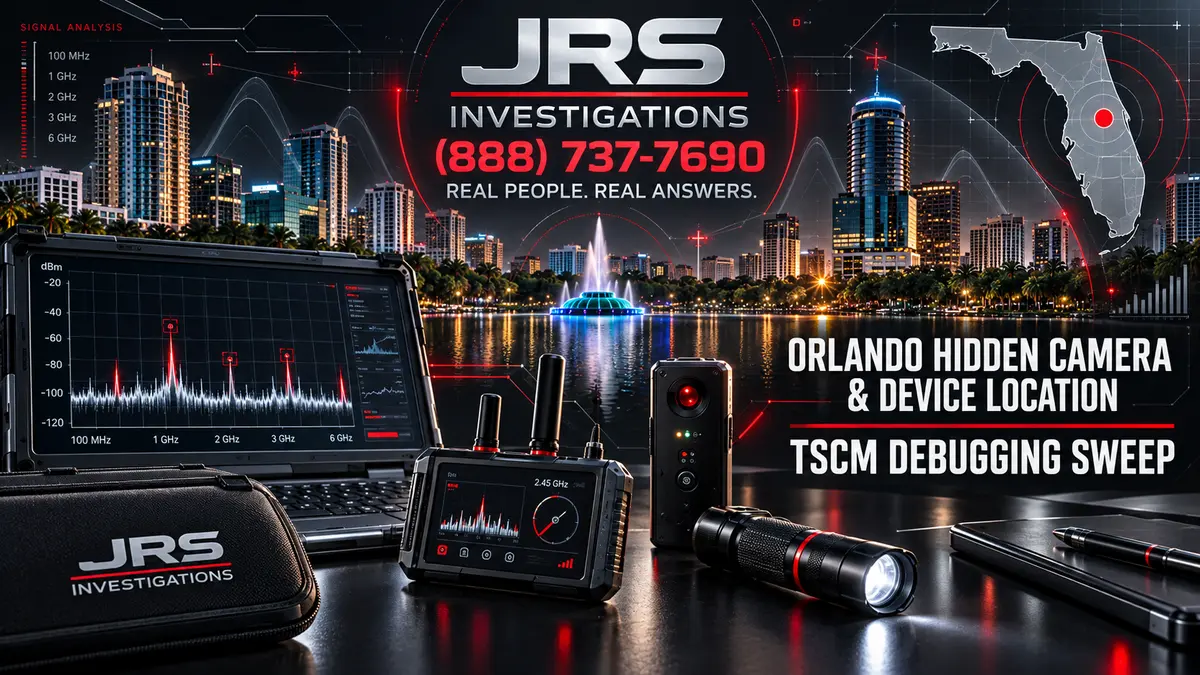
TSCM Bug Sweeps in Orlando, Florida: Professional Guide
Privacy concerns in Orlando rarely arrive with a clear warning. A confidential meeting may feel exposed, a former employee may still know too much about an office, or an unfamiliar device may appear in a rental, residence, hotel suite, or vehicle. Professional Orlando TSCM bug sweeps address those concerns through a controlled examination for hidden cameras, listening devices, unauthorized transmitters, and other surveillance risks.
nn
Technical Surveillance Countermeasures, commonly called TSCM, is not a single gadget or a quick pass with a consumer detector. A credible sweep combines technical measurements, physical inspection, environmental knowledge, lawful access, and careful reporting. JRS Investigations applies that layered approach for clients who need discreet answers without exaggerated promises.
nn
If you have a current concern, call (888) 737-7690 or use the confidential JRS contact form to discuss the location, timing, and reason for the inspection.
nn
Why Orlando Environments Require a Layered TSCM Approach
nn
Orlando combines dense downtown offices, major convention and hospitality properties, medical and technology corridors, gated residential communities, short-term rentals, and heavily traveled vehicles. Those settings create different technical conditions. A high-rise near downtown may contain dozens of legitimate Wi-Fi networks, Bluetooth devices, building controls, and cellular signals. A resort or meeting venue may add temporary audiovisual equipment, smart televisions, wireless presentation systems, and changing occupants.
nn
This signal density can make a simple alarm from a handheld detector meaningless. A professional examiner must separate normal emissions from unexplained activity, compare signals over time, inspect likely concealment points, and consider devices that do not transmit continuously. The goal is not to declare that every radio signal is suspicious. It is to build and test reasonable explanations for what the equipment and physical environment reveal.
nn
Orlando’s mix of permanent workplaces and temporary spaces also affects planning. An executive office can often be examined under controlled conditions. A hotel suite, vacation rental, conference room, or event space may have a short access window and furniture or electronics that cannot be altered. The sweep plan should reflect those limitations before equipment arrives.
nn
When an Orlando Bug Sweep May Be Appropriate
nn
A TSCM inspection may be reasonable when the potential harm from exposed information is substantial or when specific facts support concern. Common requests involve confidential negotiations, executive or legal meetings, sensitive personnel matters, intellectual property, domestic disputes, suspected stalking, unexplained knowledge of private conversations, or a property recently accessed by an adversarial party.
nn
Businesses may also schedule preventive sweeps before or after a high-value meeting, following a security incident, during an office transition, or when access controls have failed. Residents and travelers may request an inspection after finding an altered object, unexplained wiring, an unfamiliar account or device on an authorized network, or evidence that a private area has been entered.
nn
Concern alone does not prove surveillance. Many ordinary devices generate radio-frequency activity, heat, reflections, or network entries that can appear unusual without context. A disciplined TSCM process tests the concern and documents findings rather than assuming the conclusion.
nn
What Professional Orlando TSCM Bug Sweeps Examine
nn
Radio-frequency spectrum activity
nn
Spectrum analysis evaluates radio-frequency activity across relevant bands and over time. The examiner looks for unexplained transmitters, unusual signal behavior, frequency-hopping or burst activity, and relationships between a signal and a specific area or object. Because downtown offices and hospitality properties are electrically busy, signal identification and correlation matter more than the number of signals detected.
nn
Electronic components, including powered-off devices
nn
A non-linear junction detector can help locate semiconductor components concealed in objects or building features. This tool may identify electronics even when a device is not actively transmitting, but it also responds to ordinary electronic components and some metal junctions. Results therefore require careful localization and physical confirmation.
nn
Hidden-camera lenses and visual anomalies
nn
Optical inspection tools can reveal reflections associated with camera lenses. Examiners also inspect sightlines, small openings, smoke detectors, clocks, chargers, power strips, decorative objects, and other items positioned to view private activity. Not every reflective point is a camera, so optical findings must be examined directly.
nn
Heat patterns and physical concealment
nn
Thermal imaging may show heat that deserves closer inspection, especially around recently powered electronics. It cannot see through walls and does not independently establish that surveillance exists. Physical inspection remains essential because a recorder, wired microphone, altered fixture, or dormant device may produce little or no useful radio-frequency evidence.
nn
Authorized network review
nn
When the client controls the network and authorizes access, a review may identify unfamiliar connected devices, unusual addressing, or equipment that does not match the site inventory. Network review complements the physical and RF examination. It does not replace them because a device may record locally, use cellular service, connect only intermittently, or remain offline during the sweep.
nn
For a closer look at the local service, see Orlando TSCM debugging and bug-detection sweeps. You can also review the broader JRS TSCM bug-sweep services.
nn
How the TSCM Process Is Structured
nn
1. Confidential intake and scope
nn
The process begins with the reason for concern, the areas involved, who has lawful authority over them, relevant dates, known access, and any devices or incidents already observed. This information helps define priorities and prevents unnecessary disturbance of the scene. Clients should avoid confronting a suspected person or handling a questionable object before receiving guidance.
nn
2. Site preparation and baseline observations
nn
Whenever practical, the area should be available without unnecessary occupants and with normal electronic devices identified. The examiner records the layout, visible equipment, nearby sources of interference, and access limitations. In a hotel, convention, or shared office environment, the baseline may be especially important because neighboring systems can influence readings.
nn
3. Layered technical and physical examination
nn
The sweep proceeds methodically through defined rooms, furnishings, fixtures, electronics, and other relevant assets. RF analysis, non-linear junction detection, optical inspection, thermal observations, and physical examination are used where appropriate. Suspect findings are cross-checked with another method rather than accepted from a single instrument alert.
nn
4. Findings, documentation, and next steps
nn
The client should receive a clear explanation of what was examined, material limitations, notable findings, and recommended follow-up. If a suspected device is discovered, preserving its location and condition may matter. Photographing before movement, limiting access, documenting who handled it, and consulting counsel or law enforcement can help protect evidence and avoid an impulsive response.
nn
Orlando Locations That Need Special Planning
nn
Corporate offices and executive suites: Shared walls, managed networks, access cards, conference technology, and after-hours contractors can complicate both the threat picture and the sweep. Planning may include boardrooms, private offices, reception areas, and vehicles used for sensitive conversations.
nn
Hotels, resorts, and convention spaces: Short access windows and high device turnover require a tightly defined scope. A client should confirm authority to inspect the specific room or space and coordinate timing without announcing sensitive details broadly.
nn
Residences and short-term rentals: Smart-home equipment, security cameras, voice assistants, chargers, and guest devices can create confusing signals. The inspection should distinguish authorized technology from unknown equipment and focus on spaces where privacy is reasonably expected.
nn
Vehicles: Modern vehicles contain Bluetooth, cellular, telematics, navigation, cameras, and diagnostic systems. A vehicle examination may consider the passenger compartment, cargo areas, exterior attachment points, wiring, and authorized digital systems while recognizing that factory equipment can resemble aftermarket tracking technology.
nn
Medical, legal, and professional environments: Confidentiality obligations increase the consequences of disruption or mishandled data. Scope and documentation should be coordinated with authorized leadership, counsel, or security personnel as appropriate.
nn
Lawful Access and Evidence Preservation
nn
A sweep should be conducted only with permission from someone who has authority over the property, room, vehicle, or network being examined. Ownership, tenancy, workplace policy, consent, and the type of communication involved can all affect what is lawful. Federal law restricts the intentional interception of certain communications under 18 U.S.C. Section 2511, and Florida or local rules may also apply.
nn
JRS investigators do not provide legal advice. When a matter involves employee monitoring, a domestic dispute, litigation, privileged communications, or possible criminal conduct, consult a qualified Florida attorney before taking action. If evidence could be used in court, discuss collection and chain-of-custody requirements early.
nn
What a TSCM Sweep Can and Cannot Establish
nn
A well-executed sweep can identify suspicious devices or anomalies present and detectable within the agreed scope at the time of examination. It can also document the environment, eliminate some false alarms, and provide practical security recommendations. It cannot guarantee that no device has ever been present, predict later installation, or overcome areas and systems that were not accessible.
nn
Results are strongest when the scope matches the concern, the site is preserved, access is complete, and multiple methods support the conclusion. Follow-up may include removing unauthorized access, changing meeting practices, improving physical security, reviewing network credentials, or scheduling another inspection after a material incident.
nn
Choosing a TSCM Provider in Orlando
nn
Ask how the provider develops scope, which methods are used, how false positives are evaluated, what reporting is provided, and how confidentiality is protected. Be cautious of guaranteed detection claims, vague references to secret equipment, or a process centered on one consumer detector. Experience, methodical documentation, lawful conduct, and the ability to explain limitations are more useful than dramatic promises.
nn
For another Orlando-focused perspective, read Orlando TSCM bug sweeps for company security. The two resources address related concerns, while this guide provides a fuller overview of residential, business, hospitality, and vehicle environments.
nn
Schedule a Confidential Orlando TSCM Consultation
nn
If private information, personal safety, or business strategy may be at risk, avoid disturbing the location more than necessary. Record what prompted the concern, preserve relevant access logs or messages, and speak with an investigator about a lawful, proportionate next step.
nn
Call JRS Investigations at (888) 737-7690 to discuss an Orlando hidden-camera and device-location sweep. Real people answer real questions, and the consultation can help determine the appropriate scope before an on-site examination is scheduled.
n