(888) 737-7690
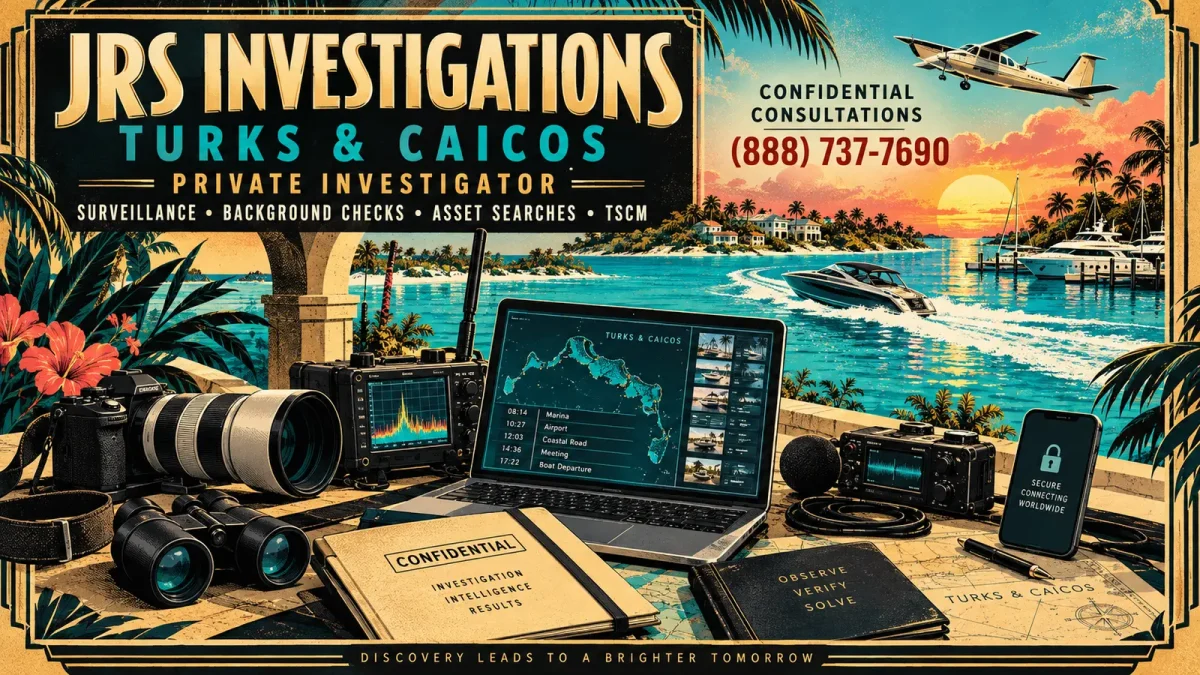
Turks and Caicos Private Investigator Hiring Guide | JRS
Turks and Caicos Private Investigator Hiring Guide
Personal, legal, and business concerns in the Turks and Caicos Islands often involve more than one jurisdiction, limited travel windows, resort or villa access, maritime movement, and a strong need for discretion. JRS Investigations coordinates confidential investigative services for clients with matters connected to Providenciales, Grand Turk, North Caicos, Middle Caicos, South Caicos, Salt Cay, and nearby cays.
This guide explains when to hire a private investigator, which services may fit your situation, how cross-border assignments should be planned, and what to ask before authorizing work.
Confidential consultation: Call (888) 737-7690 or contact JRS Investigations.
When to Hire a Private Investigator in Turks and Caicos
An investigator is most useful when you need independent verification, lawful evidence gathering, or a clear plan for resolving uncertainty. Clients may be located in the United States, United Kingdom, Canada, or elsewhere while the subject, property, company, or event is connected to the Turks and Caicos Islands.
Common assignments include surveillance, infidelity and domestic investigations, background checks, missing-person inquiries, hidden-asset and property research, business due diligence, fraud investigations, and technical surveillance countermeasures.
A professional agency should define the objective, identify which jurisdiction’s rules may apply, explain practical limits, and distinguish verified facts from inference. No investigator can guarantee what an assignment will uncover.
Investigative Services for Turks and Caicos Matters
Surveillance and Activity Documentation
Surveillance can document movements, meetings, routines, and specific conduct when there is a legitimate investigative purpose. Island assignments require careful timing. Subjects may move among airports, resorts, villas, marinas, restaurants, beaches, commercial districts, and private residences, or travel between islands with little notice.
JRS plans surveillance around the event that matters and the evidence the client actually needs. Investigators use lawful observation and modern photographic equipment while protecting confidentiality. Reports should accurately record dates, times, locations, and relevant activity without overstating what the evidence proves.
Infidelity and Domestic Investigations
A resort trip, second residence, yacht itinerary, or recurring business visit can create questions that are difficult to answer from another country. A measured investigation is more useful than confrontation or improvised monitoring. JRS can review the known facts, identify productive observation windows, and coordinate discreet fieldwork.
For family-related concerns, review JRS’s infidelity and cheating-spouse investigation services and child-custody and domestic investigations.
Background Checks and International Due Diligence
A professional background investigation is more than an internet search. Identity confirmation, name variations, jurisdictions, source quality, and the purpose of the inquiry all matter. Depending on the lawful scope, research may examine company interests, court and regulatory records, property connections, professional history, sanctions, litigation, and other verifiable information.
Due diligence can support business partnerships, investments, property transactions, vendor selection, litigation, and high-value personal decisions. Results should identify the source and limitation of each finding rather than presenting database matches as confirmed facts.
See JRS background-check services.
Property and Hidden-Asset Research
Asset investigations may help attorneys, judgment creditors, business owners, and individuals identify ownership interests, companies, real property, transfers, liens, and related leads. The official Turks and Caicos Islands Land Registry records land transactions and maintains public property records available through its application process and applicable fees.
An investigator can organize lawful research, connect records across jurisdictions, and document leads. Protected bank, tax, credit, and account information cannot be obtained without consent, a court process, or other legal authority.
Missing Persons and Locates
Locating a person across islands or borders may require multiple identifiers, address history, travel information, lawful databases, public records, interviews, and careful lead development. The purpose of the search matters because an investigator must consider privacy, safety, and whether contact information can be released.
If someone’s whereabouts are unknown and you fear for their safety, contact the Royal Turks and Caicos Islands Police Force immediately. Its guidance states that there is no requirement to wait 24 hours before making a missing-person report. Private investigators may supplement official efforts but do not replace emergency services or police.
Fraud and Business Investigations
International transactions can create risks involving false identities, undisclosed conflicts, misrepresented assets, shell companies, vendor fraud, internal theft, or suspicious transfers. JRS can help define the subject, preserve source information, develop public-record leads, and coordinate findings for counsel or decision-makers.
When a matter may lead to litigation, employment action, or a regulatory report, involve qualified counsel early. The investigative plan should preserve evidence and avoid actions that interfere with legal duties in any relevant jurisdiction.
TSCM Bug Sweeps and Counter-Surveillance
Technical Surveillance Countermeasures, often called a TSCM sweep or bug sweep, is a structured examination for unauthorized listening devices, covert cameras, suspicious radio-frequency activity, and other surveillance risks. Effective work combines modern detection equipment with physical and technical inspection. No single consumer detector can rule out every threat.
Villas, hotel suites, offices, meeting rooms, vehicles, and vessels present different inspection challenges. A pre-inspection consultation should address the suspected threat, recent access, unusual devices or communications, affected spaces, and the need to preserve evidence.
Why Cross-Border Planning Matters
A Turks and Caicos investigation may involve a client, subject, attorney, account, company, or evidence source in another country. Before fieldwork begins, the agency should determine where each investigative act will occur and what permissions, local coordination, privacy restrictions, or professional requirements apply.
JRS does not assume that authority in one jurisdiction automatically transfers to another. Assignments are scoped and coordinated according to the location, available lawful methods, and any necessary local resources. That planning protects the client and improves the reliability of the resulting evidence.
Technology, Privacy, and Lawful Authority
Modern investigators may use professional cameras, secure case-management systems, open-source research tools, lawful databases, and specialized TSCM equipment. Technology supports the investigation; it does not create permission to access private accounts, intercept communications, obtain protected records, or track someone unlawfully.
Drones, GPS devices, recordings, communications data, and digital forensics can raise aviation, privacy, property, consent, and evidentiary issues. Their use depends on the facts and legal authority. Clients should not install monitoring tools, enter another person’s accounts, or record communications without receiving jurisdiction-specific legal advice.
How to Choose a Turks and Caicos Investigator
Use the initial consultation to determine whether the agency understands both the case objective and the cross-border issues. Ask:
- Who will perform the work? Understand which agency or vetted professional will conduct each part of the assignment.
- What local requirements apply? Ask how the agency will address permissions, privacy, access, and jurisdictional limits.
- What is the specific objective? Each proposed activity should support a defined question or evidence need.
- How are fees calculated? Discuss retainers, hourly rates, travel, lodging, transportation, records, equipment, and report time.
- What updates and deliverables will I receive? Confirm the communication schedule, reports, photographs, video, records, and evidence retention.
- What cannot legally or practically be done? Avoid anyone promising protected records, illegal access, or guaranteed results.
What to Prepare for the Consultation
You do not need to solve the case before calling. Organized information helps the investigator assess feasibility and cost:
- The subject’s full name, aliases, recent photograph, known addresses, vehicles, and contact information
- Flight, hotel, villa, marina, vessel, meeting, or event details lawfully available to you
- Important dates, travel windows, court deadlines, and expected movements
- The exact question you need the investigation to answer
- Relevant court orders, contracts, ownership records, or attorney instructions
- Original messages, photographs, video, and documents connected to the concern
- Any immediate safety, police-report, or evidence-preservation issue
Preserve original files and avoid altering screenshots or forwarding evidence repeatedly. If litigation is underway, ask counsel about preservation, discovery, privilege, and how the investigator should report findings.
What a Professional Case Should Deliver
A well-managed assignment begins with a defined objective, lawful scope, and realistic budget. The agency should explain the work, provide meaningful updates, and adjust the plan when verified findings change the case. Deliverables may include a factual report, photographs, video, public-record documentation, or a summary of investigative leads.
Evidence quality matters more than volume. Accurate times, locations, source descriptions, and continuity allow attorneys and clients to evaluate what the information proves. Investigators should separate direct observation, source information, public records, and analysis.
Frequently Asked Questions
How much does a private investigator cost in Turks and Caicos?
Cost depends on the assignment, islands involved, number of investigators, timing, transportation, travel, equipment, records, and reporting requirements. After learning the objective, JRS can explain the anticipated retainer and billing structure.
Can an investigator guarantee results?
No. An investigator can commit to professional effort, lawful methods, and clear reporting. What is discovered depends on subject activity, available records, access, timing, and other facts outside the agency’s control.
Will the investigation remain confidential?
Investigative agencies treat client communications and case information as confidential, subject to legal obligations, safety issues, and disclosures authorized by the client. Ask how records, media, and communications will be stored and delivered.
Can the evidence be used in court?
Lawfully obtained reports, photographs, video, records, and testimony may assist legal proceedings, but admissibility depends on the forum and evidence rules. Involve qualified counsel early when litigation is expected.
Contact JRS Investigations
If your matter is connected to the Turks and Caicos Islands, JRS Investigations can review the circumstances confidentially, explain realistic options, and develop a focused cross-border plan. Services include surveillance, domestic investigations, child-custody matters, background checks, missing-person searches, property and hidden-asset research, due diligence, fraud investigations, and TSCM bug sweeps.
Knowledge is power. Call (888) 737-7690, review our private investigation services, visit the Turks and Caicos private investigator service page, or request a confidential consultation.