(888) 737-7690

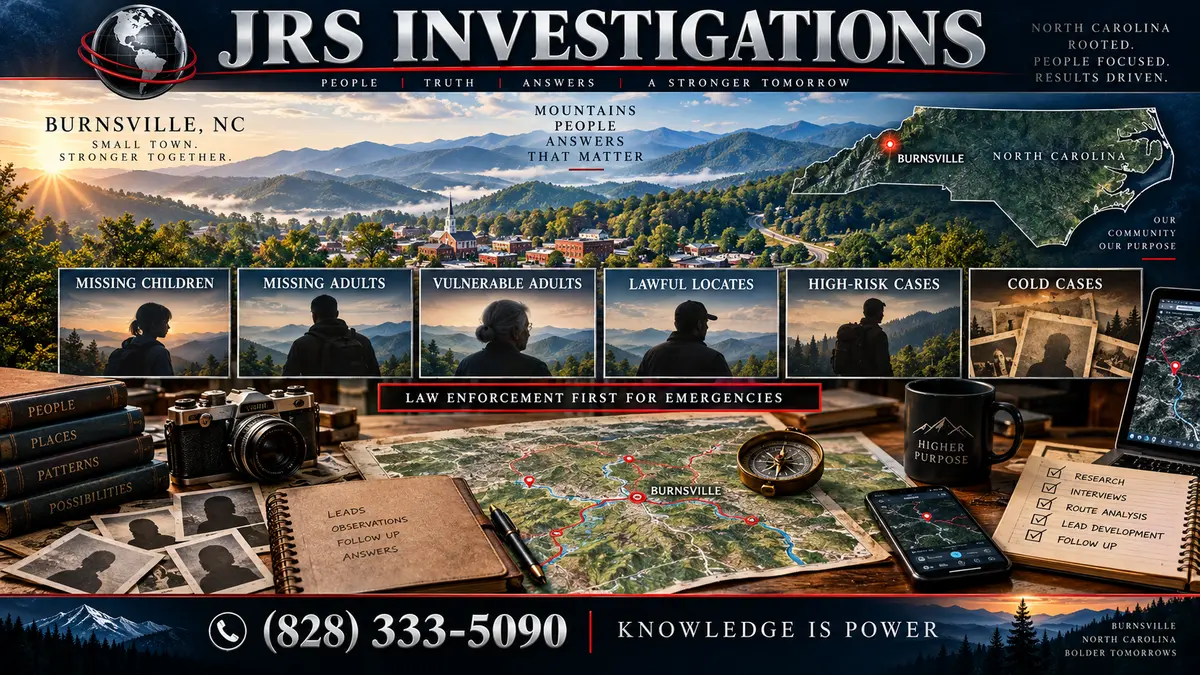
6 Types of Missing-Person Cases in Burnsville, NC
When someone cannot be located, the first question is not simply “Where are they?” It is whether the situation is urgent, who has lawful authority to request the search, and which facts can help distinguish an emergency from a voluntary loss of contact. A Burnsville missing person investigator can support families, attorneys, guardians, and authorized clients with focused fact-finding while coordinating appropriately with law enforcement.
JRS Investigations handles missing-person and locate matters in Burnsville and throughout western North Carolina. Private investigative work can help develop leads, verify information, locate witnesses, and document findings, but it does not replace a police investigation, emergency response, or search-and-rescue operation.
Six types of missing-person cases in Burnsville
1. Missing children and parental-abduction matters
A missing child requires immediate action. Contact local law enforcement first—there is no need to wait before reporting a child missing. After making the police report, families can also contact the National Center for Missing & Exploited Children at 1-800-THE-LOST (1-800-843-5678).
In a parental-abduction or custody-related matter, a private investigator may support counsel and the investigating agency by organizing timelines, verifying addresses and relationships, locating witnesses, reviewing lawfully available records, and developing leads. The investigator cannot alter a custody order, take physical custody of a child, or interfere with law enforcement.
2. Missing or disconnected adults
Adults may lose contact for many reasons, including travel, family conflict, a changed phone number, housing instability, medical vulnerability, or a deliberate decision to seek privacy. An investigator should not assume that a missing adult is experiencing mental illness, substance use, or criminal victimization without evidence.
Work may include verifying the last confirmed contact, mapping known locations, checking authorized records and public information, speaking with relevant contacts, and testing leads. When a competent adult is located and does not consent to disclosure, the investigator may be limited to confirming safety or passing along a message rather than revealing the person’s location.
3. Vulnerable and endangered adults
Cases involving dementia, cognitive impairment, a medical condition, domestic violence, suicidal statements, exposure to severe weather, or another immediate risk should be reported to 911 or law enforcement without delay. Time-sensitive public safety decisions belong to trained emergency personnel.
A private investigator may supplement the official response by helping the authorized family or guardian organize photographs, vehicle details, recent communications, routines, known destinations, and contact information. Field inquiries must be coordinated carefully so they do not disrupt emergency operations.
4. Skip tracing and lawful locate investigations
Skip tracing is used to locate a person for a defined lawful purpose, such as service of process, estate administration, witness location, family contact, or another authorized matter. It differs from an emergency missing-person investigation because the person may be intentionally difficult to reach and may not be in danger.
A locate investigation can involve identity resolution, address-history analysis, public records, business affiliations, professional licenses, property information, open-source research, and carefully planned outreach. JRS does not provide a person’s private information merely because someone is curious about them; the client’s purpose, authority, and privacy implications must be reviewed first.
5. High-risk disappearances and possible exploitation
Unexplained travel, coercive relationships, online contacts, threats, sudden financial activity, or evidence of exploitation may raise the risk level of a case. Those indicators should be documented and reported to the appropriate law-enforcement agency. Suspected child sexual exploitation can also be reported through the National Center for Missing & Exploited Children’s CyberTipline.
Private investigative support may focus on preserving communications supplied by the client, identifying usernames or known associates, building a factual chronology, locating witnesses, and forwarding credible leads through the proper channel. Investigators should not confront a suspected trafficker, attempt a rescue, or compromise an active police investigation.
6. Long-term missing-person and cold-case support
Older cases can benefit from a structured review of what is known, what was assumed, and which leads were never independently verified. New public records, address changes, digital footprints, property transfers, obituaries, family connections, or witness availability may create a fresh avenue of inquiry.
A private investigator can help re-index the file, rebuild the timeline, conduct lawful open-source research, locate former contacts, and prepare organized findings for the client, attorney, or law enforcement. A review cannot guarantee resolution, and potential evidence should always be handled with the appropriate agency.
How a Burnsville missing-person investigation is developed
A useful investigation starts with a disciplined intake and a clear division of responsibility:
- Assess urgency: Identify immediate danger, age, medical vulnerability, weather exposure, threats, and the last confirmed contact.
- Confirm reporting: Record the law-enforcement agency, report number, assigned contact, and any instructions already provided.
- Build the timeline: Organize dates, communications, transactions supplied by authorized parties, travel plans, vehicles, and known locations.
- Verify identities and relationships: Separate confirmed contacts from nicknames, outdated information, duplicate profiles, and unverified tips.
- Develop and prioritize leads: Use lawful records, open-source research, interviews, and field inquiries appropriate to the case.
- Document results: Preserve source information, distinguish fact from inference, and report credible findings promptly.
JRS offers additional information on its missing-person and skip-tracing service page and the broader private-investigation services page.
Why Burnsville’s local geography matters
Burnsville and Yancey County include mountain roads, wooded property, trail access, scattered residences, limited cellular coverage in some areas, and routes leading toward Asheville and other western North Carolina communities. Weather, terrain, seasonal travel, and incomplete addresses can affect how quickly a lead can be checked.
Local context helps an investigator plan fieldwork, identify realistic travel routes, and decide which contacts or locations should be prioritized. Clients can learn more from the Burnsville private-investigator page, the nearby Asheville investigator page, and the related Asheville missing-person guide.
Information to gather now
- A recent, clear photograph and accurate physical description.
- Full legal name, aliases, date of birth, phone numbers, emails, and usernames.
- Last confirmed date, time, location, clothing, vehicle, and direction of travel.
- Medical needs, cognitive concerns, threats, unusual behavior, or known safety risks.
- Names and contact details for family, friends, coworkers, neighbors, and recent associates.
- Copies of relevant messages, call logs, travel plans, receipts, and photographs that you are authorized to provide.
- The law-enforcement report number and assigned agency contact.
Preserve original files and avoid editing screenshots, logging into another person’s account, announcing investigative steps publicly, or confronting a suspected party. Share urgent new information with law enforcement first.
Contact a Burnsville missing person investigator
If someone is in immediate danger, call 911. For non-emergency investigative support, JRS Investigations can review the facts, explain a lawful scope, and coordinate around any active official investigation. Knowledge Is Power. Call (828) 333-5090 or contact JRS Investigations for a confidential consultation.