(888) 737-7690

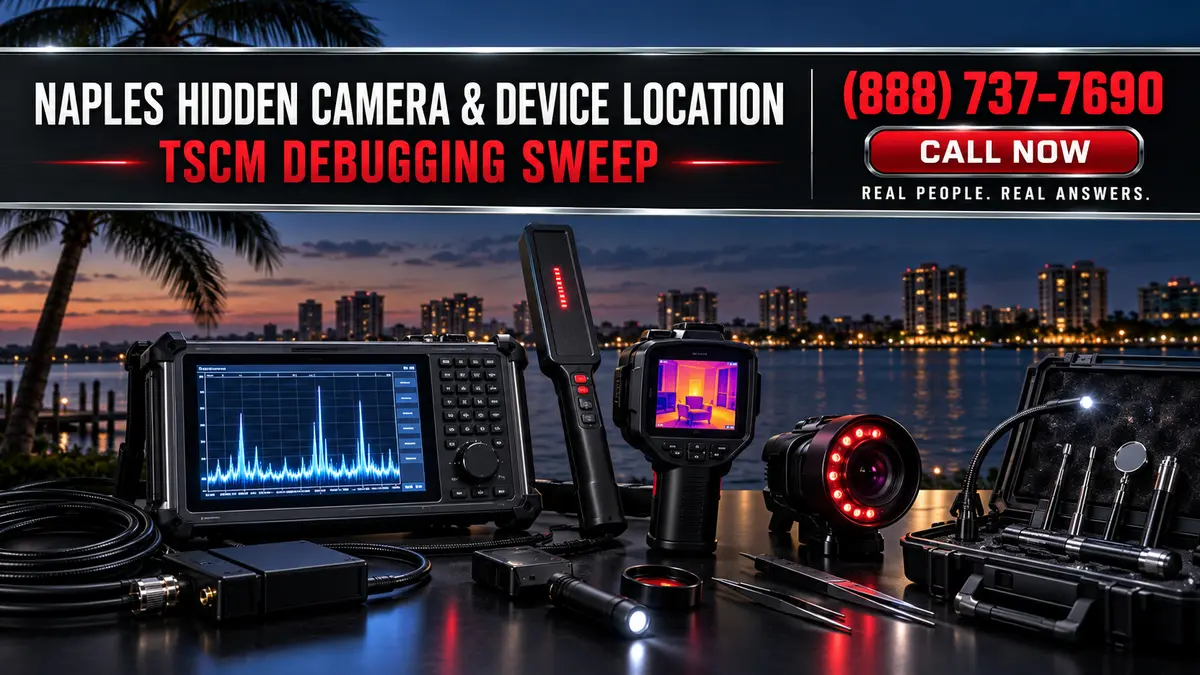
TSCM Bug Sweeps in Naples, Florida: Professional Guide
Professional TSCM bug sweeps in Naples, Florida combine electronic analysis with a careful physical inspection to look for hidden cameras, microphones, tracking devices, unauthorized transmitters, and suspicious modifications. A qualified inspection does more than scan a room with a handheld detector. It evaluates the property, documents the normal electronic environment, examines likely concealment points, and explains any finding in a clear written report.
JRS Investigations provides discreet TSCM and debugging services in Naples for residences, condominiums, offices, hotel rooms, rental properties, vehicles, and other authorized locations. This guide explains when a sweep may be appropriate, how professional examiners work, how to prepare, and what to do if something unusual is discovered.
What a Naples TSCM bug sweep is designed to find
Technical Surveillance Countermeasures, commonly shortened to TSCM, is the disciplined search for unauthorized surveillance and the vulnerabilities that could support it. The target is not limited to a radio-frequency “bug.” Modern devices may transmit continuously, activate only when sound or motion is detected, record locally without transmitting, use cellular or Wi-Fi connections, or remain dormant until an operator retrieves them.
A professional sweep may look for:
- Hidden or disguised cameras, including devices placed in clocks, chargers, smoke detectors, décor, vents, and electronics
- Audio transmitters, concealed microphones, and recording devices
- Cellular, Wi-Fi, Bluetooth, and other radio-frequency devices that do not belong in the space
- GPS or cellular tracking devices attached to or concealed inside vehicles
- Unauthorized wiring, altered outlets, modified fixtures, and suspicious electronic components
- Network-connected devices or access points that require closer review
- Physical vulnerabilities that could allow a device to be installed later
No single instrument can reliably identify every category. That is why an effective TSCM inspection uses several complementary methods and treats instrument readings as evidence to be investigated, not as automatic proof of surveillance.
When should you consider a debugging sweep?
A sweep is reasonable when there is a specific event, pattern, or exposure that raises a legitimate privacy concern. Examples include confidential information reaching an unexpected person, a device or fixture appearing to have been moved, unexplained access to a home or office, a contentious business or domestic dispute, a change in household or workplace access, or the discovery of an unfamiliar electronic item.
Clients also schedule preventive inspections before or after sensitive meetings, executive travel, litigation strategy sessions, negotiations, property turnovers, or a change of staff. A periodic sweep may be part of a broader security program when a location routinely handles valuable financial, legal, medical, or personal information. For more examples, see four reasons to schedule a Naples TSCM bug sweep.
A concern should be evaluated calmly. Static, interference, rapid battery drain, or a strange sound can have ordinary technical causes. Consumer phone applications and inexpensive detectors also produce false alarms. A professional examiner tests an observation in context and works to distinguish normal electronics from something that warrants further examination.
Naples properties require a location-specific plan
Naples includes waterfront homes, gated communities, high-rise condominiums, professional offices, hotels, short-term rentals, marinas, and vehicles moving between several locations. Each environment presents different access, ownership, and radio-frequency conditions. A condominium may contain strong signals from neighboring units. A hotel room has limited inspection authority and high turnover. A large residence may include extensive automation, cameras, alarm components, wireless audio, and smart-home controls that must be identified before an unknown device can stand out.
Homes and condominiums
Residential sweeps may include bedrooms, home offices, living areas, utility spaces, garages, exterior-access points, and the electronic systems that serve them. In multi-unit buildings, the examiner must avoid treating a neighbor’s legitimate signal as evidence inside the client’s unit. Baseline identification and close-range confirmation are therefore important.
Businesses and professional offices
Conference rooms, executive offices, reception areas, file rooms, shared workspaces, and communications equipment may receive different levels of attention based on what information is discussed and who can enter. Scheduling also matters. A quiet inspection window can reduce disruption and make it easier to investigate equipment without employees or visitors moving through the space.
Hotels, rentals, and seasonal properties
An occupant, owner, or authorized manager may have a valid reason to inspect, but authority and scope should be confirmed before work begins. The examiner should focus on the assigned or controlled space and avoid destructive work without permission. If a suspicious camera is discovered in temporary lodging, preserve the scene and consider contacting property management, law enforcement, or an attorney before handling it.
Vehicles, boats, and waterfront locations
Vehicles and vessels contain legitimate cellular, GPS, Bluetooth, Wi-Fi, telematics, navigation, entertainment, and security systems. A sweep must account for factory equipment and owner-installed accessories while checking likely attachment points, power sources, wiring changes, and concealed compartments. Salt, heat, moisture, reflective surfaces, and marina radio traffic can also affect how instruments and physical inspections are used.
How a professional TSCM sweep works
The exact sequence depends on the property and the concern, but a defensible process usually includes the following stages.
1. Confidential intake and authorization
The examiner identifies the locations, devices, vehicles, rooms, and systems the client is legally authorized to have inspected. The intake should also address who has access, when the concern began, whether litigation or law enforcement is involved, and whether the client has already touched or removed anything. Sensitive details should be discussed from a device and location that are not part of the suspected compromise when practical.
2. Baseline survey
Known routers, access points, phones, smart-home devices, alarm components, televisions, computers, and other electronics are documented. This inventory helps the examiner understand the normal signal environment and reduces false positives. It also exposes items that the owner cannot identify and that may require closer review.
3. Radio-frequency analysis
Spectrum analysis examines energy across relevant frequency ranges. The examiner looks at signal strength, persistence, modulation, bandwidth, timing, and how a signal changes while moving through the space. Close-range tools may help isolate the physical source. The goal is not to declare every signal suspicious, but to separate known communications from unexplained activity.
4. Nonlinear junction detection
A nonlinear junction detector, or NLJD, can indicate semiconductor junctions even when an electronic device is powered off or not transmitting. This can help locate concealed circuitry, but metal corrosion and ordinary electronics may also respond. An NLJD result must be interpreted with the physical setting and followed by a closer inspection.
5. Optical, thermal, and physical inspection
Optical inspection can reveal camera lenses or unusual apertures. Thermal imaging may identify heat patterns from powered components or unexpected wiring, although insulation, sunlight, and normal devices can create similar signatures. The examiner then checks fixtures, furnishings, outlets, vents, ceiling areas, cables, electronics, and other plausible concealment points. Physical examination is essential because a recorder that stores data locally may produce no useful radio-frequency signal.
6. Correlation and controlled testing
Potential findings are tested with more than one method where possible. Known devices may be powered down or activated in a controlled sequence to see how the electronic environment changes. Network identifiers, component markings, installation details, location, and access history can all help determine whether an item is ordinary, unauthorized, or still unresolved.
7. Reporting and recommendations
The final report should describe the inspected scope, methods used, material limitations, observations, photographs when appropriate, and recommended next steps. It should distinguish confirmed devices from anomalies that require additional work. A responsible provider does not guarantee that every possible device will be found or label an unexplained reading as a bug without supporting evidence.
How to prepare without disturbing evidence
Good preparation improves the sweep and protects potentially important evidence.
- Do not announce the inspection to people who do not need to know.
- Do not conduct repeated amateur scans that could alert an operator or create confusion.
- Do not unplug, dismantle, move, or discard a suspicious item unless safety requires it.
- Keep ordinary electronics in their normal locations and operating states unless the examiner gives different instructions.
- Prepare a list of authorized routers, access points, smart devices, cameras, alarm equipment, vehicles, and recent installations.
- Document who can authorize access to each room, vehicle, condominium, rental, or vessel.
- Arrange keys, alarm codes, building access, parking permission, and a private inspection window.
- Share the facts that created concern, but separate observations from assumptions.
If there is an immediate threat to personal safety, contact law enforcement or emergency services. A TSCM inspection is a technical examination and does not replace emergency response.
What happens if a suspicious device is found?
The safest response depends on the situation. Removing or powering down a device immediately may destroy fingerprints, stored data, installation evidence, or information that could help identify how it was used. It may also alert the person monitoring it. The examiner should photograph and document the item in place, restrict unnecessary access, and discuss evidence preservation before removal.
Law enforcement, legal counsel, a digital-forensics specialist, property management, or another qualified professional may need to be involved. The client should avoid accessing stored content, impersonating the operator, or using a discovered device to intercept communications. A technical report can document what was observed, but whether evidence is admissible is a legal question decided under the facts and applicable rules.
Florida privacy law and inspection authority
Before a sweep, confirm that the person requesting it owns, controls, or has valid authority over the property or vehicle. A client’s concern does not authorize an examiner to enter another person’s space, bypass access controls, damage property, or search devices and accounts outside the agreed scope.
Florida law generally prohibits intentional interception of wire, oral, or electronic communications except where a statutory exception applies. The official text of Florida Statutes section 934.03 includes an all-parties-consent provision for many communications and several specific exceptions. Because the facts matter, clients should obtain legal advice before recording communications, accessing captured data, or taking action based on a suspected device.
How to choose a Naples TSCM provider
Ask a prospective provider to explain the inspection process in practical terms. A credible answer should cover electronic and physical methods, authorization, documentation, evidence handling, limitations, and reporting. Be cautious if the entire service is described as a quick RF scan or if the provider promises to find every device.
Useful questions include:
- What training and field experience does the examiner have?
- Which methods are included, and how are readings confirmed?
- Will the provider inspect non-transmitting and locally recording devices?
- How are condominiums, neighboring signals, smart-home systems, vehicles, or vessels handled?
- What access and authorization are required?
- What report, photographs, and recommendations will the client receive?
- How will a discovery be preserved and escalated?
- What exclusions or practical limitations apply to the quoted scope?
You can also review these questions to ask before hiring a private investigator. The provider should give a written scope based on the property, square footage, number of rooms, construction, devices, vehicles, travel, urgency, and reporting needs. Equipment cost alone is not a meaningful measure of quality; sound methodology and experienced interpretation matter more.
Frequently asked questions
Can a phone app find a hidden camera or listening device?
A phone may reveal some Bluetooth or Wi-Fi devices, but it cannot comprehensively examine the radio spectrum or reliably locate dormant, wired, locally recording, or well-concealed electronics. Apps can be useful for awareness, not as a substitute for a professional sweep.
Can a sweep find a device that is turned off?
Sometimes. Physical inspection, optical tools, and NLJD testing may reveal electronics that are powered off or not transmitting. Results depend on the construction, location, access, materials, and device design, which is why several methods are combined.
How long does a Naples bug sweep take?
Duration depends on the property size, construction, number of rooms, electronic density, vehicles, access, and any suspicious findings. A provider should estimate the time after defining the scope rather than promising a universal duration.
Should the Wi-Fi be turned off before the examiner arrives?
Usually not unless the examiner requests it. Seeing devices and networks in their normal operating state can help build an accurate baseline. Controlled shutdowns may be performed later to isolate signals.
How often should a property be swept?
There is no single schedule for every client. Consider the sensitivity of the information, access changes, travel, renovations, disputes, prior incidents, and major meetings. A provider can recommend a risk-based interval after the first inspection.
Schedule a confidential Naples TSCM consultation
If you are concerned about hidden cameras, listening devices, trackers, or unauthorized surveillance in an authorized Naples location, JRS Investigations can help define an appropriate inspection scope. Learn more about listening devices a Naples sweep may encounter, or contact JRS Investigations to discuss the property, timing, and concern privately.
Call (888) 737-7690 to request a confidential consultation for a Naples hidden-camera and device-location TSCM debugging sweep.