(888) 737-7690
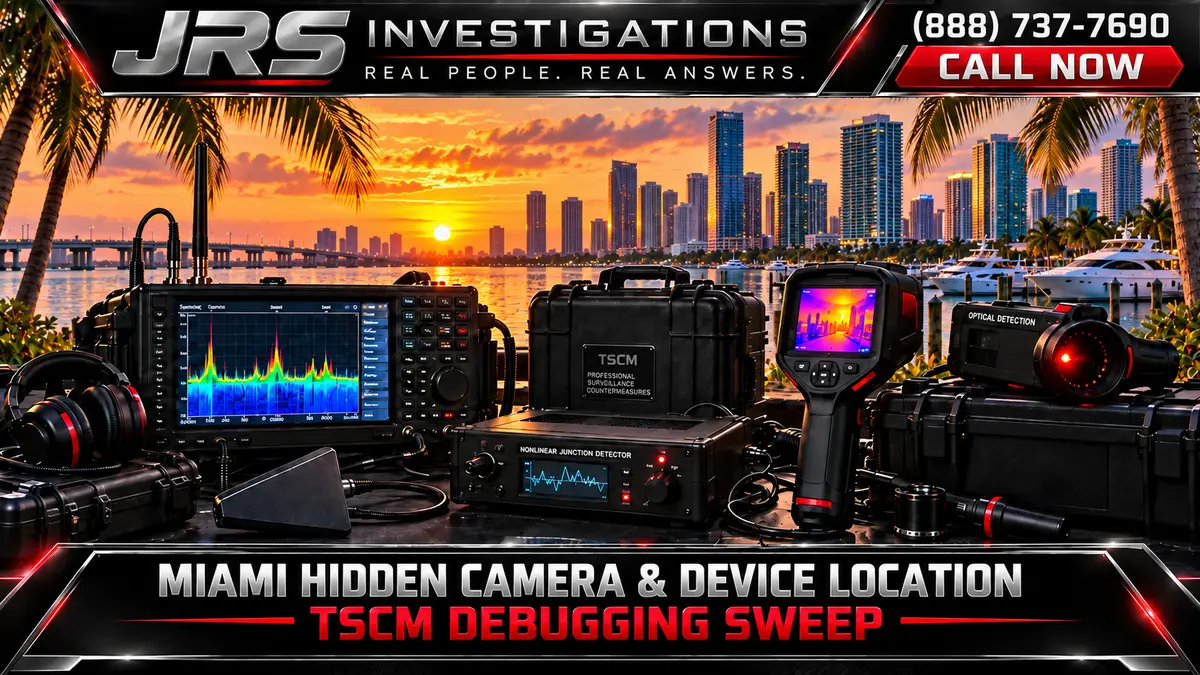
TSCM Bug Sweeps in Miami, Florida: Professional Guide
A concern about an unauthorized camera, audio recorder, radio-frequency transmitter, or tracking device deserves a calm technical response. Professional TSCM bug sweeps in Miami, Florida combine electronic testing, physical inspection, signal analysis, and clear documentation. The process can be adapted for condominiums, homes, hotels, offices, meeting rooms, vehicles, yachts, and other authorized spaces.
A credible inspection is more than a quick pass with a consumer RF detector. Miami properties can contain dense Wi-Fi, Bluetooth, cellular, security, entertainment, smart-building, and marine systems. The real work is identifying what belongs in the environment and investigating anything that does not. For local service information, visit the Miami TSCM bug-sweep service page.
What a professional TSCM inspection examines
Technical surveillance countermeasures, commonly called TSCM, is a structured technical and physical examination for surveillance risks. Depending on the agreed scope, an inspection may address wireless transmitters, hidden cameras, audio recorders, cellular devices, GPS trackers, altered electronics, suspicious wiring, network-connected equipment, and physical concealment points.
No responsible provider can guarantee that every possible device will be found. Some equipment records locally, transmits only at intervals, remains powered off, or resembles an ordinary charger or sensor. Construction, access, safety, ownership, and timing may also limit testing. Layered methods provide broader coverage and a more useful basis for explaining the findings.
Reasons Miami clients request a sweep
- Confidential personal, legal, financial, or business information has surfaced unexpectedly.
- An unfamiliar charger, cable, sensor, camera, adapter, or network device appears in a private area.
- A residence, office, meeting room, hotel suite, vehicle, or vessel has experienced unexplained access.
- A property has recently changed occupants, staff, contractors, furnishings, or technology.
- A sensitive meeting, dispute, transaction, relocation, or travel period calls for a documented precautionary inspection.
These circumstances do not prove that surveillance is present. They help establish the timeline, access history, threat context, and priority areas before technical work begins.
Why Miami requires a tailored inspection plan
Miami includes high-rise condominiums, single-family homes, hotels, professional offices, event spaces, garages, vehicles, marinas, and vessels. Each setting has a different combination of authorized electronics, neighboring signals, access patterns, wiring, and concealment opportunities. A condominium may receive wireless activity from units above, below, and across the hall. A hotel suite may contain property-managed technology and furnishings that the guest does not own. A marina or yacht can place navigation, communications, monitoring, and power systems close together.
Neighborhood names or property values do not establish that a surveillance threat exists. An inspection plan should be based on the client’s specific concern, authority, recent access, information exposure, and observable anomalies. Brickell conference rooms, Downtown offices, Miami Beach hotels, Coral Gables residences, and waterfront properties may require different access coordination and equipment documentation even when the technical methods are similar.
Signal density and building access
Wireless activity from neighboring units, offices, roads, boats, and ordinary consumer electronics can complicate interpretation. Signal strength alone does not prove that a source is covert. The technician evaluates frequency, bandwidth, behavior, timing, direction, location, and its relationship to equipment that belongs in or near the environment.
Condominium associations, building management, hotel policies, keys, elevators, loading areas, parking garages, vessel access, and electrical or network controls can affect scheduling. Clients should identify every space they want inspected before the appointment so the provider can reserve enough uninterrupted time and confirm authorization.
How professional TSCM bug sweeps work
The sequence varies with the property and concern, but a credible inspection normally moves from confidential intake to environmental review, electronic testing, physical examination, validation, and reporting.
1. Confidential intake and authorization
The provider reviews the concern, recent access, important rooms, known electronics, relevant events, and the client’s objective. The client’s authority to inspect the property, vehicle, vessel, network, or device must be established. Shared homes, condominiums, workplaces, hotels, rental properties, and third-party equipment may require additional permission.
2. Radio-frequency spectrum analysis
RF spectrum analysis surveys transmitting activity and identifies signals that require closer examination. The technician correlates observations with known Wi-Fi, Bluetooth, cellular, broadcast, security, building, and marine systems. Measurements may be repeated from several positions or while authorized equipment is selectively controlled when permission and conditions allow.
A spectrum analyzer produces data, not a final conclusion. Frequency, bandwidth, timing, signal strength, location, and known sources must be considered together before an unexplained transmission can be associated with a particular object or area.
3. Nonlinear junction detection
A nonlinear junction detector, or NLJD, can help identify semiconductor components concealed in accessible objects or structures. It may be useful when a device is not transmitting or has no active power. Ordinary electronics, corrosion, and other materials can also produce responses, so every indication requires interpretation and physical follow-up.
4. Hidden-camera and optical inspection
Camera detection may include lens-reflection techniques, controlled lighting, line-of-sight analysis, and close examination of objects aimed toward private areas. Chargers, clocks, sensors, décor, smoke detectors, vents, electronics, and fixtures may receive additional attention when their position, orientation, or condition is unusual.
5. Thermal and physical examination
Thermal imaging can highlight temperature differences associated with operating electronics, but heat alone does not prove surveillance. Physical examination remains essential. Technicians may inspect seams, screws, wiring, outlets, power supplies, network equipment, furnishings, fixtures, and recently introduced objects for signs of alteration or concealment.
6. Validation and documentation
An anomaly should be investigated before it is described as a finding. Documentation may include photographs, signal observations, locations, authorized-device correlations, inaccessible areas, technical limitations, and recommended next steps. If a suspicious item may be evidence, the client should obtain guidance before it is moved, opened, disconnected, or removed.
Condominium, residential, and hotel sweeps
A residential assignment may prioritize bedrooms, home offices, living areas, entry points, network equipment, and objects introduced by people with recent access. High-rise buildings require particular care because legitimate electronics can be physically close while remaining outside the client’s unit and inspection authority.
The scope should distinguish the client’s private space from common areas, association-managed systems, hotel equipment, rental furnishings, and property belonging to another occupant. The provider should understand those boundaries before opening fixtures, testing installed technology, or entering restricted areas.
Hotel and short-term-rental assignments may be limited by the guest’s rights, the property’s policies, and the inability to open or alter building-owned fixtures. The inspection should document those limits instead of implying unrestricted access. For a related overview of provider qualifications, review reasons to use a professional TSCM provider in Miami.
Office, vehicle, and vessel inspections
Offices and meeting rooms
Commercial sweeps may focus on conference rooms, executive offices, legal or financial work areas, communications equipment, and spaces used for confidential conversations. Scheduling outside normal operating hours can reduce disruption and make it easier to document or control authorized electronics during testing.
Employer systems, leased equipment, access-control devices, and shared building infrastructure should be identified before testing. A useful scope names the specific rooms, cabinets, network areas, telephones, audiovisual systems, and adjoining spaces the client is authorized to inspect.
Vehicles and parking areas
A vehicle inspection may address tracking devices, unauthorized wiring, altered components, concealed electronics, and unusual power connections. The agreed scope should identify which vehicles are included and confirm the client’s ownership or authority. Garages and valet operations may impose separate access and scheduling requirements.
Yachts and waterfront environments
Vessels may contain dense wiring, navigation equipment, radios, sensors, battery systems, cameras, and compact service spaces. Those legitimate systems must be documented and correlated before an anomaly is treated as suspicious. Access to locked compartments, marina-managed infrastructure, or third-party equipment requires appropriate authorization.
Legal authority and evidence preservation
Technical capability does not replace legal authority. Ownership, tenancy, employer policy, shared occupancy, hotel rules, managed systems, and third-party property can affect what may be inspected. A provider should not bypass locks, accounts, or access restrictions without permission from the appropriate person or entity.
Federal and Florida law may govern the interception, recording, use, and disclosure of communications. Florida’s interception and recording provisions appear in Florida Statutes section 934.03. A lawyer should address questions about a specific recording, device, property, employment relationship, domestic situation, or possible evidence.
If a suspected device is found, avoid experimenting with it. Moving, powering down, opening, or transmitting from the item may affect evidence, alert another person, or create legal and safety issues. Photograph what is visible when safe, restrict access, and coordinate with counsel or law enforcement as appropriate.
How to prepare for a Miami TSCM inspection
- Discuss the concern privately. Use a trusted phone, network, or off-site meeting if the suspected environment may be compromised.
- Preserve normal conditions. Do not discard unfamiliar objects, reset networks, rearrange rooms, or disconnect equipment unless safety requires it.
- List every location. Identify rooms, units, offices, vehicles, vessels, cabinets, ceiling areas, network equipment, and devices that may fall within scope.
- Confirm authorization. Obtain necessary permission from owners, managers, employers, associations, hotels, marinas, or other controlling parties.
- Document recent access. Note guests, staff, maintenance, contractors, renovations, deliveries, valet access, and technology work.
- Identify authorized electronics. List routers, access points, cameras, smart devices, trackers, conferencing systems, navigation equipment, and radios.
- Reserve uninterrupted time. Reduce unnecessary occupants and avoid competing maintenance or technology work in the inspection area.
How to evaluate a TSCM provider
Ask direct questions before scheduling. A professional provider should explain the proposed process and its limitations without promising a guaranteed result or relying on vague claims about “military-grade” equipment.
- Which methods are included beyond basic RF scanning?
- Does the scope include physical inspection, NLJD testing, optical checks, thermal imaging, networks, vehicles, or vessels?
- How will authorized electronics and outside signals be identified?
- What property access and client authorization are required?
- How are anomalies validated and documented?
- How will inaccessible areas and technical limitations be reported?
- How is confidential client information protected?
Pricing and duration depend on scope. Property size, construction, wireless activity, access, number of locations, vehicles or vessels, travel, and reporting requirements all matter. A useful estimate should state what is included instead of relying on an unsupported generic price range. Clients can also review questions to ask before hiring a private investigator.
What the final report should explain
The client should understand which areas were inspected, which methods were used, what was observed, what could not be accessed, and what actions are recommended. The report should distinguish confirmed findings from authorized equipment, benign conditions, unresolved anomalies, and general security weaknesses.
An inspection that does not confirm a covert device does not establish that surveillance was impossible at every earlier moment. It means the sweep did not confirm one within the tested scope and conditions. Follow-up may be appropriate after unauthorized access, renovations, equipment changes, a change of occupancy, or before an especially sensitive event.
Frequently asked questions
Can a sweep find a device that is powered off?
Sometimes. Physical inspection and NLJD testing can identify certain electronics that are not transmitting. No method detects every device in every concealment condition, which is why professionals combine several techniques.
Will signals from neighboring condos interfere?
They can add legitimate activity to the signal environment. The technician evaluates frequency, behavior, strength, direction, location, and known sources rather than treating every nearby signal as a threat.
Can one assignment include a condo, office, vehicle, and yacht?
Yes, when every location is included in the agreed scope and the client has proper authority. Tell the provider in advance so access, equipment, travel, and scheduling can be planned correctly.
Should I use a signal jammer?
No. Signal jamming can disrupt authorized and emergency communications. A professional sweep should focus on detection, correlation, documentation, and lawful evidence handling rather than intentionally interfering with radio services.
What should I do if I find something suspicious?
Do not dismantle or test it. Photograph the item in place if that can be done safely, restrict access, and obtain guidance from the investigator, legal counsel, or law enforcement as appropriate.
Schedule a confidential Miami TSCM consultation
A professional sweep replaces speculation with a documented technical process. JRS Investigations can discuss the location, access, timing, concerns, and reporting needed for a Miami condominium, residence, hotel suite, office, vehicle, waterfront property, or vessel.
Call JRS Investigations at (888) 737-7690 or request a confidential consultation. Avoid using a device or network you believe may be compromised to discuss sensitive details.