(888) 737-7690
West Palm Beach TSCM Sweep Tools: Professional Guide
A professional technical surveillance countermeasures inspection is not a pass with a single “bug detector.” Effective work combines planning, physical inspection, radio-frequency analysis, optical checks, non-linear-junction detection, thermal review, cable tracing, and careful documentation. This guide explains the principal West Palm Beach TSCM sweep tools JRS Investigations may use to examine authorized homes, condominiums, offices, conference rooms, vehicles, and other agreed spaces.
The exact equipment and sequence depend on the property, the client’s concerns, the known timeline, and the technology already present. A waterfront residence with extensive automation presents a different environment from a law office, executive suite, hotel meeting room, or vehicle. No instrument can guarantee that every device will be found, so the process depends on overlapping methods and an experienced examiner’s judgment.
For local service information, visit our West Palm Beach TSCM bug-sweep page or call (561) 322-0056 for a confidential consultation.
What a TSCM Sweep Is Designed to Assess
A TSCM sweep evaluates a defined physical environment for signs of unauthorized audio, video, location, or data-collection equipment. It can also identify security weaknesses that deserve additional review. The goal is not to prove a theory in advance. The goal is to examine the space methodically, separate normal signals and electronics from anomalies, preserve important observations, and give the client a defensible report.
Common assignments involve concerns about hidden cameras, concealed microphones, transmitting devices, dormant recorders, modified power adapters, suspicious wiring, unauthorized network hardware, or vehicle-tracking equipment. Our broader TSCM and counter-surveillance services explain the role of a layered physical inspection.
Pre-Sweep Planning Is the First Tool
Before equipment is deployed, the examiner develops a baseline. JRS asks who controls the property, who has had access, when the concern began, what information appears compromised, whether construction or maintenance recently occurred, and which devices or rooms are most sensitive. Clients should identify legitimate Wi-Fi networks, Bluetooth accessories, security cameras, smart-home devices, alarm components, cellular boosters, and other expected electronics.
This inventory reduces false alarms. It also helps the examiner prioritize likely access points, power sources, lines of sight, meeting locations, and places where a device could be installed or retrieved. In West Palm Beach, that may include condominium common-access issues, service entrances, short-term rental turnover, executive offices, marina or vessel-related environments, and vehicles used for frequent business travel.
Radio-Frequency Spectrum Analysis
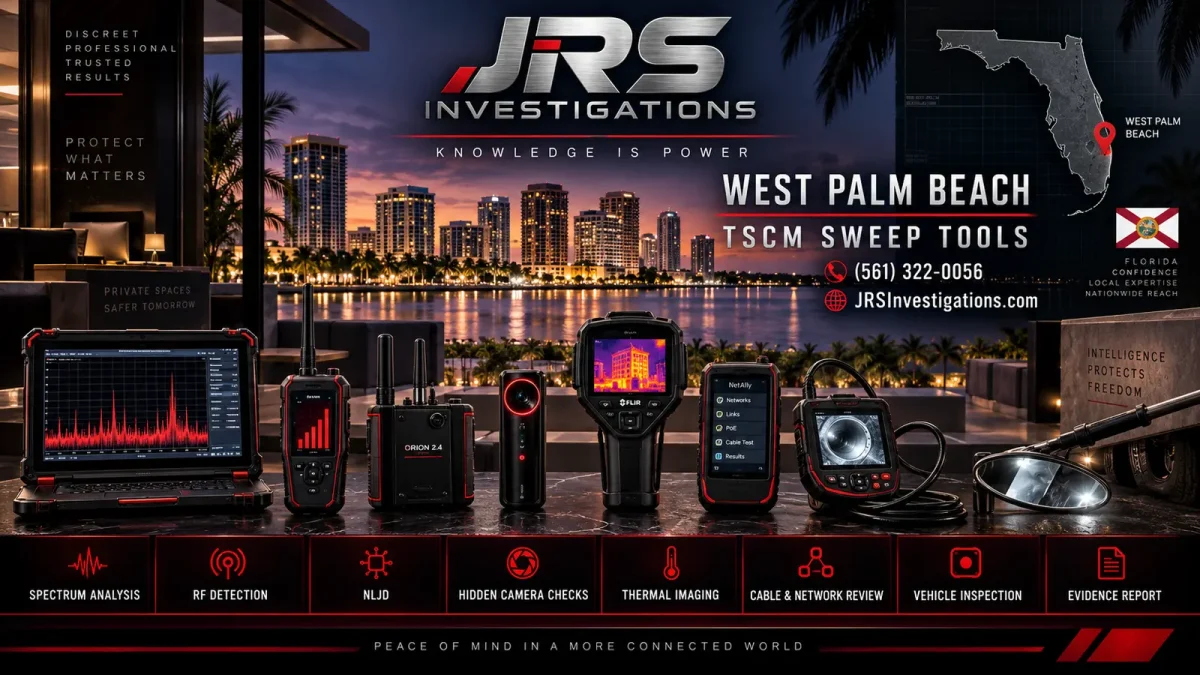
A spectrum analyzer displays radio-frequency activity across selected frequency ranges. It helps an examiner see signal strength, bandwidth, timing, and changes while moving through a property. This can support the investigation of active transmitters using cellular, Wi-Fi, Bluetooth, or other radio technologies.
The instrument does not label a signal “legal” or “malicious.” Modern spaces contain many ordinary transmissions from routers, phones, access points, smart televisions, security systems, vehicles, neighboring units, and public infrastructure. The examiner must compare signals with the baseline, change locations, observe behavior over time, and use directional or near-field methods to narrow a source.
Broadband RF Detectors and Near-Field Probes
Broadband RF detectors can provide a fast indication that radio energy is present nearby. Near-field probes help investigate a smaller area, cable, device, outlet, or object. These tools are useful for localization, but they are not substitutes for spectrum analysis or physical inspection. A strong reading may come from a legitimate phone, router, wireless charger, or access-control component.
Directional Antennas
Directional antennas help compare signal strength from different directions. Used with appropriate test equipment, they can help trace an unfamiliar transmission toward a room, wall, ceiling area, vehicle compartment, or nearby source. Reflections from glass, metal, concrete, and neighboring buildings can complicate direction finding, particularly in high-rise and dense urban settings.
Non-Linear Junction Detection
A non-linear junction detector, commonly called an NLJD, is designed to help locate semiconductor junctions in electronic components. It can support searches for devices that are powered off, not transmitting, or storing information locally. The examiner may use it on furniture, walls, containers, fixtures, and other areas after considering the materials and legitimate electronics present.
An NLJD does not automatically identify a hidden camera or recorder. It can respond to ordinary electronics and, in some conditions, corrosion or dissimilar metals. Results must be interpreted alongside the physical setting, access history, visual inspection, and other test findings.
Optical Hidden-Camera Detection
Optical camera detectors use directed light and viewing optics to look for lens reflections. They can help inspect smoke detectors, clocks, chargers, vents, decorative objects, shelving, ceiling fixtures, and other positions with a useful view of a private area. Careful changes in angle and distance matter because a concealed lens may only reflect from a narrow line of sight.
Optical inspection is particularly important because some cameras record to local storage and emit no radio signal. It is combined with a close visual examination and, when appropriate, thermal or NLJD review. For examples of device categories that may prompt concern, see our related guide to surveillance devices examined during West Palm Beach TSCM work.
Thermal Imaging
A thermal camera can reveal temperature differences associated with powered electronics, power supplies, recently operating devices, or unusual heat patterns. It may help prioritize an outlet, adapter, wall area, ceiling feature, or equipment cabinet for closer review.
Heat alone does not identify surveillance equipment. Sunlight, air-conditioning, plumbing, appliances, chargers, lighting, and building materials can create normal thermal patterns. A thermal anomaly becomes useful only after the examiner evaluates the object, location, operating conditions, and results from other methods.
Physical Inspection, Borescopes, and Access Tools
Many important findings begin with observation rather than electronics. The examiner looks for disturbed fasteners, altered fixtures, unexplained holes, duplicate adapters, new objects, unusual wiring, mismatched components, blocked vents, tampered seals, or devices positioned toward sensitive areas. Flashlights, inspection mirrors, magnification, and borescopes can help examine difficult spaces without unnecessary damage.
JRS works only within the client’s authority. A renter, employee, condominium owner, property manager, spouse, executive, or business may have different rights to authorize access. Locked rooms, shared systems, neighboring property, building infrastructure, and employer-owned devices may require separate permission.
Telephone, Network, and Cable Examination
Telephone, Ethernet, coaxial, alarm, audio-visual, and other low-voltage lines can be inspected for unfamiliar connections, splitters, adapters, bridges, or changes from the documented configuration. Cable tracers, continuity tools, network discovery methods, and physical inspection may help identify unexplained pathways or hardware.
A TSCM inspection is not the same as a full cybersecurity incident response. If the concern involves account compromise, malware, cloud access, mobile-device management, or data exfiltration, a qualified digital-forensics or cybersecurity provider may be needed. The NIST mobile-device security guidance describes enterprise controls and countermeasures that fall outside a purely physical sweep.
Wi-Fi, Bluetooth, and Connected-Device Review
Wireless-network and Bluetooth review helps document devices visible in or near the environment. The examiner compares names, identifiers, manufacturers, signal behavior, and client-provided inventories. Unknown equipment is investigated carefully because neighboring networks, guest devices, vehicles, wearables, televisions, printers, access controls, and building systems may all appear during a scan.
Discovery is not proof of access or interception. JRS does not hack devices, bypass passwords, intercept private communications, or enter accounts without authorization. When a network or endpoint concern requires deeper analysis, we explain the boundary and recommend the appropriate next step.
Vehicle TSCM Tools and Inspection
A vehicle sweep may include visual and tactile inspection, RF review, underbody examination, wheel-well and compartment checks, and assessment of accessible power or diagnostic connections. The approach depends on vehicle design, ownership, authorization, and the reported concern. Factory telematics, toll transponders, insurance devices, fleet equipment, aftermarket alarms, dash cameras, and paired phones must be distinguished from unexplained hardware.
Weather, road grime, heat, water exposure, and limited access can affect an exterior inspection. A credible finding should be photographed in place and documented before removal whenever safety permits. If a suspicious item may relate to stalking, domestic violence, or a crime, the client should consider contacting law enforcement or counsel before handling it.
Evidence Documentation and Reporting
Professional tools are only as useful as the documentation surrounding them. JRS records the agreed scope, areas inspected, relevant equipment, observations, anomalies, photographs, device details, limitations, and recommended next steps. A report should distinguish verified facts from possibilities and should not claim that an ordinary signal or component is surveillance equipment without supporting evidence.
If suspicious equipment is found, the response depends on safety, ownership, legal strategy, and the client’s objectives. Immediate removal may destroy fingerprints, placement context, stored data, or attribution evidence. Florida law regulates interception and use of wire, oral, and electronic communications; clients can review Florida Statutes section 934.03 and consult an attorney about a specific situation.
What TSCM Equipment Cannot Guarantee
No sweep can guarantee a space will remain secure or that every device will be detected. A device may be absent during the inspection, installed later, concealed beyond the authorized scope, shielded, remotely activated, connected through an unexpected pathway, or mistaken for legitimate equipment. Environmental RF noise and extensive smart technology can also complicate testing.
A careful provider explains these limits, uses multiple methods, documents the conditions, and recommends practical risk reduction. Depending on the concern, that may include access-control changes, device inventories, recurring inspections, network security review, meeting procedures, or a follow-up sweep after maintenance or staff changes. Our complete West Palm Beach TSCM guide explains the broader planning process.
How to Prepare for a West Palm Beach TSCM Sweep
- Do not announce the inspection to people who do not need to know.
- Preserve suspicious messages, photographs, access logs, dates, and prior observations.
- Do not dismantle or move a suspected device unless immediate safety requires it.
- Prepare a list of authorized Wi-Fi, Bluetooth, alarm, camera, smart-home, and office systems.
- Arrange lawful access to the rooms, vehicles, cabinets, and equipment included in the scope.
- Identify recent vendors, maintenance visits, construction, tenants, guests, or personnel changes.
- Keep normal electronics operating unless the examiner gives different instructions.
For regional coverage, see our South Florida TSCM services. To discuss a defined property or vehicle, use the secure JRS contact page or call (561) 322-0056.
Frequently Asked Questions
Can one detector find every surveillance device?
No. Some devices transmit, some store data locally, some connect intermittently, and some may be powered off. A professional sweep combines radio-frequency, optical, electronic, thermal, physical, and cable or network methods as the assignment requires.
Should Wi-Fi and phones be turned off before the sweep?
Not automatically. Normal operating conditions can help establish how the environment behaves, while selective shutdowns may help isolate signals later. Follow the examiner’s instructions so potentially useful evidence is not lost.
Can JRS inspect a condominium or rented property?
Often, but the scope depends on the client’s authority. A client may authorize an inspection of a private unit or personally controlled property but not shared building systems, another unit, a locked owner area, or equipment belonging to another party without permission.
Is a TSCM sweep the same as checking a phone for spyware?
No. A physical TSCM sweep and mobile-device forensics address different evidence. Some assignments require both. JRS defines the scope and explains when a separate qualified digital examiner is appropriate.
What happens if suspicious equipment is located?
JRS documents the condition and discusses safe next steps. Depending on the circumstances, the client may need law enforcement, counsel, a digital-forensics specialist, a property representative, or another authorized professional before the item is removed or examined further.
Schedule a Confidential West Palm Beach Consultation
JRS Investigations provides discreet, scope-specific TSCM inspections for authorized residential, business, meeting, and vehicle environments in West Palm Beach and surrounding South Florida communities. We use overlapping tools, explain their limits, and document findings without promising a predetermined result.
Knowledge Is Power. Call (561) 322-0056 or contact JRS Investigations to discuss the property, concern, timeline, and access requirements.