(888) 737-7690

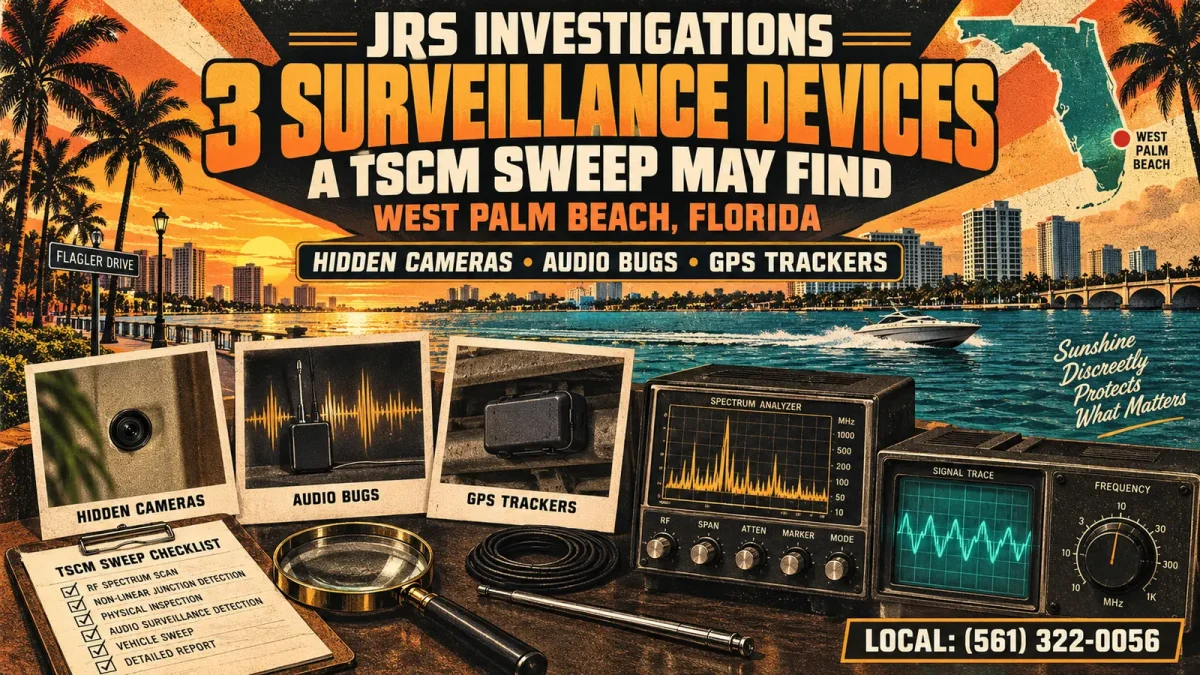
3 Surveillance Devices a TSCM Sweep May Find in West Palm Beach
Suspecting electronic surveillance can be unsettling, but a strange noise, a rapidly draining battery, or an unfamiliar wireless signal does not prove that a listening device or hidden camera is present. Homes, offices, vehicles, hotels, and condominiums in West Palm Beach contain many legitimate electronics that can create similar signs. A professional West Palm Beach TSCM bug sweep is designed to separate ordinary technology from items that warrant closer examination.
Technical Surveillance Countermeasures (TSCM) is a structured inspection process used to look for unauthorized surveillance equipment and related security weaknesses. The exact methods depend on the property, the concern, and the devices that may be involved. Below are three broad categories of equipment an investigator may evaluate during a lawful sweep.
1. Hidden cameras and covert video recorders
Covert cameras can be concealed inside everyday objects or installed as very small standalone devices. Some transmit video over Wi-Fi or cellular networks, while others record locally to a memory card. A camera that is not transmitting may not appear during a radio-frequency scan, which is why a thorough inspection should not rely on one tool or one quick pass.
Possible concealment areas include power adapters, clocks, smoke detectors, decorative objects, vents, shelving, and other locations with a view of the room. Investigators may combine a careful physical inspection with optical techniques, network review where authorized, radio-frequency analysis, and equipment intended to identify electronic components. No single method finds every camera in every condition, so context and professional judgment matter.
2. Audio transmitters and recording devices
Listening devices range from simple local audio recorders to transmitters that send sound by radio, Wi-Fi, Bluetooth, or cellular service. Some operate continuously. Others activate only when they detect sound, receive a remote command, or reach a scheduled time. Devices that are powered off or recording locally may produce no useful radio-frequency signature during the inspection.
A TSCM examination may therefore include visual and physical inspection, spectrum analysis, evaluation of suspicious wiring or power sources, and other technical tests selected for the environment. Investigators also consider ordinary explanations for signals, such as wireless speakers, access points, building controls, neighboring networks, and authorized business equipment. The goal is not simply to detect activity; it is to identify and evaluate what is causing it.
3. GPS and vehicle-tracking devices
Tracking devices may be attached to a vehicle, connected to its diagnostic port, integrated with power wiring, or placed inside an object that regularly travels with a person. Some send location data in real time. Others store data for later retrieval. Modern vehicles also contain factory-installed telematics, navigation, Bluetooth, tolling, and fleet-management systems, so an unfamiliar signal is not automatically evidence of unlawful tracking.
A vehicle inspection may include accessible exterior and interior areas, common attachment points, onboard connections, and relevant electronic activity. Scope is important: a physical tracker on a vehicle is different from location sharing through a phone account, family-safety app, cloud service, or compromised login. Those concerns may require separate mobile-device or account-security work.

How a professional West Palm Beach TSCM sweep works
A useful sweep begins before equipment is unpacked. The investigator should understand who has access to the location, what information may be at risk, when the concern began, and whether there have been recent changes to furniture, electronics, contractors, staff, vehicles, or network access. This helps define the inspection area and prevents a generic checklist from replacing case-specific analysis.
Depending on the circumstances and legal authority, a sweep may include:
- A detailed visual and physical examination of relevant rooms, fixtures, furnishings, and devices.
- Radio-frequency spectrum analysis to evaluate active transmissions and intermittent signals.
- Network and connected-device review when access is authorized and within the agreed scope.
- Optical examination for concealed camera lenses.
- Testing intended to locate electronic components, including equipment that may not be transmitting.
- Inspection of vehicles, telephone equipment, wiring, or other specific areas identified during the initial assessment.
- Documentation of findings and practical recommendations for reducing future exposure.
The tools selected for a downtown office may differ from those used in a waterfront residence, hotel room, gated-community home, or vehicle. West Palm Beach also has a dense wireless environment, so experience in distinguishing normal signal traffic from anomalies is especially important.
What to do before requesting a sweep
If you believe your privacy may have been compromised, avoid broadcasting your plan from the location or device you suspect. Do not dismantle an item, confront another person, or remove a possible device unless there is an immediate safety concern. Unnecessary handling can damage evidence or make later evaluation more difficult.
Instead, write down dates, locations, unusual events, people with access, and the specific information that appears to have been exposed. Preserve relevant messages, account alerts, photographs, or security-camera records. If the concern involves stalking, domestic violence, threats, or immediate danger, contact law enforcement or an appropriate victim-support resource. TSCM services do not replace emergency assistance or legal advice.
Common questions about TSCM bug sweeps
Can an app detect every hidden camera or listening device?
No. Consumer apps generally examine a limited set of network or sensor clues and can produce both false positives and false negatives. They are not a substitute for a methodical physical and technical inspection.
Does a radio-frequency scan find devices that are turned off?
Not by radio transmission alone. Dormant, hardwired, or locally recording equipment may require other inspection methods. This is one reason a professional sweep uses multiple techniques.
Can a sweep guarantee that no surveillance device exists?
No responsible provider can guarantee that every possible device will be found under every condition. Results depend on access, scope, timing, construction, device state, and other factors. A professional should explain those limitations clearly and document the work performed.
Should phones and computers be included?
Mobile phones, laptops, cloud accounts, and online location sharing can create privacy risks that differ from a physical bug sweep. Tell the investigator about those concerns when scheduling so the appropriate scope or specialist can be discussed.
Schedule a West Palm Beach TSCM consultation
JRS Investigations provides TSCM bug-sweep services in West Palm Beach for residential, commercial, and vehicle-related concerns. You can also review our broader counter-surveillance services or learn more about our West Palm Beach private-investigation services.
For a confidential discussion about the property, timeline, and concern, contact JRS Investigations or call (561) 322-0056 (West Palm Beach local) or (888) 737-7690 toll-free. Knowledge is power.