(888) 737-7690

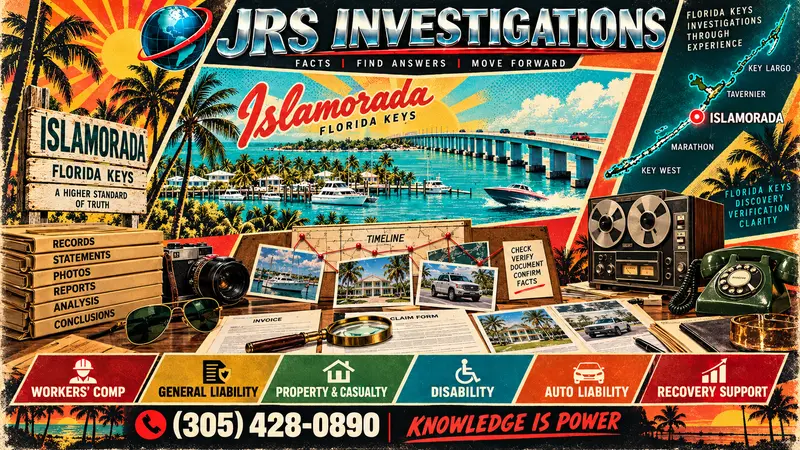
6 Types of Fraud Investigations in Islamorada
Islamorada fraud investigations are most useful when they begin with a specific question: What happened, which facts can be independently verified, and what evidence would help an insurer, business, attorney, or individual make an informed decision?
JRS Investigations conducts lawful fact-finding for matters involving disputed claims, suspected misrepresentation, conflicting accounts, and possible financial loss. The investigator’s role is to document facts objectively—not to presume that every questionable claim is fraudulent or to decide civil or criminal liability.
Six types of fraud and claim investigations in Islamorada
1. Workers’ compensation claim investigations
A workers’ compensation investigation may address conflicting accounts of an incident, questions about employment or activity, witness availability, or whether observable conduct is consistent with specific reported limitations. Depending on the lawful scope, work may include incident-location documentation, neutral witness interviews, authorized record review, open-source research, and surveillance from places where the subject has no reasonable expectation of privacy.
Surveillance shows only what was observable during a defined period. It does not diagnose an injury, replace medical evidence, or independently establish fraud. For a fuller explanation of this distinction, see the JRS guide to workers’ compensation investigations in Florida.
2. General liability claim investigations
Slip-and-fall incidents, premises claims, and other liability matters often turn on details that can change or disappear quickly. An investigator may document the location, identify potential witnesses, compare accounts, establish a chronology, and review lawfully available photographs, video, public records, or business documentation.
The objective is not to “disprove” a claim on demand. It is to locate reliable information, preserve relevant observations, and identify inconsistencies or corroboration so the client and counsel can evaluate the matter.
3. Property and casualty claim investigations
Property losses can involve storm damage, water intrusion, theft, vandalism, fire, marine property, or disputed ownership and valuation. In the Florida Keys, properties, vessels, vacation rentals, contractors, and seasonal occupancy can create a complicated timeline of access and responsibility.
A scoped investigation may include site documentation, witness interviews, ownership or business-record research, review of material supplied by the client, and verification of dates or relationships. Technical conclusions about fire origin, engineering, repair causation, or valuation should be left to appropriately qualified specialists.
4. Disability claim investigations
Disability matters require particular care because a person may be capable of one activity while still experiencing a legitimate medical limitation. An investigator may lawfully document public activity, verify non-medical facts, review public-facing information, and organize a chronology for the authorized client.
Investigators do not make medical diagnoses or determine eligibility for benefits. Observations should be reported accurately and without assumptions about pain, recovery, or a condition that is not visible.
5. Auto liability claim investigations
Auto-related cases may involve disputed accident circumstances, inconsistent driver or passenger accounts, questions about vehicle use, staged-loss indicators, or difficulty locating witnesses. Investigative work can include scene documentation, witness outreach, public-record research, lawful social-media review, timeline development, and comparison of information provided by authorized parties.
Accident reconstruction, mechanical failure analysis, and medical causation require the appropriate technical or medical experts. A private investigator can help build the factual foundation those professionals and legal counsel use.
6. Subrogation and recovery-support investigations
Subrogation is a recovery process, not automatically a fraud allegation. Investigators can support it by helping identify potentially responsible parties, verify ownership or business relationships, locate witnesses, document the sequence of events, and organize information relevant to recovery efforts.
JRS Investigations does not seize assets, compel records, or make legal determinations. Collection remedies, subpoenas, litigation strategy, and enforceability remain matters for the client’s attorney and the appropriate court.
How an Islamorada fraud investigation is developed
A strong assignment is evidence-led and proportionate to the issue. The process may include:
- Defining the allegation: Identifying the exact statement, transaction, claim, or event that needs verification.
- Preserving the source file: Organizing policies, reports, photographs, messages, invoices, timelines, and other client-authorized material.
- Building a chronology: Comparing dates, access, locations, communications, and changes in the account.
- Independent fact-finding: Conducting lawful research, interviews, scene documentation, or public-place surveillance when appropriate.
- Corroborating findings: Separating assumptions and unverified tips from facts supported by more than one reliable source.
- Clear reporting: Explaining what was checked, what was observed, what remains unresolved, and the limitations of the work.
For a broader overview of available case types, visit the JRS fraud-investigation service page or the guide to private-investigation services in Florida.
Records, privacy, and digital evidence
Private investigators do not have unrestricted access to bank transactions, private phone records, credit files, medical records, or private online accounts. Those materials generally require the subject’s authorization, a permissible legal purpose, a valid legal process, or another lawful basis.
Public records, consented materials, open-source information, and records supplied by an authorized client can still provide valuable leads. When a case requires account forensics, device extraction, accident reconstruction, engineering, or another specialized discipline, JRS can define the investigative portion and recommend that the client coordinate with the appropriate qualified professional.
Why local context matters in the Florida Keys
Islamorada cases may involve residences, marinas, vessels, hospitality businesses, seasonal visitors, remote owners, short-term rentals, or people who move between islands and the mainland. Travel time, changing occupancy, weather, and limited access can affect witness availability and the condition of a scene.
Planning early helps preserve time-sensitive information and makes fieldwork more efficient. Clients needing broader regional support can review the Florida Keys investigation page, while local service information is available on the Islamorada private-investigator page.
What to prepare before the initial consultation
- A concise summary of the suspected misrepresentation or disputed event.
- A chronology with dates, locations, names, and known points of access.
- Original copies of relevant photographs, messages, reports, invoices, and policy or claim documents.
- A list of facts already confirmed and facts that remain assumptions.
- Any legal deadlines, attorney instructions, or restrictions on contact.
- The outcome the investigation needs to support, such as witness location, claim evaluation, litigation preparation, or recovery analysis.
Do not access another person’s private account, impersonate someone, or alter suspected evidence. If immediate safety is at risk, contact emergency services. Potential criminal conduct may also require coordination with law enforcement and legal counsel.
Discuss an Islamorada fraud investigation
JRS Investigations can help define a focused, lawful plan for a disputed claim or suspected fraud matter in Islamorada and throughout the Florida Keys. Knowledge Is Power. Call (305) 428-0890 or contact JRS Investigations for a confidential consultation.