(888) 737-7690

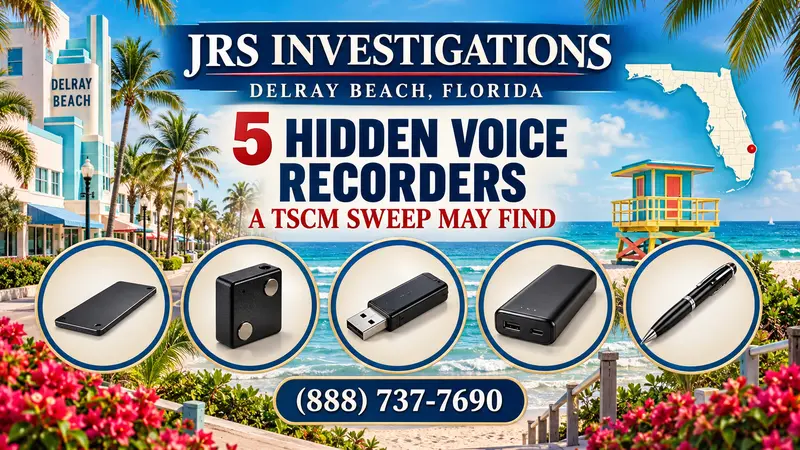
5 Hidden Voice Recorders a Delray Beach TSCM Sweep May Find
A hidden voice recorder can be small, silent, and designed to resemble an ordinary object. That is why a professional Delray Beach TSCM bug sweep uses more than a quick visual check or a single consumer detector. Technical surveillance countermeasures, or TSCM, combine a structured inspection of the environment with appropriate technical methods to evaluate possible audio, video, and tracking threats.
JRS Investigations provides TSCM bug-sweep services in Delray Beach, Florida. The scope may include a residence, office, meeting room, vehicle, or another location when the client has lawful authority to authorize the inspection. The method depends on the property, the specific concern, and the legitimate electronics already present.
The following are five types of recorders that could be used for covert audio collection. Their presence is not proof of unlawful recording, and this list does not mean they are the five devices most frequently recovered in every investigation.
1. Thin digital micro-recorders
Compact digital recorders can be built with a thin profile and placed behind furniture, beneath a surface, inside a bag, or among ordinary desk materials. Because some models record directly to internal memory, they may not continuously transmit a radio signal.
An inspector may consider unexplained placement, access history, new or unfamiliar items, power sources, and physical changes to the environment. A small object found near a private meeting area deserves careful evaluation, but size alone does not make it a recorder. Batteries, memory devices, sensors, and harmless electronic components can look similar.
Clients should avoid opening, resetting, or destroying a suspicious item before receiving guidance. Its location, condition, stored data, and chain of handling may matter if legal counsel or law enforcement later becomes involved.
2. Magnetic recorders
A recorder with an integrated magnet can be attached to a metal surface without permanent installation. Possible locations could include the underside of furniture, metal shelving, equipment housings, or accessible areas of a vehicle. The device may be difficult to notice during normal use if it is outside the occupant’s usual line of sight.
A professional inspection considers whether an item belongs in the location, who had access, what area its microphone would capture, and whether its construction and electronic behavior match an ordinary purpose. Dust patterns, disturbed surfaces, unfamiliar adhesive, or a newly attached object may justify closer examination, but none proves surveillance by itself.
Vehicle-related concerns require additional care. A private investigator must have clear lawful authority for the vehicle being examined, and some components may require a qualified automotive or technical professional to access safely.
3. USB flash-drive recorders
A device shaped like a USB thumb drive can blend into an office, home workspace, computer bag, or conference room. Some products may still function as storage devices while containing a microphone and separate recording capability. Because USB drives are so common, an unfamiliar one can easily be overlooked.
During a sweep, the investigator may document where the drive was found, whether anyone recognizes it, whether it is connected to a power source or computer, and whether its physical features are consistent with an ordinary storage device. Unknown drives should not be inserted into a computer merely to see what they contain. They can create cybersecurity and evidence-preservation risks.
If digital examination is needed, that work may fall outside a physical TSCM inspection and require appropriate forensic tools and procedures. A bug sweep does not automatically analyze every file, account, computer, or cloud service.
4. Power-bank and charger recorders
Portable battery packs, chargers, and plug-in adapters are designed to sit near phones, desks, beds, and seating areas. Their normal shape provides space for batteries and electronics, and their expected need for power can make an altered device appear ordinary.
An unknown charger may warrant attention if no one can identify its owner, it does not perform its stated function, it has an unexplained opening, or it is positioned toward a private area. Manufacturing differences and normal indicator lights can create innocent explanations, so a professional should evaluate the complete context rather than rely on appearance alone.
Clients should maintain an inventory of authorized chargers in sensitive spaces and remove equipment left by former occupants, contractors, guests, or employees when ownership cannot be established.
5. Wearable and pen-style recorders
Audio recorders can be incorporated into pens, badges, watches, key fobs, eyeglass accessories, or other items carried by a person. These devices create a different challenge because they may enter and leave the location with a visitor rather than remain hidden in the room.
A property sweep cannot guarantee that every future visitor is free of recording equipment. Security therefore requires both technical inspection and practical meeting procedures. Organizations may control which devices enter a sensitive room, provide secure storage for personal electronics, document authorized recording, and limit attendance to people with a legitimate need to know.
Any response must respect privacy, property rights, workplace rules, and applicable law. Suspicion alone does not justify searching another person or seizing their belongings.
Why voice recorders can be difficult to detect
Some recorders transmit audio, while others store it locally for later retrieval. Some operate continuously, activate when sound is detected, or remain dormant until scheduled. Meanwhile, ordinary phones, routers, Bluetooth accessories, security equipment, and smart-home devices produce legitimate electronic activity.
No single phone application or inexpensive radio-frequency detector can reliably identify every recorder in every condition. Consumer tools may react to normal electronics, overlook devices that are not transmitting, or create false confidence. A meaningful TSCM process uses multiple methods and evaluates the environment as a whole.
For a closer look at the service, watch JRS Investigations’ TSCM debugging overview.
What a professional Delray Beach TSCM sweep includes
The process begins with a confidential consultation about the concern, the people who have had access, recent changes, and the areas that need inspection. The investigator confirms authorization, establishes the scope, accounts for legitimate electronics, and applies suitable physical and technical checks. Objective documentation helps the client distinguish observations from assumptions.
A sweep is a point-in-time assessment. It cannot guarantee that a location will remain free of surveillance after people re-enter or new objects are introduced. It also does not replace a complete cybersecurity or digital-forensic examination when the concern involves compromised accounts, malware, or remote access.
What to do if a suspicious recorder is identified
Do not immediately destroy, erase, disconnect, or publicly confront someone over a suspected device. Moving it may change its condition or interfere with later examination. If it is safe, preserve the scene and obtain appropriate guidance.
The next step may involve law enforcement, an attorney, property management, an employer, or a qualified forensic specialist. A private investigator does not replace law enforcement, legal counsel, or a forensic laboratory. JRS Investigations can explain the inspection’s scope and discuss reasonable options without guaranteeing that a device will be found or that evidence will produce a specific legal outcome.
Reducing covert-recording risks
Homes and organizations can strengthen privacy by controlling keys and access codes, maintaining an inventory of authorized electronics, removing unknown devices, reviewing who enters sensitive spaces, and setting clear rules for meetings. An inspection may be particularly useful after unexplained access, an occupancy or personnel change, or before a highly confidential event.
A strange noise, battery problem, or information leak is not proof of a hidden recorder. Many ordinary technical or human explanations are possible. The purpose of a professional assessment is to investigate methodically and recommend a proportionate response.
Schedule a confidential Delray Beach consultation
To discuss an appropriate inspection scope, call JRS Investigations toll-free at (888) 737-7690. Learn more about our Delray Beach private-investigation office and discreet investigative services.
Please contact us from a device and communication method you believe are safe. If you believe someone is in immediate danger or a crime is in progress, call 911 or the appropriate law-enforcement agency.