(888) 737-7690

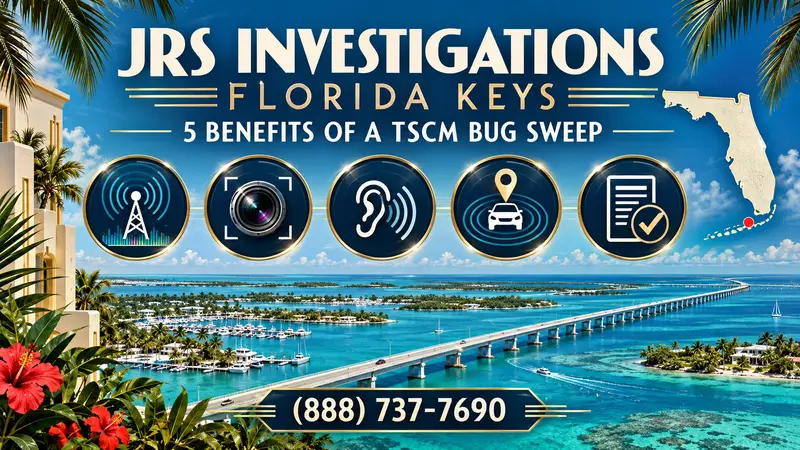
Florida Keys TSCM Bug Sweep: 5 Key Benefits
A Florida Keys TSCM bug sweep is a professional inspection for hidden listening devices, covert cameras, unauthorized transmitters, and other surveillance risks. It can be useful when private information is leaking, a residence or office has had unexplained access, or an important meeting requires a controlled environment. The goal is not to confirm a theory before the inspection begins. It is to examine the space methodically, document what is observed, and help the client make informed security decisions.
JRS Investigations provides TSCM bug-sweep services throughout the Florida Keys. A professional assessment may combine visual inspection, physical examination, radio-frequency analysis, and other appropriate technical methods. The exact process depends on the property, the client’s concerns, and the equipment or activity present during the inspection.
What does TSCM mean?
TSCM stands for technical surveillance countermeasures. It is a structured approach to finding indications of unauthorized electronic surveillance and weaknesses that could expose confidential conversations or movements. A proper sweep is broader than walking through a room with a single detector. Modern environments contain Wi-Fi routers, Bluetooth devices, cellular equipment, smart televisions, security systems, chargers, and countless ordinary electronic signals. The investigator must distinguish expected activity from anomalies that deserve closer inspection.
Here are five practical benefits of arranging a professional TSCM bug sweep in Key West, Islamorada, Marathon, Key Largo, or another Florida Keys community.
1. Protect confidential conversations and private spaces
Homes, offices, conference rooms, boats, vehicles, and temporary accommodations can all contain sensitive information. Family matters, legal strategy, financial decisions, business negotiations, and personal conversations may cause serious harm if they are captured or shared without permission.
A TSCM inspection helps assess whether the selected environment shows signs of covert audio, video, tracking, or transmitting devices. It also gives the investigator an opportunity to identify ordinary items or placement choices that may create avoidable exposure. For example, a meeting area beside an unsecured smart device may deserve attention even when no hidden transmitter is found.
Privacy concerns should be handled discreetly. JRS Investigations discusses the reason for the sweep, who has lawful authority over the property, which areas should be inspected, and how findings will be communicated. That planning helps protect confidentiality from the first consultation through the final discussion.
2. Examine more than one type of surveillance threat
No single tool can reliably identify every possible device in every condition. Some devices transmit continuously, some transmit intermittently, some store information locally, and some may be built into objects that look ordinary. A meaningful sweep therefore uses multiple methods selected for the environment.
Depending on the assignment, an inspection may include a careful visual and physical review, radio-frequency evaluation, examination of accessible electronics or fixtures, and checks for suspicious changes or unexplained equipment. The investigator also considers legitimate signal sources so that normal devices are not automatically treated as threats.
This layered process is especially valuable in the Florida Keys, where properties can range from permanent residences and professional offices to condominiums, vacation properties, marinas, and vessels. Each setting has a different layout, access history, and electronic background. A customized approach is more useful than a one-size-fits-all scan.
3. Receive documented, objective findings
Concern about surveillance can be stressful, and uncertainty often makes the situation worse. One important benefit of a professional inspection is a clear record of what was examined and what was observed at that time. Documentation can help the client separate confirmed findings from assumptions and decide whether another qualified professional should be involved.
If a suspicious item or condition is identified, the correct next step depends on the facts. The client may need to preserve the scene, contact law enforcement, consult an attorney, speak with an information-technology specialist, or arrange additional investigative work. A private investigator does not replace law enforcement, legal counsel, a cybersecurity firm, or a forensic laboratory. JRS Investigations can explain the scope of its inspection and help the client understand reasonable options without promising a particular legal or investigative outcome.
Clients should avoid handling or destroying a suspected device before receiving appropriate guidance. Moving an item may change its condition, disrupt a potential investigation, or make later analysis more difficult.
4. Identify security weaknesses and reduce future risk
A sweep is not only about locating a device. It can also reveal conditions that make unauthorized monitoring easier, such as uncontrolled access, unfamiliar electronics, weak visitor procedures, exposed meeting areas, or equipment that no one can account for. Correcting those vulnerabilities may lower the chance of a future privacy breach.
Useful next steps may include maintaining an inventory of authorized devices, changing access procedures, reviewing who holds keys or entry codes, controlling unattended rooms, and scheduling inspections after significant access events. Businesses may also decide to assess sensitive rooms before major negotiations or confidential meetings.
No inspection can guarantee that a property will remain free of surveillance after the sweep. Conditions can change as soon as people re-enter the space or new equipment is introduced. Good security combines a point-in-time technical assessment with practical ongoing controls.
5. Gain clarity and a sensible plan for what comes next
Unexplained information leaks, unfamiliar objects, or signs of unauthorized access can make people feel they must react immediately. A methodical TSCM process replaces guesswork with an organized assessment. Whether the sweep finds an item, identifies a vulnerability, or records no significant anomaly during the inspection, the client leaves with more useful information than they had at the beginning.
That clarity can guide proportional next steps. A suspected hidden camera may require a different response from a questionable radio signal, an unknown tracker, or a compromised online account. Technical surveillance and digital compromise can overlap, but they are not the same problem. A physical bug sweep does not by itself examine every phone, computer, cloud account, or network for malware or unauthorized access.
For clients who manage high-value information or face continuing access concerns, periodic inspections may become one part of a broader security plan. The frequency should be based on actual risk, changes in occupancy or personnel, important events, and previous findings—not fear alone.
When should you consider a Florida Keys bug sweep?
You may want to discuss a TSCM inspection when confidential information is repeatedly known by people who should not have it, an unauthorized person may have entered the space, unfamiliar equipment appears, a sensitive meeting is planned, or a residence, office, vehicle, or vessel has changed hands. A consultation can help determine whether a technical sweep fits the concern or whether another service would be more appropriate.
Do not rely on phone apps or inexpensive consumer detectors as proof that a space is safe or compromised. They can react to common electronics, miss non-transmitting devices, and create false confidence. Professional judgment, suitable equipment, and a documented process matter.
Schedule a confidential Florida Keys TSCM consultation
JRS Investigations serves clients throughout the Keys, including Key West, Marathon, Islamorada, and Key Largo. Learn more about our Florida Keys private-investigation services or our dedicated Key West TSCM services.
To discuss the location, your concerns, and the appropriate scope, call the Florida Keys office at (305) 428-0890 or toll-free at (888) 737-7690. Please use a device and communication method you believe are safe. If you believe there is an immediate threat or crime in progress, contact 911 or the appropriate law-enforcement agency.